
Guide · AI Search
Why Fridica Uses AI - But Doesn’t Let AI Decide Your Score
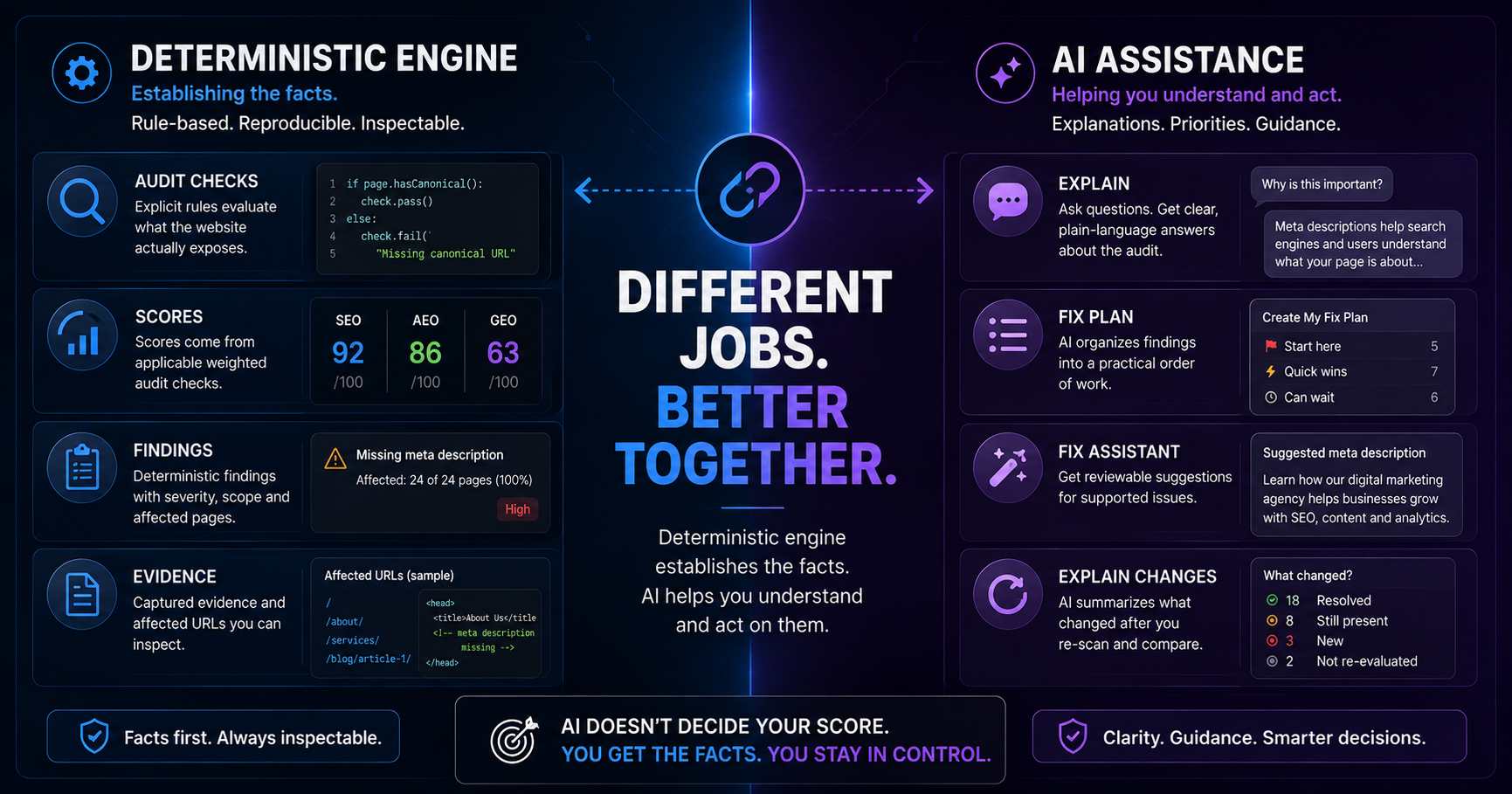
AI can explain an audit, organize a fix plan and suggest what to do next. But should it decide whether your website passed or failed a technical check? Fridica deliberately keeps those two jobs separate.
AI is very good at sounding confident.
Sometimes that is useful.
Sometimes it is exactly the problem.
Imagine running a website audit and getting:
SEO Score: 84/100
Fair enough.
But then you ask:
“Why 84?”
And the answer is:
“Our AI analyzed your website and determined that this score best represents its SEO quality.”
That sounds sophisticated.
It also leaves a rather important question unanswered:
What exactly did it check?
Fridica takes a different approach.
AI is part of the product.
But AI is not the authority that decides whether your website passed or failed the audit.
Two different jobs require two different tools
There are really two problems inside a website audit.
The first is:
What does the website actually expose?
The second is:
How do we help a human understand what that means?
Fridica deliberately separates them.
For the first job, it uses deterministic checks.
For the second, AI can be extremely useful.
In simple terms:
The audit detects.
AI explains.
What does “deterministic” mean here?
The word sounds more dramatic than the idea.
A deterministic check follows an explicit rule.
For example:
Does the page expose a meta description?
Does it have a canonical URL?
Is there a clear primary heading?
What robots directives are present?
Does the structured data expose a particular identity relationship?
The same captured input evaluated by the same rule should produce the same audit result.
The system is not asking:
“What does the AI feel about this page today?”
Why does that matter?
Because an audit finding should be inspectable.
If Fridica reports:
Missing canonical URL — 24 of 24 pages affected
you should be able to understand what produced that finding.
The pages were captured.
The canonical signal was evaluated.
The applicable rule failed.
That is a much stronger foundation than:
“The model believes canonicalization could use improvement.”
Does deterministic mean perfect?
No.
This distinction matters too.
A deterministic rule can still:
- need refinement;
- lack business context;
- apply differently to unusual implementations;
- or require human interpretation.
Deterministic does not mean:
“The computer is always right.”
It means:
“The rule is explicit and reproducible.”
That makes disagreement much easier.
You can inspect the evidence and decide whether the recommendation makes sense for your particular website.
So why use AI at all?
Because an audit can be technically correct and still be miserable to use.
Consider this:
Canonical URL missing. Scope: website-wide. Prevalence: 100%.
An SEO professional probably understands the implication immediately.
A business owner may reasonably respond:
“I understood approximately three words in that sentence.”
That is where AI becomes useful.
Not to replace the finding.
To translate it.
Ask Fridica explains the audit you already have
With Ask Fridica, you can ask questions such as:
- What does this finding mean?
- Why does it matter?
- Which issues affect most pages?
- What should I look at first?
- Why is my score high if this problem affects the whole website?
The important part is that asking the question does not recalculate the audit.
If the audit says:
24 pages affected
AI cannot decide that 17 would sound more reasonable.
It receives bounded audit context and explains what is already there.
AI also helps organize the work
Finding problems is only the beginning.
After an audit you may have:
- site-wide issues;
- isolated page problems;
- high-severity findings;
- quick fixes;
- and things that are valid but can reasonably wait.
That can become a lot to process.
So Fridica can use Create My Fix Plan to organize the deterministic findings into a more practical order.
For example:
Start here
Issues that deserve early attention based on the audit context available.
Quick wins
Useful corrections that may be relatively straightforward.
Can wait
Valid findings that do not necessarily need to become today's problem.
But again:
AI is organizing the findings.
It is not secretly creating a second audit.
Why not simply let AI decide the priority too?
It can help with priority.
But it should not pretend to know everything you know.
Fridica may have information about:
- severity;
- rule weight;
- scope;
- affected-page prevalence;
- representative URLs;
- and available guidance.
You may also know:
- which page makes the most money;
- what the client needs tomorrow;
- which migration is happening next week;
- what Search Console shows;
- which keyword matters most;
- and how much development time is available.
Those are different kinds of context.
The Fix Plan is guidance.
Not a commandment.
Fix Assistant is another place where AI makes sense
Suppose the audit already determined:
Missing meta description.
That is a deterministic finding.
But writing a useful description is not a simple yes-or-no rule.
Now AI can help.
For supported findings, Fix Assistant can provide a reviewable suggestion based on the affected page and bounded audit context.
It might suggest:
- a meta description;
- a clearer title;
- a better heading structure;
- more descriptive anchor text;
- or implementation guidance for supported structured or canonical signals.
That is exactly the sort of task generative AI is good at.
Why doesn't Fix Assistant automatically change the website?
Because a suggestion and a production change are not the same thing.
A generated title may need editorial review.
A canonical implementation may depend on routing architecture.
Structured data may depend on information outside the page.
A developer may need to change a shared template rather than one URL.
So Fridica currently uses a safer workflow:
AI suggests → you review → you apply.
No silent CMS writes.
No invisible production edits.
Sometimes the best AI answer is “I don't know”
This is not very fashionable.
AI products are often designed to always provide an answer.
But imagine a canonical issue where the audit does not contain enough information to determine the site's intended preferred URL.
AI could generate something plausible.
It might even look convincing.
That does not make it correct.
The better answer may be:
“Verify the intended canonical URL before implementing this.”
A confident guess is still a guess.
The same separation applies after a re-scan
Suppose you fix several problems and run another audit.
Fridica compares the two deterministic audit results.
Comparable findings can be classified as:
- Resolved;
- Still present;
- New;
- Not re-evaluated.
AI does not decide which bucket sounds right.
The comparison engine determines the lifecycle state first.
Then Explain What Changed can summarize the result.
Why is that separation especially important for comparison?
Because:
“It looks like you fixed it.”
is not the same thing as:
“The comparable current audit no longer detects the finding.”
If there is not enough comparable evidence, Fridica can use:
Not re-evaluated.
That may be less satisfying than:
Resolved ✓
But it is more accurate.
Could AI simply audit the entire website by itself?
Technically, you could send website content to a model and ask:
“Tell me everything wrong with the SEO.”
You would probably receive an impressive answer.
The problem is reproducibility.
Run it again and the emphasis may change.
Change the prompt and the findings may change.
Change the model and the interpretation may change.
That does not make the output useless.
It makes it a different kind of analysis.
Fridica wants its core audit result to remain inspectable and repeatable.
This also protects the scores
Fridica's SEO, AEO and GEO readiness scores come from applicable weighted deterministic checks.
AI does not look at the website and choose:
“This feels like an 87.”
That means the score can be traced back to the rules that participated in it.
It also means AI cannot quietly move the score because its explanation changed.
What does a score actually mean then?
A readiness score summarizes performance across applicable weighted checks within that perspective.
It is useful orientation.
It is not:
- a Google ranking score;
- a traffic prediction;
- a probability of indexing;
- an AI citation probability;
- or a universal measurement of website quality.
It answers a narrower question:
How did the website perform against the applicable checks Fridica actually evaluated?
AI should not make uncertain things look certain
This principle goes beyond scores.
There are many things a public website audit cannot directly know.
For example:
- whether Google has indexed a particular URL;
- what ranking a page will achieve;
- how much traffic a fix will produce;
- whether ChatGPT will cite the website;
- or whether another AI system considers a source authoritative.
AI can write very convincing sentences about all of those things.
That does not give Fridica the missing data.
“AI-powered” should not mean “AI decides everything”
There is a tendency to treat more AI as automatically better.
But different tasks benefit from different approaches.
For Fridica:
Deterministic logic is better for:
- rule evaluation;
- scores;
- finding status;
- affected-page counts;
- comparison lifecycle;
- and captured evidence.
AI is useful for:
- explanation;
- summarization;
- prioritization assistance;
- reviewable content suggestions;
- and turning technical results into clearer language.
Use each tool where it is strongest.
This also makes Fridica useful to different audiences
A site owner may care about:
“What does this mean and what should I do?”
AI can make that much easier.
A developer may care about:
“Which pages are affected and is there a shared root cause?”
The deterministic evidence matters.
An SEO professional may ask:
“What rule produced this, what is the scope, and what changed between audits?”
That evidence remains available too.
Same audit.
Different depth.
Can AI make mistakes inside Fridica?
Yes.
Generative AI can misunderstand context, phrase something poorly or produce a suggestion you should not use.
That is precisely why AI output should remain reviewable.
It is also why the underlying audit result does not change because an AI explanation made a mistake.
If Ask Fridica explains something badly, the deterministic finding remains what it was.
That separation limits the damage.
What should you trust?
Trust is probably too strong a word for any software tool.
A better approach is:
inspect what the tool is claiming.
With Fridica, ask:
- What was detected?
- Which pages are affected?
- What evidence is available?
- What part came from deterministic rules?
- What part is AI-generated guidance?
- Can I verify the result with a re-scan?
That is a healthier relationship with an audit tool than simply accepting a score because the interface looks expensive.
The whole workflow in one example
Imagine Fridica detects:
Missing meta description — 17 pages affected.
1. Deterministic audit
Fridica detects that the relevant pages do not expose a usable meta description.
2. Ask Fridica
AI explains what meta descriptions are and why the finding may deserve attention.
3. Fix Plan
AI can help decide where this finding fits among the other deterministic findings.
4. Fix Assistant
For an affected page, AI may suggest a reviewable description.
5. You make the change
In your CMS, template or code.
6. Re-scan
The deterministic audit evaluates the website again.
7. Compare
The comparison engine decides whether the finding is resolved, still present, new or not safely re-evaluated.
8. Explain What Changed
AI summarizes the deterministic comparison.
That is the relationship between automation and AI throughout Fridica.
Why build it this way?
Because website owners deserve understandable results.
Developers deserve inspectable evidence.
SEO professionals deserve to know where a score came from.
And AI is too useful to ignore.
It is simply not necessary to let it decide everything.
The short version
Fridica uses AI.
Quite a lot, actually.
It can:
- explain findings;
- organize a Fix Plan;
- suggest reviewable fixes;
- and explain what changed after a re-scan.
But it does not decide:
- what the audit found;
- what your score is;
- how many pages are affected;
- or whether a deterministic comparison says an issue is resolved.
That job stays with explicit audit logic.
Let deterministic checks establish the facts.
Let AI help humans work with them.
Keep learning
Related AI Search guides
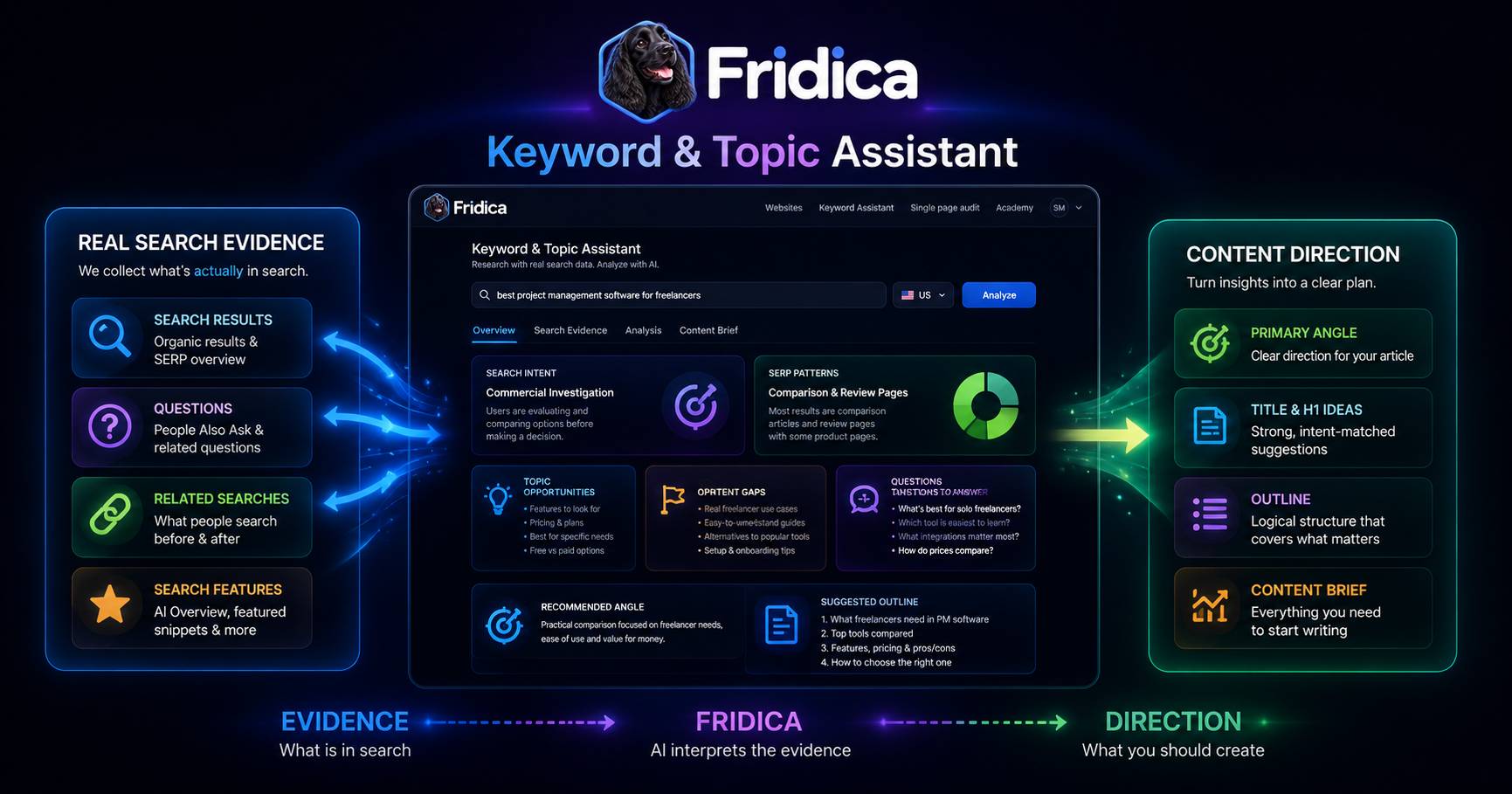
How Fridica’s Keyword & Topic Assistant Works
Fridica’s Keyword & Topic Assistant combines real search evidence with AI interpretation to help you understand search intent, identify useful opportunities and turn a topic into a practical content brief.
Read guide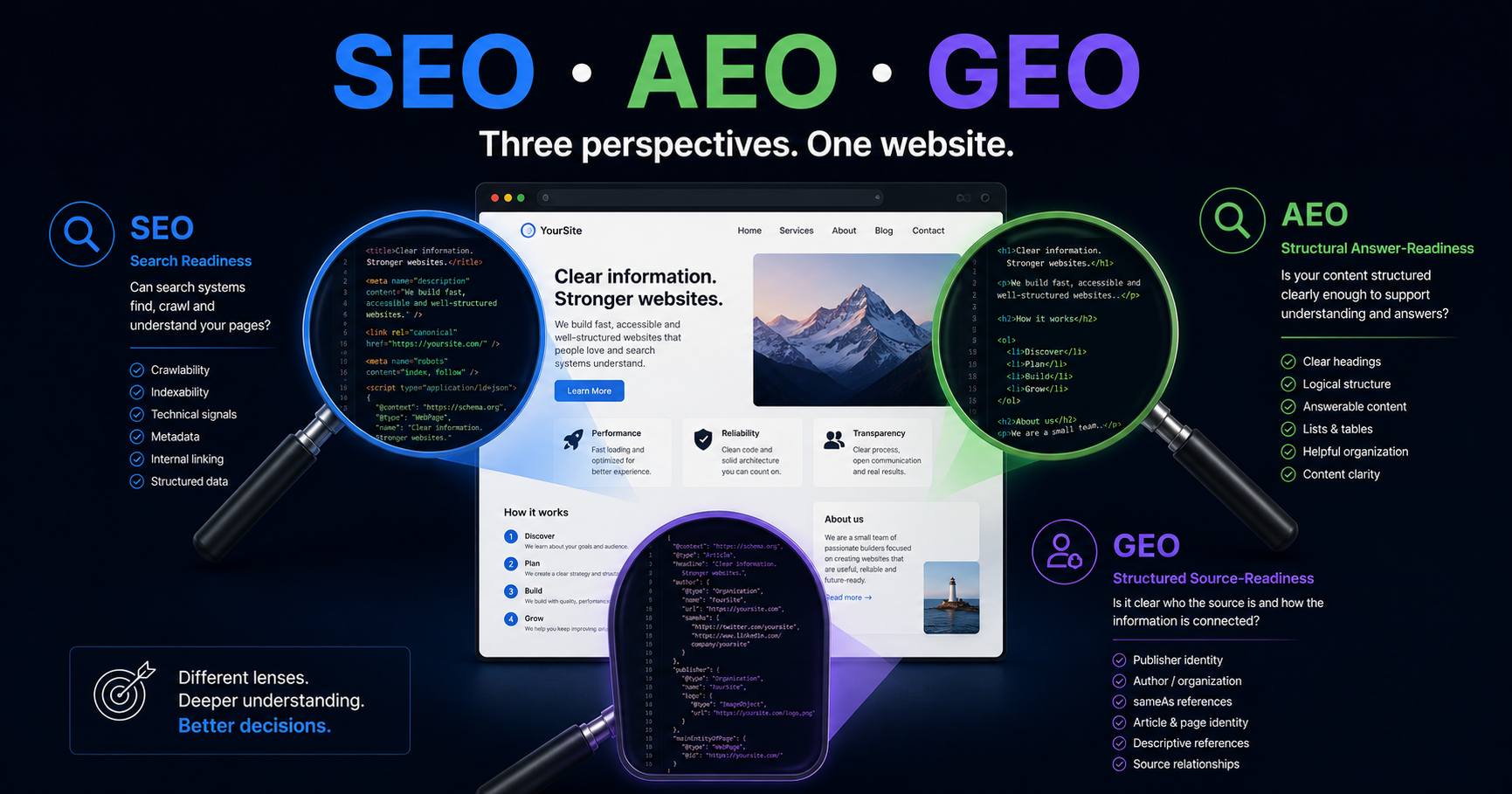
SEO vs AEO vs GEO: What Does Your Website Actually Need?
SEO, AEO and GEO are often presented as three competing strategies. They are not. Learn what each one actually describes, where they overlap, and why a website may need all three perspectives without chasing every new search acronym.
Read guide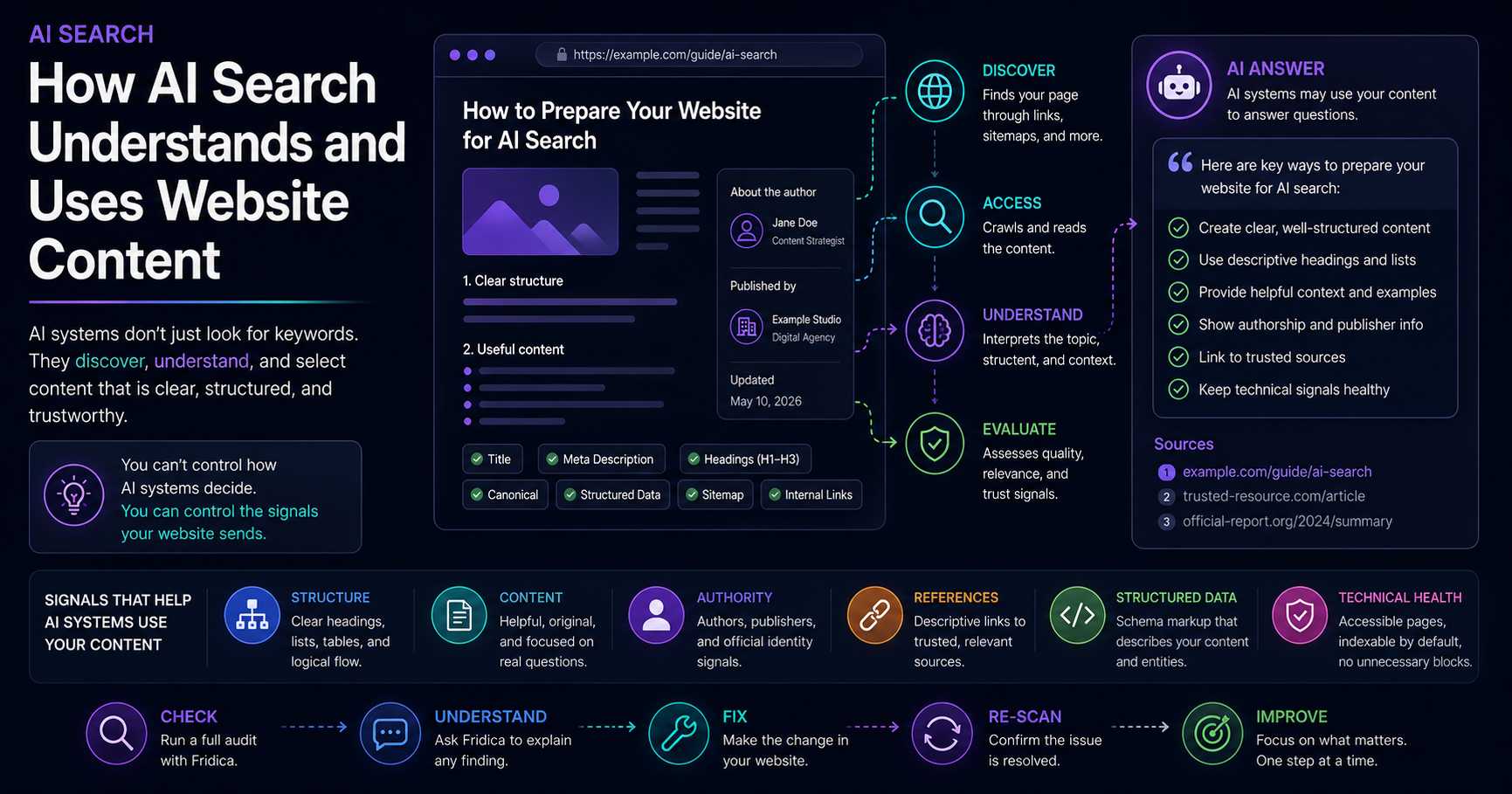
How AI Search Understands and Uses Website Content
Learn how AI-assisted search can discover, interpret, and use web content as a source — and how Fridica helps you improve the technical and structural signals you can actually control.
Read guidePut this into practice
See what applies to your page.
Start with a one-page review, then run a full site audit when you are ready.