
Guide · AI Search
How AI Search Understands and Uses Website Content
Learn how AI-assisted search can discover, interpret, and use web content as a source — and how Fridica helps you improve the technical and structural signals you can actually control.
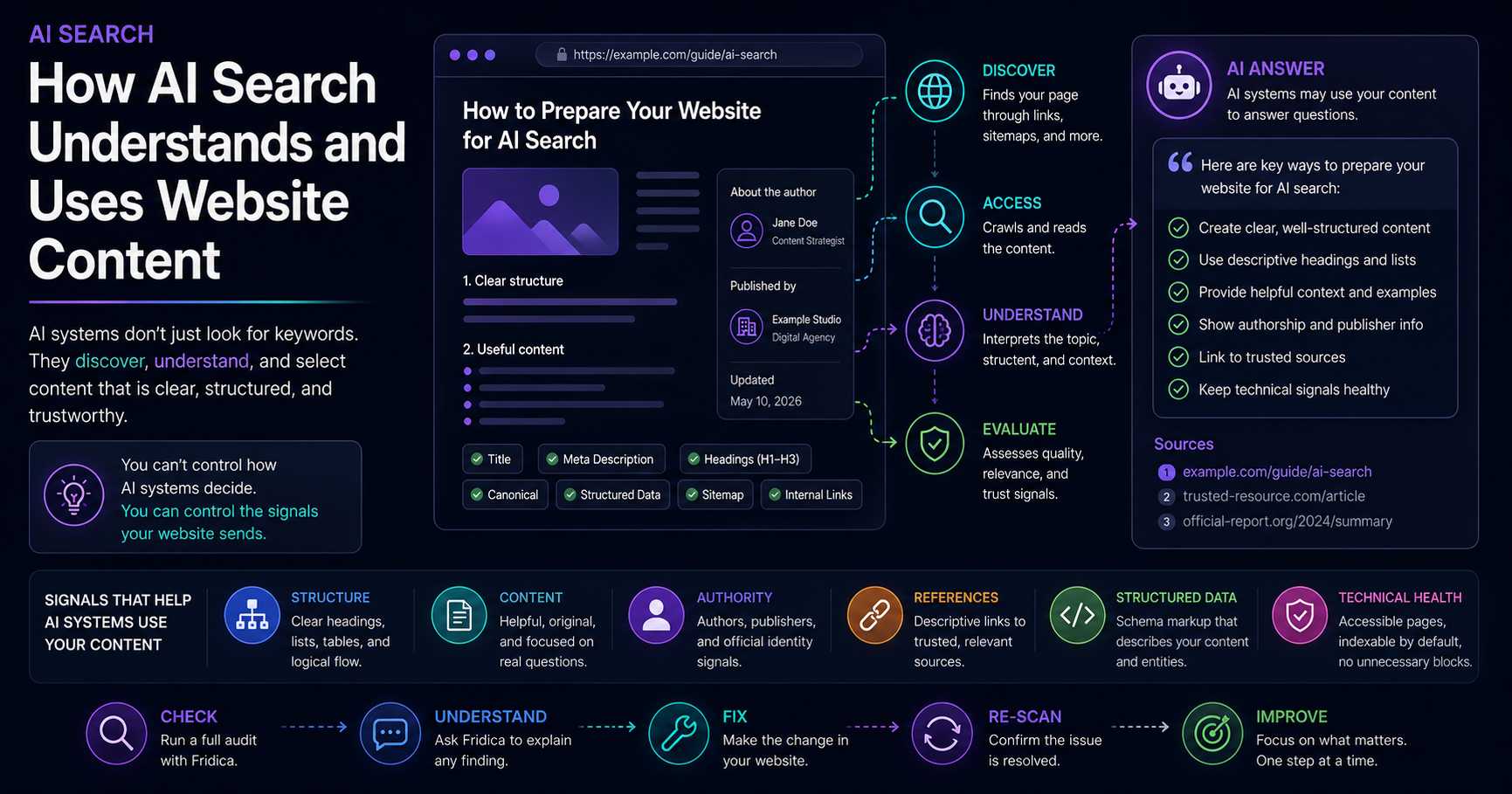
AI search can feel a little mysterious.
You publish a useful page, someone asks an AI system a question, and sometimes that system produces an answer containing information from the web.
So the obvious question is:
How does a website become useful to an AI-assisted search or answer system?
There is no single magic tag, plugin, schema property, or “AI SEO trick” that guarantees the result.
And that is actually good news.
It means you can focus on something much more practical:
making your website easy to discover, easy to understand, and clear about who produced the information.
Those are exactly the kinds of observable signals Fridica is designed to help you review.
AI search is not one single thing
When people say “AI search,” they may be talking about several different kinds of experiences.
For example:
- a traditional search engine generating a direct answer;
- an AI assistant retrieving current information from the web;
- a search interface combining links with generated summaries;
- a system citing or referencing external sources;
- an answer model using information retrieved by another system.
These systems do not all work in exactly the same way.
That is one reason Fridica does not give you an imaginary:
“ChatGPT visibility score.”
We cannot honestly determine from a public page alone whether a specific AI product will select, cite, mention, or recommend it.
What we can inspect are the signals the website itself exposes.
Start with the boring part: the page has to be reachable
Before anyone worries about AI citations, the page needs to exist in a form that can be found and accessed.
That means technical basics still matter.
For example:
- Does the page return successfully?
- Is the website broadly blocked by robots rules?
- Is the page marked
noindex? - Is there a usable canonical URL?
- Can important URLs be discovered through links or sitemap resources?
This may not sound glamorous.
But neither search engines nor AI systems can do much with a page they cannot reliably reach.
That is why Fridica still treats traditional technical SEO as part of the bigger picture.
Then the page has to make sense
Imagine opening a page with:
- no clear title;
- weak or confusing headings;
- huge blocks of unrelated text;
- generic links;
- unclear authorship;
- no obvious relationship between sections.
A human reader may eventually work out what the page is trying to say.
But why make that harder than necessary?
Clear structure helps people first.
It also exposes more explicit signals about the meaning of the page.
This is where Fridica’s AEO Structural Answer-Readiness perspective becomes useful.
What does “answer-ready” content look like?
Answer-ready does not mean writing every page like an FAQ.
It means that the structure reflects the information.
For example:
- a clear H1 establishes the main topic;
- H2 headings introduce major sections;
- H3 headings organize subsections;
- lists are used for actual lists;
- tables have meaningful headers;
- questions have clearly associated answers when questions are genuinely part of the content.
None of that requires you to write “for robots.”
It is simply good publishing.
Fridica checks structural signals like these because they are observable and useful — not because they guarantee inclusion in an AI answer.
AI systems also need to understand the source
Knowing what a page says is one thing.
Understanding who is saying it is another.
A website can expose useful information about:
- the organization behind the site;
- the author of an article;
- the publisher;
- official public profiles;
- the page represented by structured data;
- references to supporting sources.
This is where Fridica’s GEO Structured Source-Readiness perspective comes in.
GEO in Fridica is not a prediction of whether an AI system likes your brand.
It is an inspection of structured source and identity signals that your website actually exposes.
A simple example
Imagine you publish an article called:
How to Prepare a Small Business Website for Search
The article itself is useful.
Now imagine that the page also clearly exposes:
- the preferred canonical URL;
- an Article or BlogPosting entity;
- the article author;
- the publisher;
- the page identity through
mainEntityOfPagewhere appropriate; - official identity references for the organization;
- descriptive links to referenced external resources.
None of these things guarantees that an AI system will cite the article.
But the page now communicates more clearly:
what it is, who published it, which page represents it, and what sources it refers to.
That is useful structured information.
What about sameAs?
You may encounter a Fridica finding mentioning sameAs.
The name sounds more complicated than the idea.
In structured data, sameAs can associate an entity with another public URL representing that same organization or person.
For example, an organization might reference an official public profile.
The purpose is to make identity more explicit.
Fridica can check whether usable public HTTP or HTTPS references are present.
It does not decide whether one social network is better than another or whether a particular profile makes you “authoritative.”
It simply evaluates the structured signal.
And publisher information?
If a page contains Article structured data, it can also identify the publisher.
This helps make the relationship between the article and the organization publishing it more explicit.
When Fridica reports a publisher warning, it is not saying:
“AI does not trust you.”
It is saying something much more modest and useful:
“The structured publisher identity expected by this rule is not clearly present.”
That is something you can actually inspect and fix.
References matter too
Suppose an article contains a link labelled:
click here
That tells us almost nothing about the destination.
Now compare it with:
Read the European Commission report on digital policy
The second link gives the reference context.
Descriptive references can help readers understand what is being cited and why.
Fridica can detect external links whose visible anchor text provides little useful description.
Again, it does not judge whether the destination is a “good” source.
It evaluates how clearly your page represents the reference.
What AI search optimization is not
This part can save you a lot of time.
AI search optimization is not:
- adding “AI keywords” to every paragraph;
- creating fifty fake FAQ questions;
- installing a plugin that promises ChatGPT rankings;
- adding schema markup that does not match the actual content;
- publishing hundreds of low-value pages because “AI needs content.”
If an optimization makes the website worse for people, there is a good chance you are solving the wrong problem.
So what can you actually control?
This is where the topic becomes much less intimidating.
You can control:
- whether your important public pages are technically accessible;
- whether page titles and descriptions are clear;
- whether headings represent the real document structure;
- whether links describe their destinations;
- whether structured data describes real entities;
- whether authors and publishers are represented clearly where appropriate;
- whether canonical and page-identity signals are consistent;
- whether important references have useful context.
That is already plenty to work on.
And unlike vague promises about “AI visibility,” these are things Fridica can actually inspect.
Why Fridica separates SEO, AEO and GEO
You may wonder why we do not simply combine everything into one giant score.
Because the three perspectives answer different questions.
SEO Readiness
Are important technical and page-level search signals in place?
AEO Structural Answer-Readiness
Is the information structured in a way that makes the page and its answers easier to interpret?
GEO Structured Source-Readiness
Does the page expose useful structured information about identity, attribution, entities, and references?
The three areas overlap, but separating them helps you understand what kind of problem you are looking at.
What does a score of 100 mean?
Suppose Fridica reports:
GEO Readiness: 100/100
That does not mean:
“Every AI system will use this website.”
It means that the audited content passed all applicable weighted GEO checks in the current deterministic ruleset.
The same principle applies to AEO and SEO.
A readiness score is a summary of the checks Fridica actually performed.
It is not a prediction of the internet.
Can Fridica tell me if ChatGPT will cite my site?
No — and we would rather say that clearly than invent a number.
Fridica does not have access to every retrieval decision, index, ranking system, source-selection process, or model response used by external AI products.
So instead of pretending to measure something we cannot observe, Fridica focuses on the website itself.
That gives you something useful:
evidence you can inspect and improvements you can actually make.
Where Ask Fridica fits
This is where things get more interesting.
The deterministic audit may tell you:
GEO warning: publisher identity missing
If you have never heard that phrase before, it is not terribly helpful by itself.
So you can ask:
Why does publisher identity matter?
or:
What should I fix first?
or:
Which GEO issues affect most pages?
Ask Fridica receives the findings the audit has already produced and helps translate them into normal language.
It does not secretly replace the audit with an AI opinion.
That distinction is central to the product:
The audit measures. Fridica explains.
A practical AI Search routine
If you want a simple workflow, use this:
- Make sure your important pages can be accessed.
- Give every page a clear purpose and structure.
- Make authorship, publisher identity, and page identity explicit where appropriate.
- Use meaningful references.
- Run Fridica.
- Review SEO, AEO, and GEO separately.
- Ask Fridica about anything that does not make sense.
- Fix the real problem.
- Re-scan and see what changed.
One last thing: write for humans
It is surprisingly easy to forget this once words such as SEO, AEO, GEO, schema, entities, retrieval and AI enter the conversation.
Your website still exists because people need something from it.
They want an answer, a product, a service, an explanation, a contact, a solution, or perhaps just a useful article.
Make that experience good first.
Then make the structure clear enough that machines do not have to guess what you meant.
That is a much healthier way to think about AI search than chasing every new acronym that appears on LinkedIn.
And if a finding still sounds like it was written by a robot...
well, that is what Ask Fridica is for.
Keep learning
Related AI Search guides
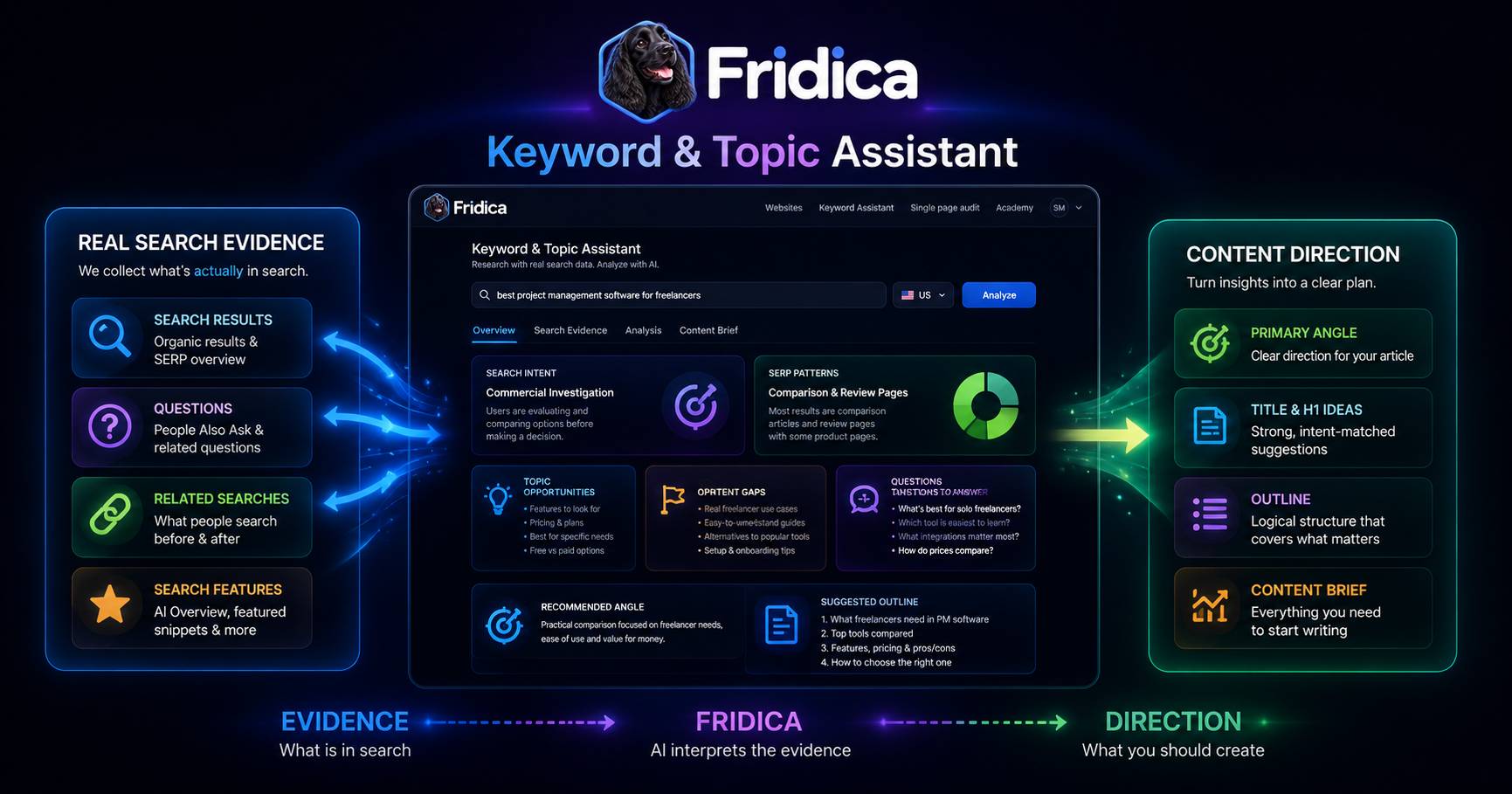
How Fridica’s Keyword & Topic Assistant Works
Fridica’s Keyword & Topic Assistant combines real search evidence with AI interpretation to help you understand search intent, identify useful opportunities and turn a topic into a practical content brief.
Read guide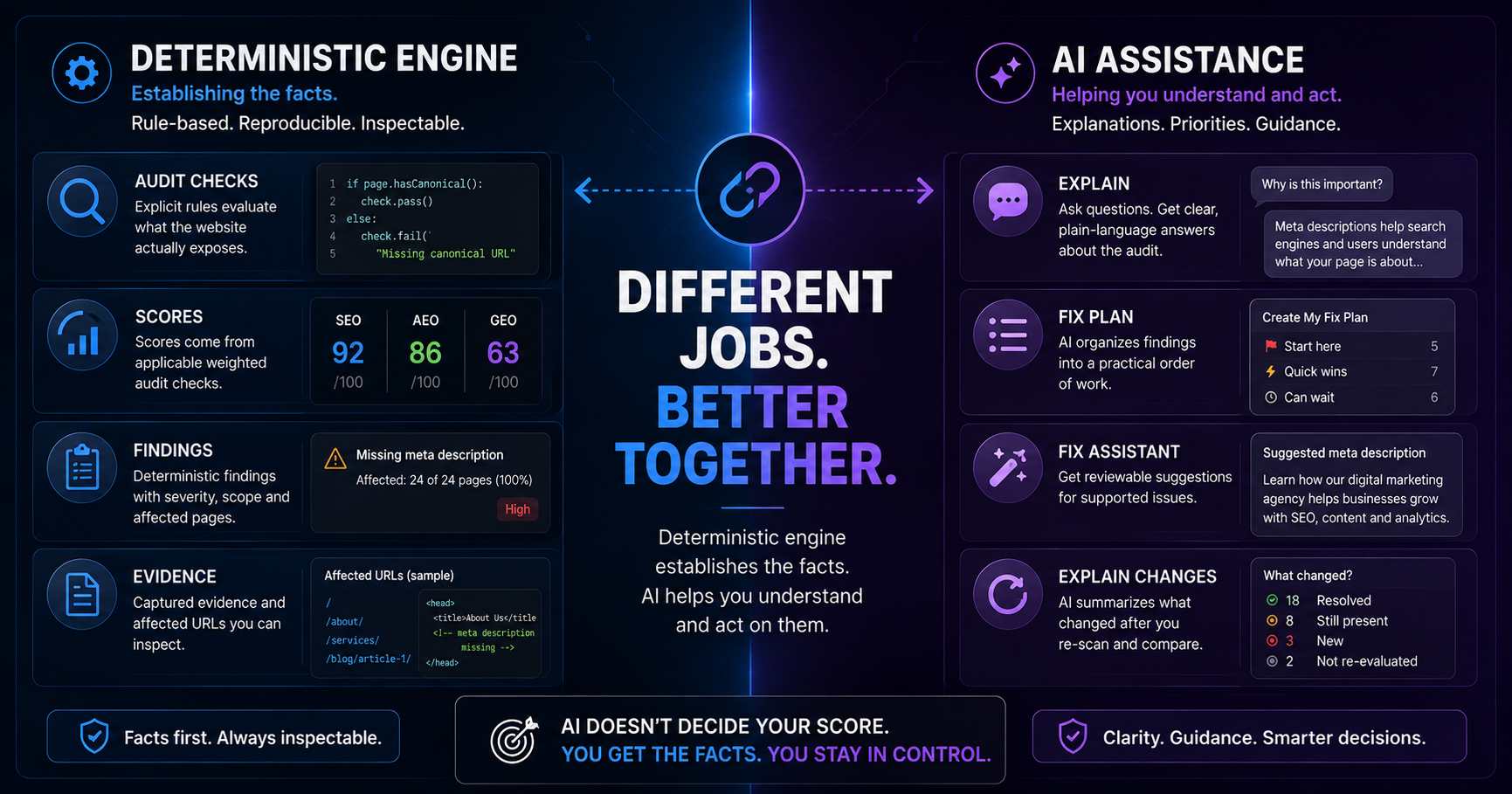
Why Fridica Uses AI - But Doesn’t Let AI Decide Your Score
AI can explain an audit, organize a fix plan and suggest what to do next. But should it decide whether your website passed or failed a technical check? Fridica deliberately keeps those two jobs separate.
Read guide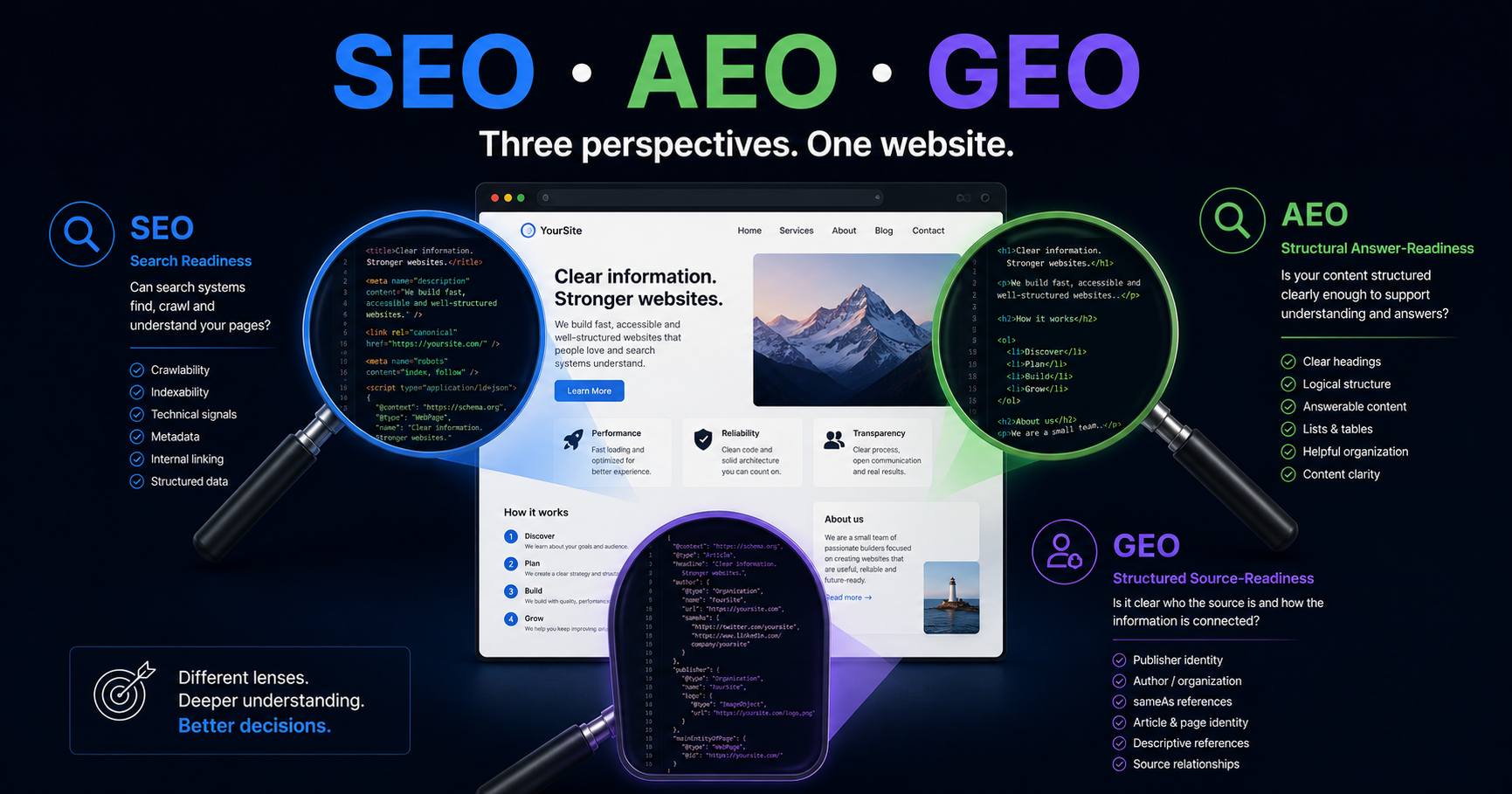
SEO vs AEO vs GEO: What Does Your Website Actually Need?
SEO, AEO and GEO are often presented as three competing strategies. They are not. Learn what each one actually describes, where they overlap, and why a website may need all three perspectives without chasing every new search acronym.
Read guidePut this into practice
See what applies to your page.
Start with a one-page review, then run a full site audit when you are ready.