
Guide · AI Search
SEO vs AEO vs GEO: What Does Your Website Actually Need?
SEO, AEO and GEO are often presented as three competing strategies. They are not. Learn what each one actually describes, where they overlap, and why a website may need all three perspectives without chasing every new search acronym.
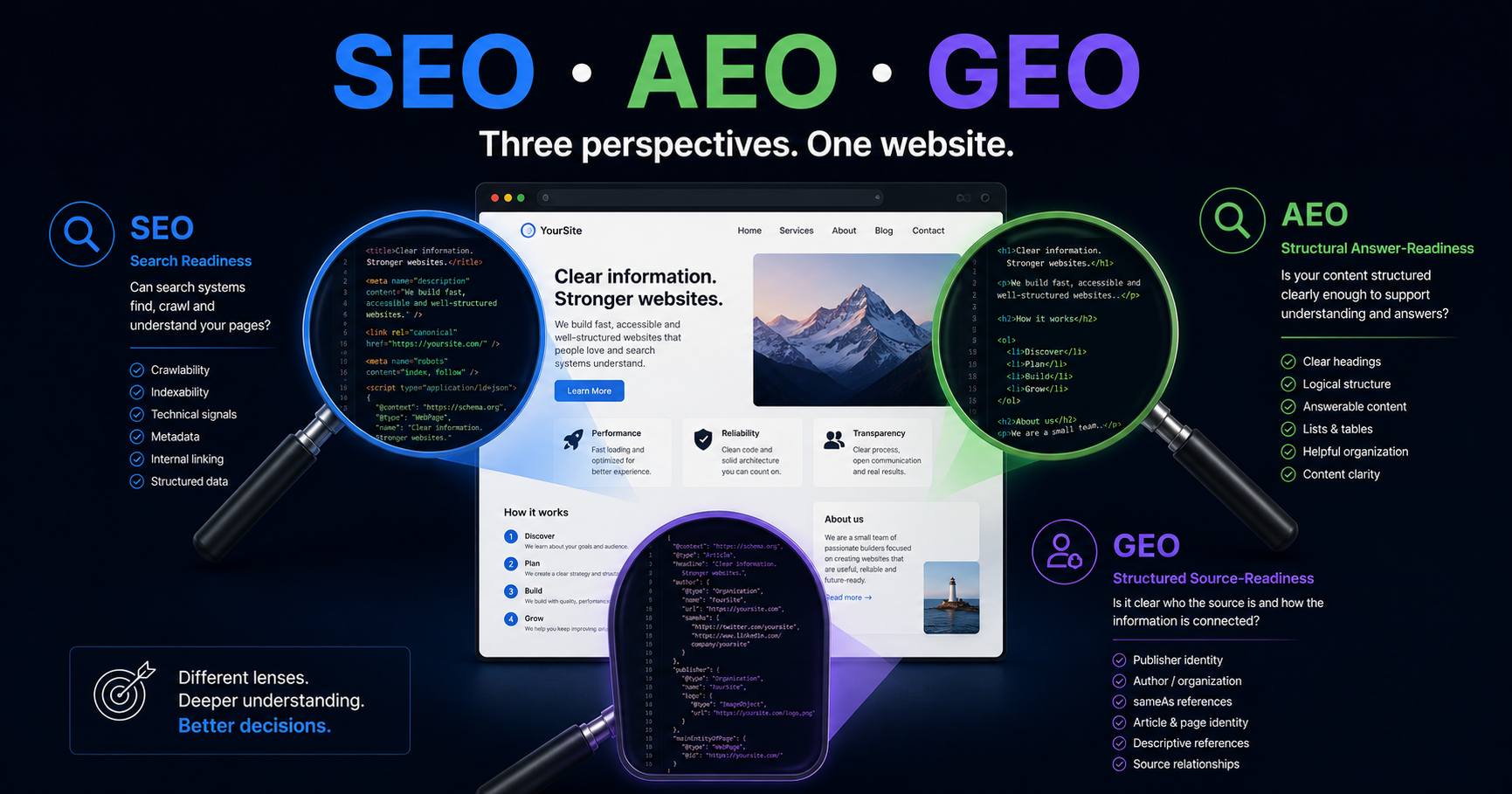
SEO.
AEO.
GEO.
Three acronyms.
One website.
And a perfectly reasonable question:
“Do I really need all of this?”
If you have been following search marketing over the last few years, it can sometimes feel as though every change in technology requires a completely new discipline, a new checklist and preferably another three-letter abbreviation.
Fortunately, the reality is less dramatic.
SEO, AEO and GEO describe different perspectives on how clearly a website communicates with search and answer systems.
They overlap.
But they are not identical.
And you generally do not need to choose one instead of the others.
The short version
A useful way to think about them is:
SEO looks at search-readiness signals across the website.
AEO looks more closely at whether content is structurally clear enough to support direct understanding and answers.
GEO looks at structured signals that help make the source, identity, attribution and relationships around the content more explicit.
Or even more simply:
SEO: Can the website communicate clearly with search systems?
AEO: Is the content structured clearly enough to answer questions?
GEO: Is it clear who the source is and how the information is connected?
That is the practical distinction Fridica uses.
Do SEO, AEO and GEO compete with each other?
No.
This is probably the most important point in the whole guide.
You do not normally reach a crossroads and decide:
“This year we are abandoning SEO and doing GEO instead.”
That would be a little like saying:
“We no longer need a good website because we have structured data.”
The concepts solve different parts of the same larger problem.
A technically unhealthy website does not become healthy because someone added an AI-search strategy.
Poorly structured content does not become easy to interpret because the publisher has a perfect organization schema.
And excellent content cannot compensate for every technical barrier that makes the page difficult to discover or process.
The layers work together.
Start with SEO
SEO remains the broadest foundation.
The arrival of AI search has not made titles, canonical URLs, crawlability, structured HTML or sensible internal linking suddenly irrelevant.
Search systems still need to access pages.
They still need signals describing what those pages are.
They still need to distinguish useful page relationships.
And websites still benefit from clear technical structure.
Fridica's SEO Readiness perspective can therefore inspect applicable signals such as:
- page titles;
- meta descriptions;
- canonical URLs;
- heading structure;
- links;
- robots directives;
- sitemaps and discoverability;
- structured-data validity;
- and other technical or page-level signals covered by the current ruleset.
That does not mean passing those checks guarantees rankings.
It means the website is exposing healthier search-readiness signals within the areas being audited.
SEO is not just “keywords”
For many people, SEO still immediately means:
“Which keyword should I put on the page?”
Keywords matter in the broader SEO process.
But technical and structural SEO is much larger than keyword placement.
A page can target the perfect phrase and still have:
a duplicate title,
an incorrect canonical,
a confusing heading structure,
or a crawlability problem.
Before worrying about increasingly sophisticated search strategies, it is worth making sure the website itself communicates clearly.
Then what is AEO?
AEO usually stands for Answer Engine Optimization.
The term became more prominent as search experiences began returning increasingly direct answers rather than only lists of links.
But the useful part of AEO does not require writing strange “AI-optimized” sentences.
A much more practical question is:
Is the information on this page structured clearly enough to understand?
That is why Fridica describes its AEO perspective as:
Structural Answer-Readiness.
What makes content answer-ready?
Imagine a page answering:
“How do I reset my account password?”
One version has:
a clear heading,
a short explanation,
a numbered process,
and a few clearly labelled exceptions.
Another version hides the answer inside twelve paragraphs with vague headings and unrelated marketing copy.
A human reader will probably prefer the first version.
Systems attempting to interpret the page may benefit from that clearer structure too.
That is the kind of problem AEO is trying to address.
AEO is not about writing for robots
This is where the topic can go wrong quickly.
People hear “answer engine” and start imagining that every page needs to sound like:
Question: What is a bakery?
Answer: A bakery is a business that sells bread.
Repeated sixty times.
Please do not do that to your readers.
Answer-ready content should still be useful content for humans.
Clear headings, logical sections, descriptive lists, well-structured tables and direct answers are not tricks for machines.
They are good communication.
So what does Fridica look for in AEO?
Fridica can evaluate applicable structural signals captured from the page.
For example, depending on the content, it may inspect whether:
there is a clear primary heading,
the heading hierarchy is coherent,
questions and answers have observable structure,
lists or tables are used meaningfully,
and useful content is actually present in the captured page.
Again, this produces a readiness perspective.
It does not tell you:
“Google will definitely use this paragraph as an answer.”
Fridica cannot observe that future decision.
And then we reach GEO
GEO usually stands for Generative Engine Optimization.
It is the newest and probably the most confusing of the three terms.
Part of the reason is that people use GEO to describe several different things.
Sometimes they mean optimizing content for AI-assisted search.
Sometimes they mean trying to increase citations in generated answers.
Sometimes they simply mean:
“SEO, but there is AI somewhere nearby.”
Fridica deliberately uses a narrower interpretation.
We call it:
GEO Structured Source-Readiness.
Why “source-readiness”?
Imagine an excellent article appears on a website.
The information itself is useful.
But the page makes it difficult to determine:
who published it,
who wrote it,
what organization stands behind the site,
whether the page clearly identifies itself,
or how referenced sources relate to the claims being made.
Now compare that with a page where those relationships are much more explicit.
The second page exposes a clearer source structure.
That is the kind of thing Fridica's GEO perspective is intended to inspect.
What can GEO readiness include?
Depending on what is applicable and observable, Fridica may inspect signals around:
publisher identity,
author or organization identity,
sameAs references,
Article page identity,
mainEntityOfPage,
canonical relationships,
descriptive source references,
and consistency between structured identity signals.
These signals can help make the source clearer.
They do not create authority out of thin air.
GEO is not an AI citation score
This distinction matters a lot.
Fridica cannot crawl your website and honestly conclude:
“You have a 78% chance of being cited by ChatGPT.”
There is no deterministic website signal that gives us that information.
Whether an AI system retrieves, trusts, selects or cites a particular source can depend on many things outside the audited page.
So Fridica does not treat GEO Readiness as an AI-visibility probability.
It is a score derived from applicable structured source-readiness checks.
That sounds less magical.
Good.
Search already has enough magic numbers.
Where do SEO, AEO and GEO overlap?
Quite a lot.
That is one reason trying to separate them into three completely independent strategies does not work very well.
Consider a clear heading hierarchy.
It can help:
users scan the page,
search systems understand document structure,
and answer-oriented systems interpret sections more clearly.
Or consider a canonical URL.
That is traditionally associated with SEO.
But source consistency can also matter when you are trying to make page identity explicit.
Good web structure tends to help more than one acronym at a time.
One page can therefore affect all three perspectives
Imagine a guide with:
a unique descriptive title,
a sensible canonical URL,
clear H1 and H2 headings,
well-structured sections,
a visible author,
publisher information,
appropriate Article structured data,
and descriptive links to supporting sources.
You did not build three different pages:
one for SEO,
one for AEO,
and one for GEO.
You built one clear, well-structured page.
Different audit perspectives can then inspect different aspects of it.
Why does Fridica keep three separate scores?
Because combining everything into one number would hide useful distinctions.
Suppose a site performs well technically:
SEO Readiness: 95
But its content structure is inconsistent:
AEO Readiness: 72
And source identity is barely expressed:
GEO Readiness: 48
A single score of:
72/100
would tell you much less.
Three perspectives show where the differences are.
The scores are not competing grades.
They are different lenses on the same website.
What if SEO is high but GEO is low?
That can be completely reasonable.
Your website may have:
excellent titles,
good canonicals,
healthy crawlability,
clear metadata,
and sensible internal links.
But perhaps it does not clearly expose:
publisher identity,
author relationships,
structured Article identity,
or descriptive references.
That would produce a very different picture across the two perspectives.
It does not mean the SEO score is wrong.
It means the audit is asking different questions.
What if AEO is already 100?
Great.
That means the page or site passed the applicable weighted structural answer-readiness checks in that audit.
It does not mean:
every sentence is perfect,
every question has been answered,
every AI system will understand the content identically,
or the site has reached the end of content strategy.
A score describes the checks that were run.
It does not describe every possible quality of the website.
Should I fix SEO before AEO and GEO?
Not as an absolute rule.
But foundational technical problems often deserve early attention.
For example, if pages are difficult to access or expose inconsistent canonical signals, spending an afternoon polishing answer structure may not be your first priority.
On the other hand, if the website is technically healthy and the main weakness is poorly organized content, an AEO-related improvement may be exactly the sensible next step.
The right question is not:
“Which acronym always comes first?”
It is:
“What does this particular website need first?”
This is where scope and findings matter more than the acronym
Suppose Fridica shows:
SEO: 94
AEO: 88
GEO: 61
It would be tempting to say:
“GEO is lowest. Fix GEO first.”
Maybe.
But you should inspect the findings.
Perhaps the SEO section contains one site-wide canonical issue.
Perhaps the GEO score is mostly affected by several lower-priority identity opportunities.
The lowest score does not automatically determine the first task.
Context still matters.
Create My Fix Plan can help organize that context
When several SEO, AEO and GEO findings exist together, Create My Fix Plan can help turn them into one practical order of work.
Instead of thinking:
“First I complete SEO. Then I complete AEO. Then I complete GEO.”
you can work around the actual findings.
For example:
Start here: fix a site-wide canonical problem.
Quick win: improve the heading structure on two important pages.
Later: strengthen structured publisher identity.
That is usually closer to how real websites are improved.
Do not optimize for the score
This deserves its own section.
Once a product shows a number, humans develop a powerful desire to make it 100.
We understand.
But the goal is not:
“Make every Fridica circle green.”
The goal is to improve the website in ways that make sense.
A finding may be valid but lower priority.
A particular signal may not matter equally to every site.
An implementation may require business or technical context that the audit does not possess.
Use the score to orient yourself.
Use the findings to decide.
Do you need a special “AI SEO” strategy?
Sometimes.
But probably not in the way the phrase is often marketed.
A useful AI-search strategy may include thinking more carefully about:
clear information architecture,
answerable content,
source identity,
expertise and attribution,
structured data,
descriptive references,
and content that actually deserves to be used as a source.
Notice something?
Most of those are sensible web-content practices even before someone adds the word “AI.”
What should website owners focus on?
If you are not an SEO professional, you do not need to manage three separate strategies in a spreadsheet.
Start with simpler questions:
Can systems access and interpret my website?
Is my content clearly structured?
Is it clear who is publishing the information?
Are there important findings affecting many pages?
What should I fix first?
Fridica can translate the three perspectives back into those practical questions.
What should developers focus on?
Developers may want to look for shared implementation problems across all three perspectives.
For example:
a base template could affect canonical URLs,
a component could affect heading structure,
and a structured-data helper could affect publisher identity across the whole site.
In each case, a repeated audit finding may point toward one shared root cause.
Fix the system when the system is the problem.
What should SEO professionals focus on?
Use the scores as orientation.
Then go underneath them.
Review:
the deterministic finding,
severity,
rule weight,
scope,
affected-page prevalence,
representative URLs,
available evidence,
and audit comparison after remediation.
Then combine that with the information Fridica does not have:
Search Console,
analytics,
search demand,
competitive context,
content strategy,
and business priorities.
What Fridica does not claim
An SEO, AEO or GEO readiness score is not a prediction of external outcomes.
Fridica does not claim that a higher score guarantees:
higher rankings,
more organic traffic,
Google indexing,
AI citations,
or inclusion in generated answers.
Those outcomes depend on systems and information outside the deterministic audit.
Fridica focuses on the website signals it can actually inspect.
So what does your website actually need?
Probably not:
SEO or AEO or GEO.
It probably needs a healthy combination of:
technically sound pages,
clear content structure,
explicit source identity,
useful information,
and sensible website architecture.
SEO, AEO and GEO simply give us different ways to inspect those qualities.
The short version
SEO is not dead.
AEO is not a replacement for SEO.
GEO is not a magic switch for AI visibility.
And your website does not need to choose a team.
Think of them as three lenses:
SEO → search readiness.
AEO → structural answer-readiness.
GEO → structured source-readiness.
Then look at the actual findings.
See what affects the website.
Fix what makes sense.
Re-scan.
And keep the acronyms in their proper place.
The website comes first.
Keep learning
Related AI Search guides
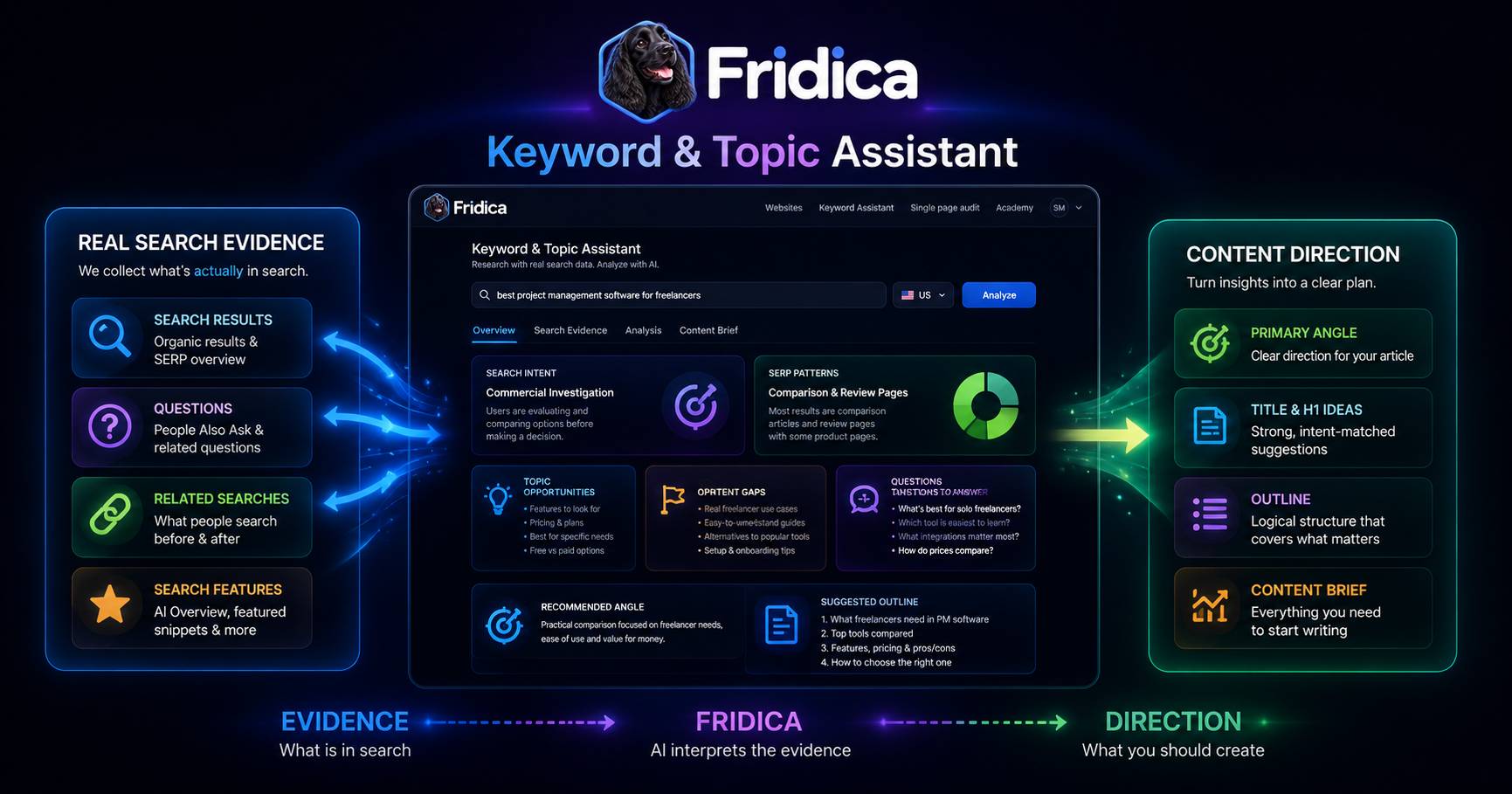
How Fridica’s Keyword & Topic Assistant Works
Fridica’s Keyword & Topic Assistant combines real search evidence with AI interpretation to help you understand search intent, identify useful opportunities and turn a topic into a practical content brief.
Read guide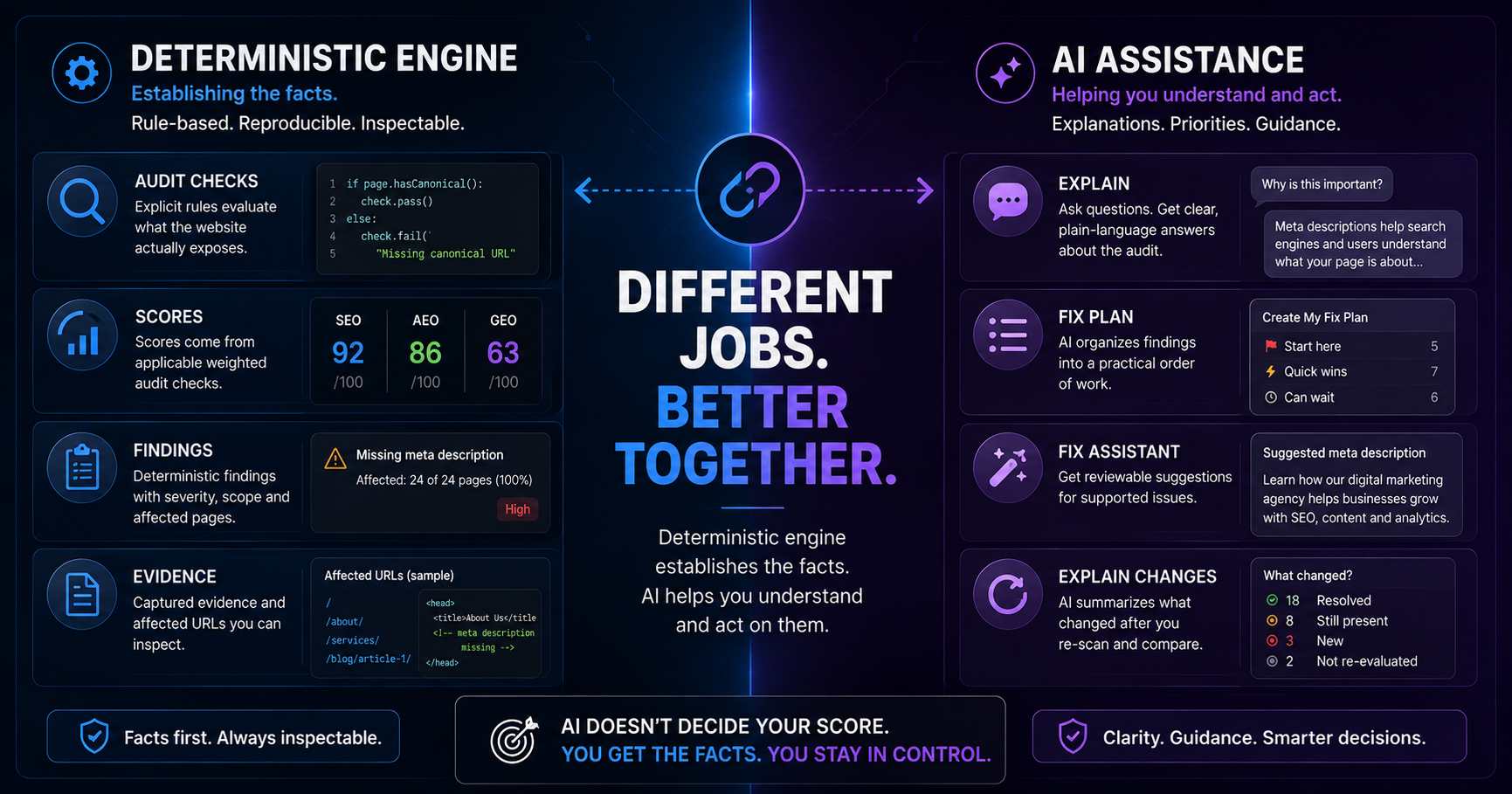
Why Fridica Uses AI - But Doesn’t Let AI Decide Your Score
AI can explain an audit, organize a fix plan and suggest what to do next. But should it decide whether your website passed or failed a technical check? Fridica deliberately keeps those two jobs separate.
Read guide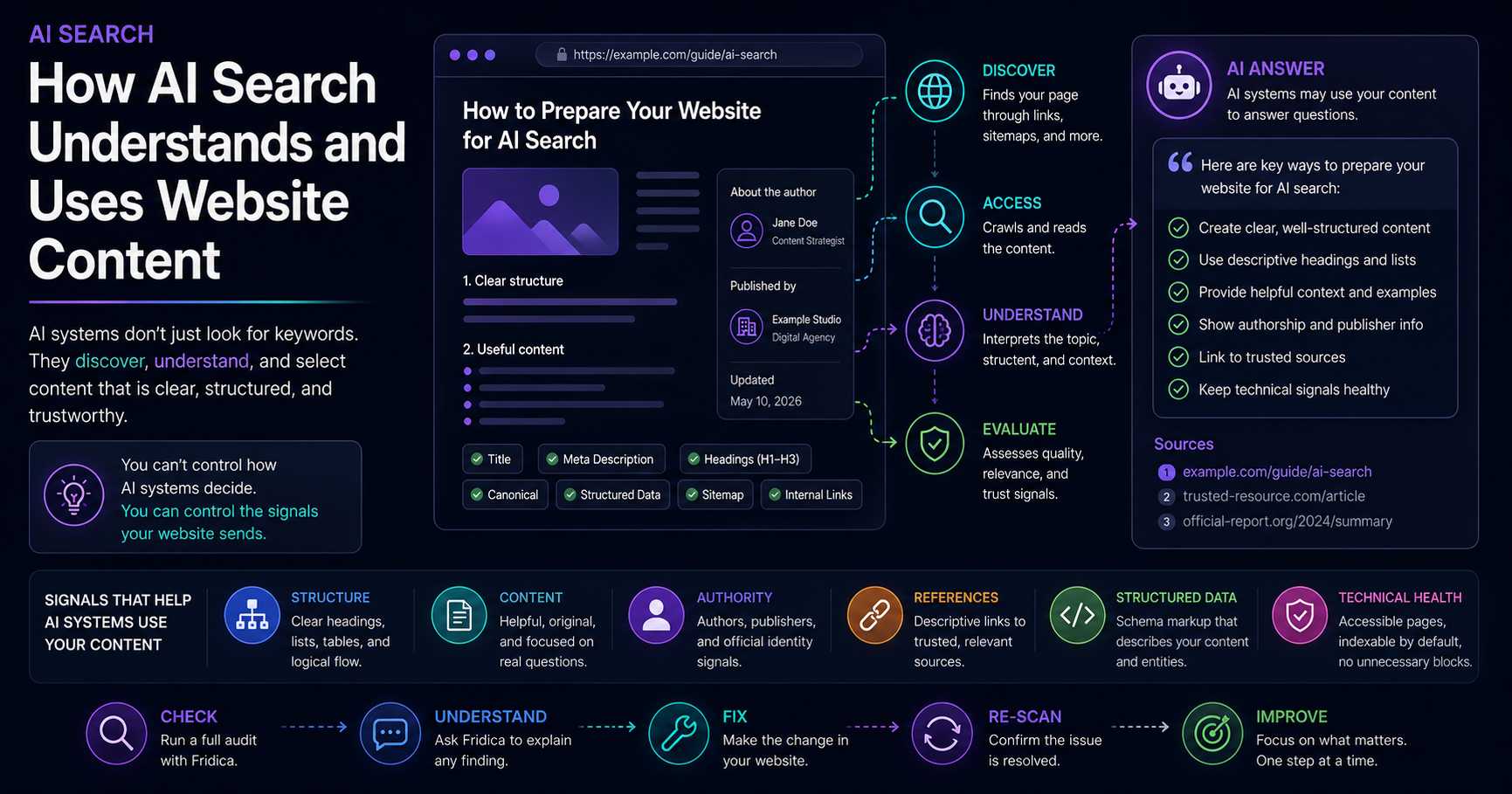
How AI Search Understands and Uses Website Content
Learn how AI-assisted search can discover, interpret, and use web content as a source — and how Fridica helps you improve the technical and structural signals you can actually control.
Read guidePut this into practice
See what applies to your page.
Start with a one-page review, then run a full site audit when you are ready.