
Guide · AI Search
How Fridica’s Keyword & Topic Assistant Works
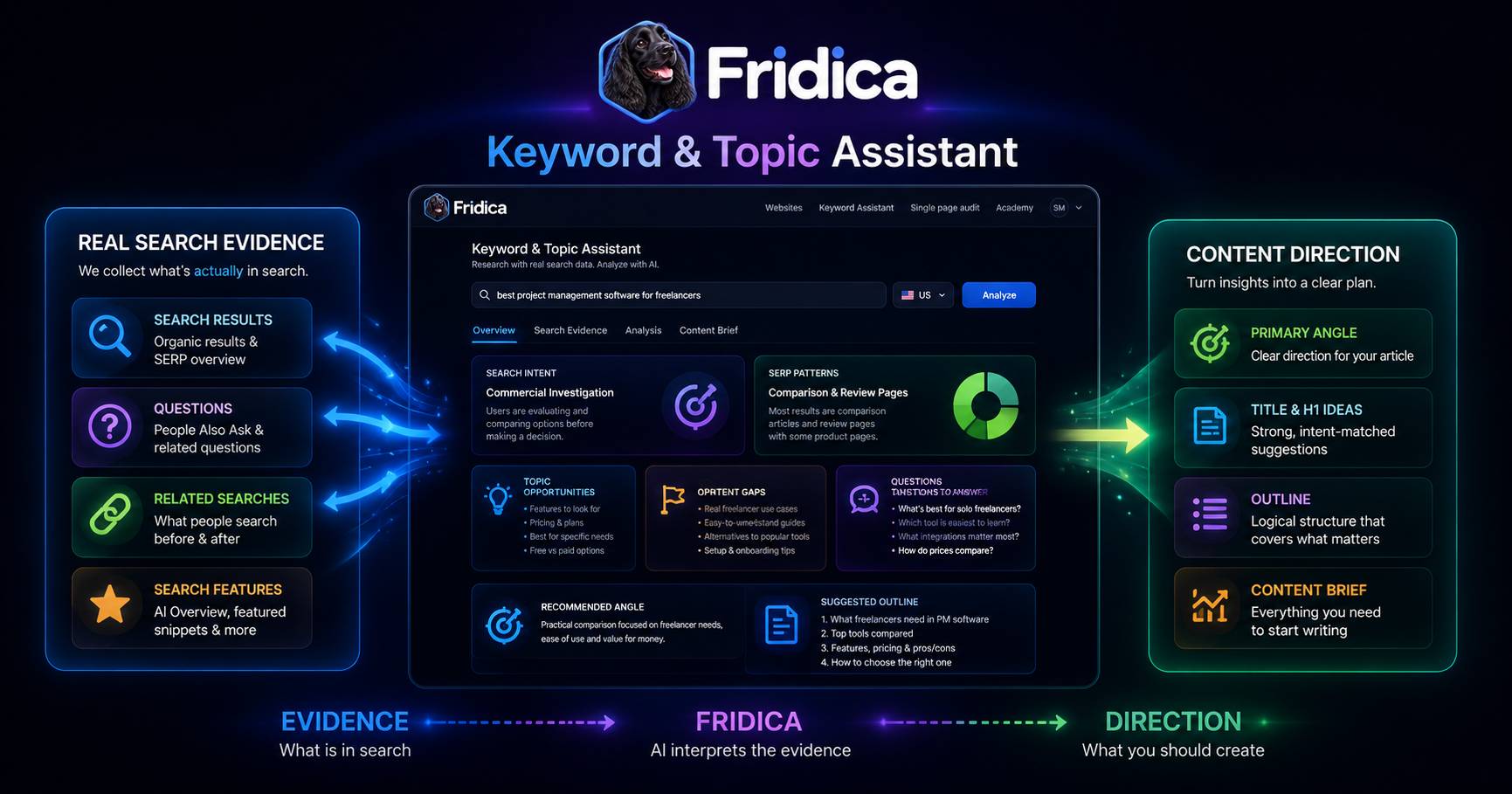
Fridica’s Keyword & Topic Assistant combines real search evidence with AI interpretation to help you understand search intent, identify useful opportunities and turn a topic into a practical content brief.
You have a topic.
Maybe you know the keyword you want to explore.
Maybe you only have a rough idea.
The difficult part usually comes next:
What do people actually expect to find when they search for it?
That is the problem Fridica's Keyword & Topic Assistant is designed to help with.
It does not start by inventing keyword metrics.
It starts by looking at the current search landscape.
Then AI helps interpret what that evidence may mean for your content.
The basic idea
The workflow is intentionally simple:
Query → Search evidence → Interpretation → Content direction.
You provide:
- a query or topic;
- a target country;
- and a language.
Fridica then gathers current search evidence and turns it into a structured research view.
That evidence can then be interpreted to help answer questions such as:
- What is the likely search intent?
- What kinds of pages dominate the results?
- Which topics keep appearing?
- Which related searches are useful?
- What questions might deserve an answer?
- Where could there be a useful content gap?
- What angle could make sense for the page?
- What might a practical content brief look like?
Step 1: Start with a real topic or query
The process begins with the phrase you want to investigate.
For example:
“best project management software for freelancers”
or:
“how to improve local SEO”
or simply:
“technical SEO audit.”
You also select the country and language.
That matters because search results can differ between markets.
The same query may produce a different search landscape depending on location and language.
Step 2: Fridica checks current search evidence
The Keyword & Topic Assistant works with real search-result evidence rather than asking an AI model to imagine what Google might show.
Depending on what is available for the query, the evidence layer can include:
- organic search results;
- related searches;
- questions or People Also Ask data when present;
- featured search elements when present;
- and AI Overview when it appears in the returned search evidence.
Not every query produces every type of search feature.
That is important.
If People Also Ask is not present, Fridica should not pretend that it was.
If an AI Overview is not returned, Fridica does not manufacture one.
The evidence layer should reflect what was actually observed.
Evidence and analysis are deliberately separated
This is one of the most important design decisions in the Keyword & Topic Assistant.
There are two different things happening:
1. Search evidence
and:
2. Fridica analysis.
Search evidence tells you what the search landscape contains.
Fridica analysis helps interpret what that evidence could mean for your content strategy.
Those two layers should not be confused.
For example, suppose the search results contain:
- six long-form guides;
- two comparison pages;
- one product page;
- several related searches;
- and a group of beginner questions.
Those are observations.
Fridica might then interpret the pattern as:
“Primarily informational intent with some commercial investigation.”
That is analysis.
It is based on the evidence, but it is not the same thing as the evidence itself.
Step 3: AI interprets the normalized search data
Once the search data has been collected and normalized, Fridica uses AI to interpret that structured evidence.
The AI is not asked:
“Tell me everything you know about this keyword.”
Instead, it receives the available search evidence and is asked to reason from that evidence.
This gives the analysis a clearer foundation.
The purpose of AI here is not to replace the search data.
It is to help make the data easier to understand and use.
What can the analysis include?
Depending on the query and available evidence, Fridica can produce several useful outputs.
Likely search intent
Fridica can interpret whether the query appears primarily:
- informational;
- commercial;
- transactional;
- navigational;
- or mixed.
This is an interpretation based on the search landscape.
It is not a permanent label attached to the keyword forever.
SERP summary and patterns
The assistant can summarize what appears to dominate the current results.
For example:
- beginner guides;
- comparison articles;
- product pages;
- service pages;
- documentation;
- videos;
- forums;
- or mixed result types.
This helps answer:
“What kind of content does this search currently appear to reward?”
Dominant content formats
A query may be dominated by:
- how-to guides;
- lists;
- comparisons;
- reviews;
- tools;
- landing pages;
- or another format.
Knowing this before writing can prevent a major intent mismatch.
Recommended primary angle
Several different articles could often be written around the same broad topic.
Fridica can suggest a primary direction based on the evidence.
That does not mean the recommendation is mandatory.
It gives you a starting point.
You still decide whether that angle makes sense for your audience, expertise and website.
Topic opportunities
Related searches, recurring topics and result patterns can reveal useful areas worth exploring.
Some may belong in the current article.
Others may make better separate pages.
The purpose is not to force every related phrase into one piece of content.
It is to understand the wider topic.
Content gaps
Fridica can also help identify areas where the current results may leave room for something more useful.
That might include:
- a weakly answered question;
- a missing beginner explanation;
- a practical example competitors do not provide;
- a technical detail that is frequently skipped;
- or an audience perspective that receives little attention.
A content gap is not valuable simply because competitors forgot it.
It still needs to help the reader.
Questions worth answering
Questions appearing in search results can be especially useful when planning content.
Fridica can also use the wider evidence to suggest useful editorial questions.
But the distinction matters.
A question observed in the search results is evidence.
A question suggested by AI is an editorial recommendation.
They should not be presented as the same thing.
Suggested title and H1
Once the likely intent and primary angle are clearer, Fridica can suggest:
- a title;
- and an H1.
These suggestions are starting points, not requirements.
A human editor should still decide whether they accurately represent the page.
Suggested outline
Fridica can turn the research into a rough structure for the article.
The outline should follow the topic and likely reader journey rather than a fixed SEO formula.
A useful outline might move from:
problem → explanation → process → examples → questions → next step.
Another topic may require a completely different structure.
Content brief
The final result brings the important findings together into a practical writing plan.
Instead of leaving you with a collection of search results and related phrases, the goal is to help answer:
“What should I actually create?”
What Fridica does not invent
The current Keyword & Topic Assistant does not fabricate metrics that it does not have.
It does not invent:
- search volume;
- keyword difficulty;
- CPC;
- traffic estimates;
- or ranking probability.
Those metrics require appropriate external data sources.
If reliable data is not available, an impressive-looking number would still be a made-up number.
Fridica deliberately avoids that.
Why not just ask ChatGPT or another AI?
You can absolutely use a general AI assistant for brainstorming.
It can generate:
- topic ideas;
- headlines;
- questions;
- outlines;
- and possible content angles.
The limitation appears when you ask:
“What is actually appearing in the current search results?”
Without current search evidence, the model may rely on general knowledge or assumptions.
That can still be useful for ideation.
But it is different from analyzing a current SERP.
Fridica's approach is:
evidence first, interpretation second.
Why current search results matter
Search intent is not permanently fixed.
SERPs change.
New products appear.
New terminology develops.
AI search experiences evolve.
The kind of content that dominates a query today may not be exactly the same a year from now.
That is why current evidence is useful.
It gives you a snapshot of the search landscape at the time you are researching the topic.
Why country and language matter
Search is not identical everywhere.
A topic researched for:
English-speaking users in the United States
may produce a different landscape from:
English-speaking users in another market.
Language changes things too.
People may describe the same problem differently.
Local brands, publications, services and search habits can also affect the results.
That is why country and language are part of the research input rather than an afterthought.
The assistant is not a ranking guarantee
A useful content brief does not guarantee rankings.
Neither does search intent analysis.
Neither does an outline.
Search visibility depends on many factors, including:
- content quality;
- competition;
- website authority;
- technical health;
- internal linking;
- crawlability;
- indexing;
- and how useful the final page actually is.
Keyword research helps you make a more informed content decision.
It does not remove uncertainty from search.
The assistant also does not write the final article for you
A brief is not the finished content.
The writer still needs:
- expertise;
- judgment;
- original examples;
- accurate information;
- clear explanations;
- and an understanding of the intended audience.
Fridica helps with the research and planning stage.
It helps you arrive at the blank document with a much clearer idea of what deserves to go into it.
How this fits into Fridica's larger workflow
Fridica has two connected workflows.
For content planning:
Research → Understand → Plan Content.
For published websites:
Scan → Understand → Plan → Fix → Verify.
The Keyword & Topic Assistant belongs primarily to the first workflow.
It helps before the page exists.
Single Page Audit and Full Website Audit become more important once the content has been published and becomes part of a real website.
The two workflows eventually meet.
You research before creating.
Then you audit, improve and verify after publishing.
A simple example
Imagine you want to write about:
“best website builder for small business.”
Instead of immediately writing a generic article, you run the topic through the Keyword & Topic Assistant.
The search evidence might reveal:
- comparison articles dominating the organic results;
- several major website-builder brands appearing repeatedly;
- questions about pricing and ease of use;
- related searches around specific business types;
- and repeated emphasis on features, templates and ecommerce.
Fridica might interpret this as strong commercial investigation intent.
A useful primary angle might then focus on helping small-business owners compare realistic options rather than explaining what a website builder is.
That one decision changes:
- the title;
- the structure;
- the examples;
- the questions;
- and the entire purpose of the article.
That is why understanding the search landscape comes before writing.
The short version
Fridica's Keyword & Topic Assistant does not try to turn keyword research into a collection of mysterious scores.
It starts with a real query.
It checks current search evidence.
It keeps that evidence separate from AI interpretation.
Then it helps turn the findings into:
- search intent;
- SERP patterns;
- content opportunities;
- useful questions;
- content gaps;
- a primary angle;
- an outline;
- and a practical content brief.
No invented search volume.
No invented keyword difficulty.
No invented ranking probability.
Real search evidence tells you what is there. Fridica helps you decide what to do with it.
Keep learning
Related AI Search guides
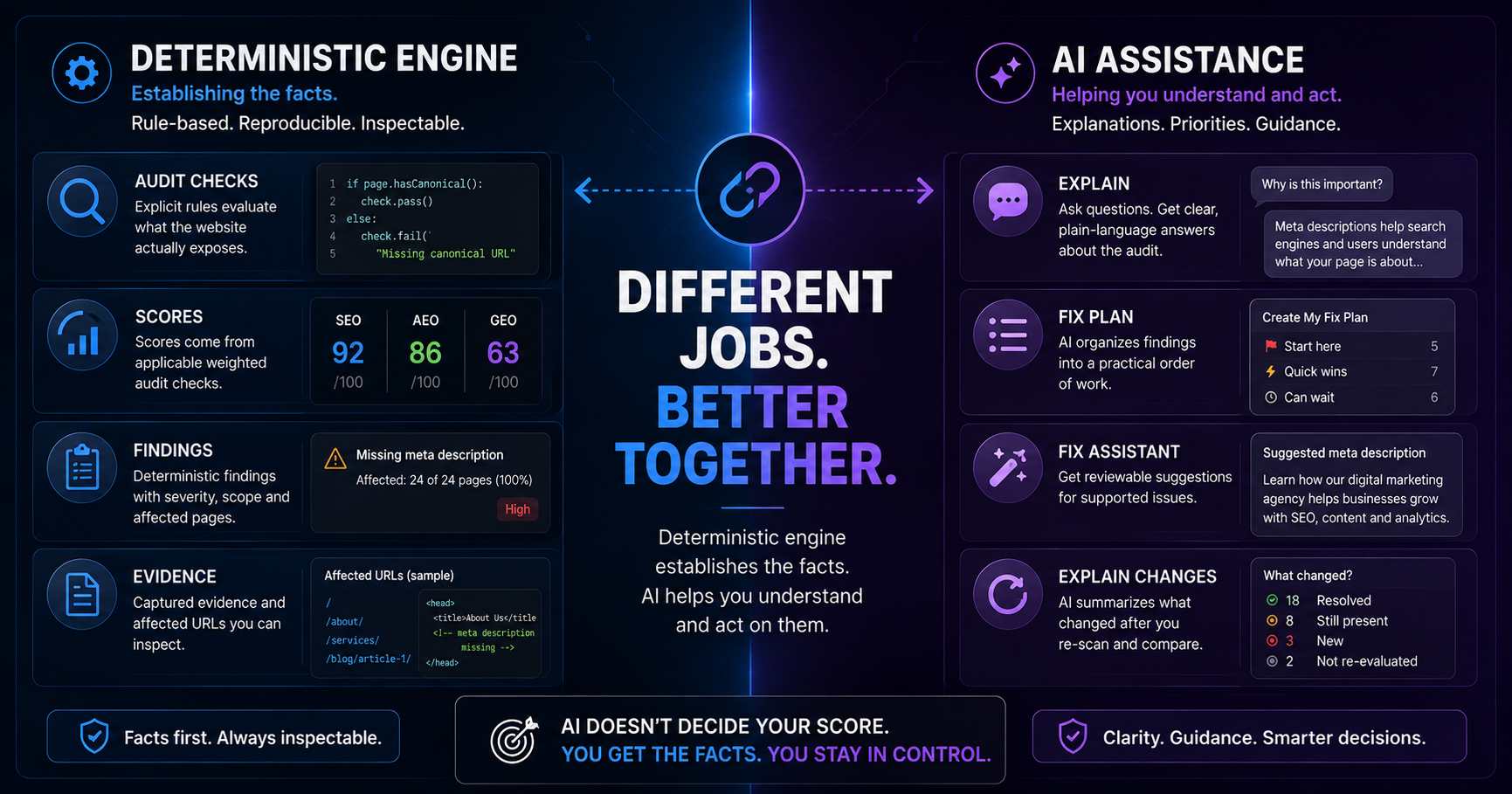
Why Fridica Uses AI - But Doesn’t Let AI Decide Your Score
AI can explain an audit, organize a fix plan and suggest what to do next. But should it decide whether your website passed or failed a technical check? Fridica deliberately keeps those two jobs separate.
Read guide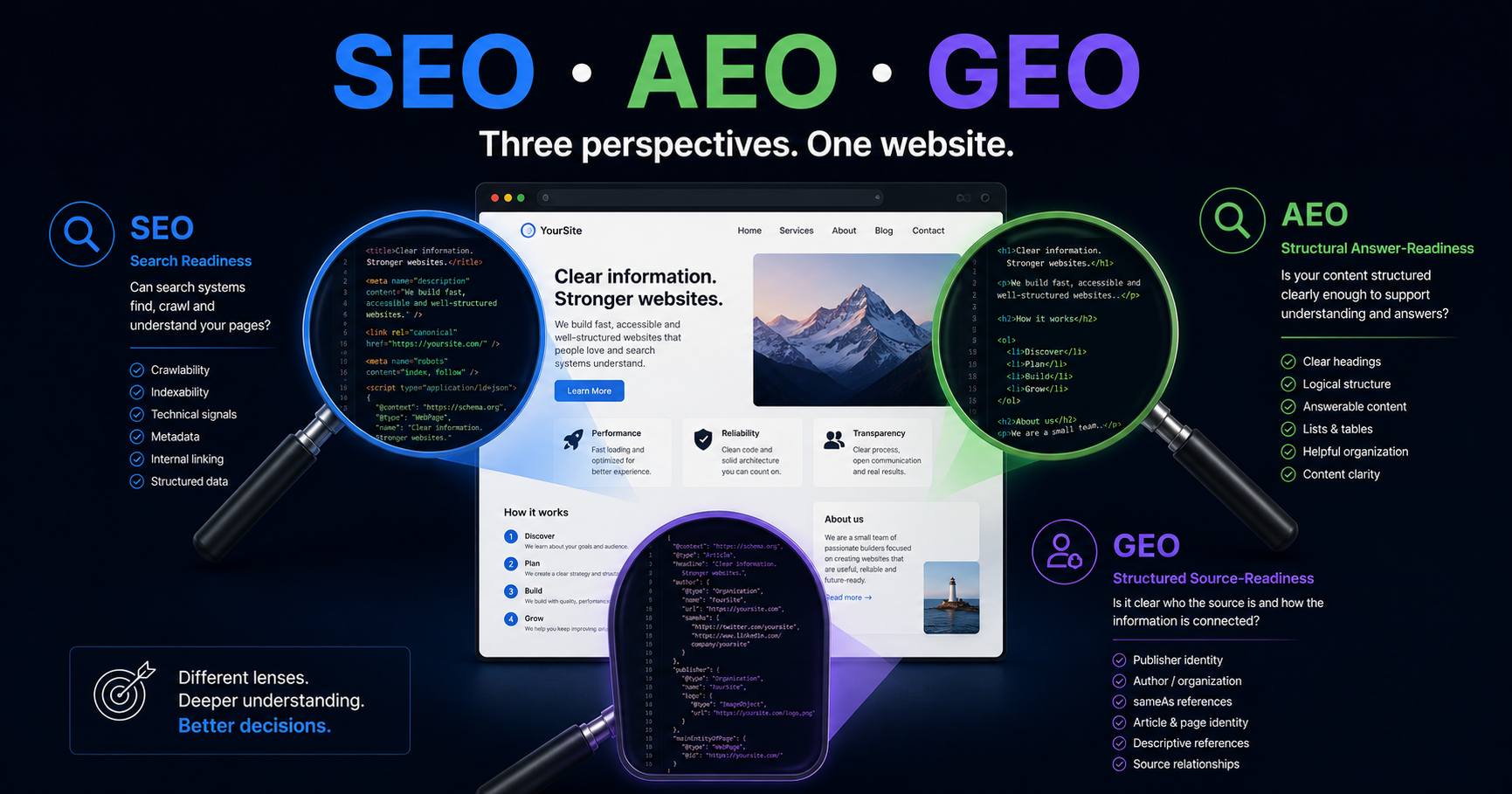
SEO vs AEO vs GEO: What Does Your Website Actually Need?
SEO, AEO and GEO are often presented as three competing strategies. They are not. Learn what each one actually describes, where they overlap, and why a website may need all three perspectives without chasing every new search acronym.
Read guide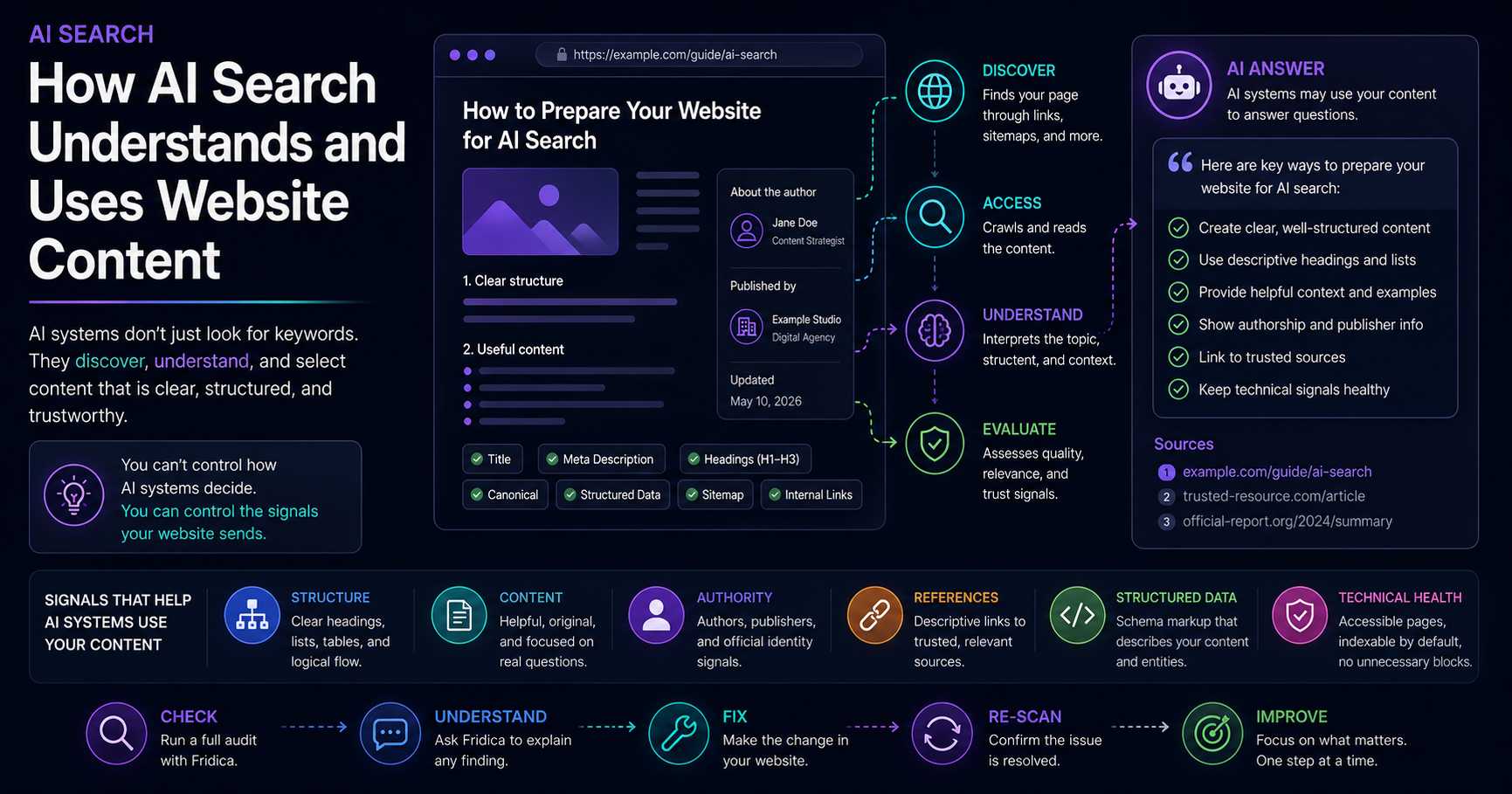
How AI Search Understands and Uses Website Content
Learn how AI-assisted search can discover, interpret, and use web content as a source — and how Fridica helps you improve the technical and structural signals you can actually control.
Read guidePut this into practice
See what applies to your page.
Start with a one-page review, then run a full site audit when you are ready.