
Guide · SEO
What Can You Learn From the First Page of Google?
The first page of Google can reveal much more than who currently ranks. It can help you understand search intent, dominant content formats, recurring topics, SERP features and where useful content opportunities may exist.
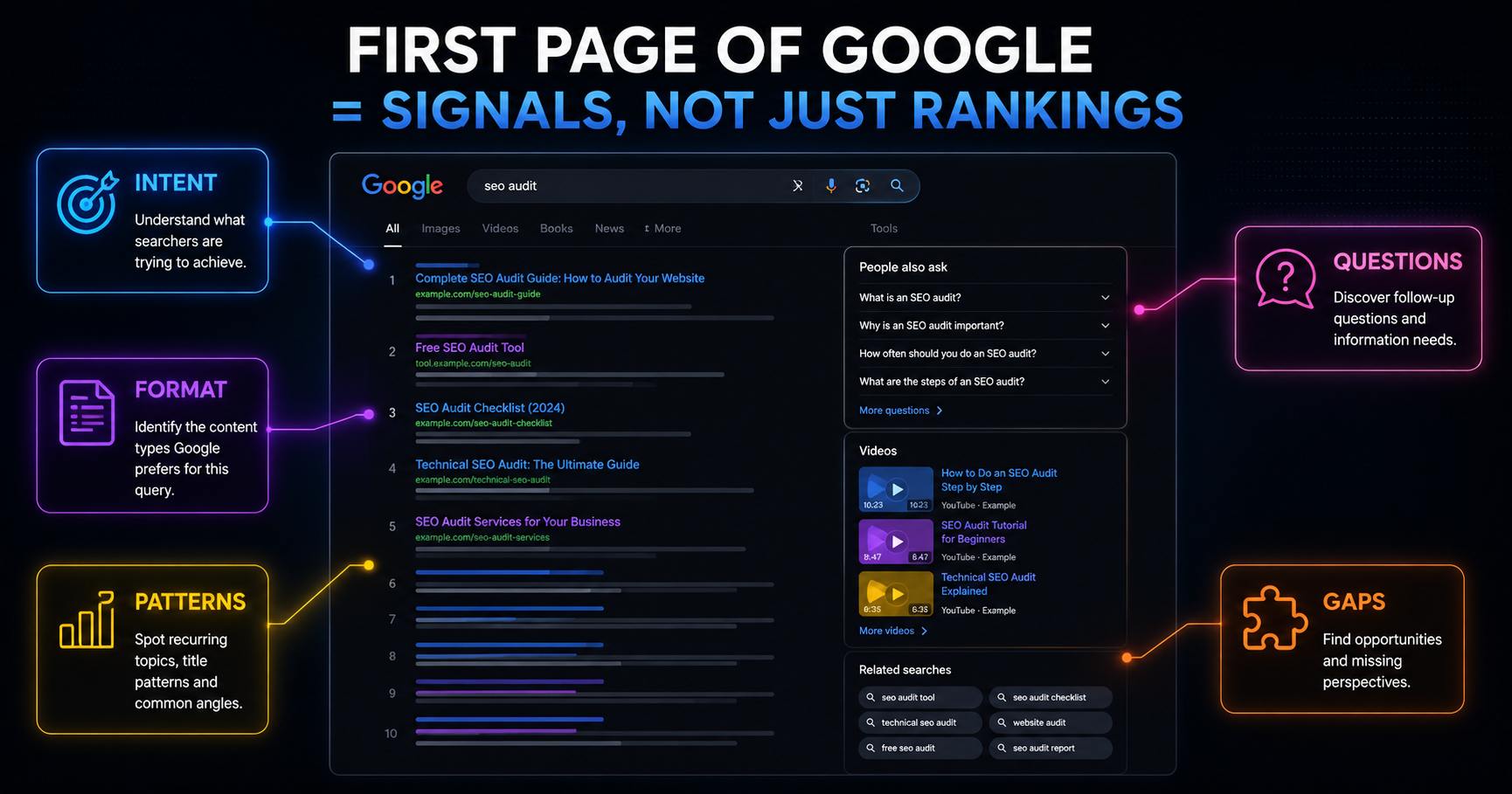
The first page of Google is not just a list of competitors.
It is research material.
Before creating an important page, the current search results can tell you a surprising amount about:
- what people may be trying to accomplish;
- which types of pages search engines currently prefer for the query;
- which topics repeatedly appear;
- which formats dominate;
- which questions surround the topic;
- and where there may still be room to create something more useful.
The important word is:
may.
A SERP is evidence.
It is not a perfect explanation of human behavior.
But if you know what to look for, the first page can help you make much better content decisions before you start writing.
The first page is a snapshot of current search intent
Search intent describes what someone is trying to accomplish with a query.
Sometimes the wording makes the intent obvious.
For example:
“how to create a sitemap”
strongly suggests informational intent.
But many searches are less clear.
Consider:
“SEO audit”
That could mean:
- an SEO audit tool;
- an SEO audit service;
- a checklist;
- a tutorial;
- a definition;
- or a downloadable report template.
The SERP helps show which of those interpretations appear strongest right now.
Start by looking at page types
Before reading individual articles, identify what kinds of pages are ranking.
Are the results mostly:
- blog posts;
- guides;
- product pages;
- category pages;
- service pages;
- comparison articles;
- reviews;
- documentation;
- tools;
- forums;
- videos;
- or local results?
The dominant page type is one of the clearest SERP signals.
If eight out of ten organic results are practical guides, that tells you something.
If the page is dominated by ecommerce categories, that tells you something else.
Content format can be as important as the topic
Two pages can cover the same topic but satisfy very different needs.
Imagine a search result page dominated by:
- “10 Best...” lists;
- comparison tables;
- reviews;
- and product recommendations.
That suggests people may be evaluating options.
A basic dictionary-style definition may technically discuss the same subject.
But it probably does not match the dominant experience in the SERP.
The first page therefore helps answer:
“What kind of content should this page probably be?”
Look for recurring title patterns
Titles are useful because they reveal how ranking pages frame the topic.
You may notice repeated patterns such as:
- How to...
- Best...
- X vs Y...
- Complete Guide...
- Checklist...
- Examples...
- Tools...
- Beginner's Guide...
Do not copy those titles.
Instead, ask what the pattern means.
If nearly every result uses a “how to” format, the searcher may want practical instruction.
If most results compare alternatives, the search is probably more commercial.
Patterns matter more than individual wording.
Recurring topics can reveal expected coverage
After identifying the result types, look at the content itself.
Which topics appear again and again?
Suppose you research:
“technical SEO audit.”
Ranking pages may repeatedly discuss:
- crawlability;
- indexing;
- robots.txt;
- XML sitemaps;
- canonical URLs;
- page speed;
- structured data;
- internal linking;
- mobile usability;
- and broken links.
That repeated coverage suggests these areas are part of the current search expectation around the topic.
It does not mean every article must contain the same sections.
It means those themes deserve consideration.
Do not mistake repetition for correctness
If ten pages repeat the same idea, that does not automatically make the idea correct.
Search results are not a peer-reviewed truth database.
Ranking pages can be:
- outdated;
- oversimplified;
- incorrect;
- commercially biased;
- or simply repeating each other.
Use the SERP to understand expectations and patterns.
Then use reliable expertise and sources to make the final content accurate.
Look for differences as well as similarities
The most useful opportunity is sometimes the thing that does not repeat.
Imagine every ranking article explains:
- what a canonical URL is;
- why duplicate content matters;
- and how to add a canonical tag.
But very few explain:
- what happens when canonicals conflict;
- how to verify implementation;
- common WordPress mistakes;
- or how canonicalization interacts with hreflang.
Those missing details may represent useful content opportunities.
The goal is not to find something competitors forgot merely for the sake of being different.
The gap should still help the reader.
Mixed SERPs reveal mixed intent
Some first pages are remarkably consistent.
Others look like several different searches collided.
You might see:
- three guides;
- two product pages;
- a comparison article;
- a forum;
- a video;
- and a tool.
That can be evidence of mixed intent.
The search engine may be trying to satisfy several possible needs because the query itself is ambiguous.
This does not mean your page should try to satisfy all of them.
It often means you need to choose one clear part of the intent.
Search features can reveal additional needs
The first page is more than the ten blue links.
Depending on the query, you may see:
- People Also Ask;
- featured snippets;
- video results;
- image results;
- local packs;
- shopping results;
- knowledge panels;
- related searches;
- AI Overview;
- or other search features.
Each one can add context.
For example, strong video visibility may suggest that demonstrating the topic is useful.
A large People Also Ask section may reveal several common follow-up questions.
A local pack can indicate strong local intent.
People Also Ask can reveal follow-up questions
When People Also Ask is present, it can be one of the most useful elements for content research.
Questions can help you understand:
- what beginners do not understand;
- which details people commonly explore next;
- which definitions need clarification;
- and which subtopics may deserve dedicated sections.
Some questions may fit naturally in the article body.
Others may work as FAQ content.
Some may deserve their own separate page.
If the feature is not present, do not invent questions and present them as Google evidence.
Related searches show how the topic expands
Related searches can reveal:
- more specific versions of the query;
- different audience segments;
- different intents;
- adjacent topics;
- and useful future content ideas.
They can also help you see when your original keyword is too broad.
For example:
“SEO tools”
may expand into:
- SEO audit tools;
- keyword research tools;
- rank tracking tools;
- SEO tools for small business;
- free SEO tools;
- or AI SEO tools.
Those are not necessarily keywords for one page.
They may represent several distinct content directions.
AI Overview can provide another clue
When an AI Overview appears, it adds another layer to the search experience.
You can examine:
- which aspects of the topic are summarized first;
- which concepts receive emphasis;
- which questions appear to be answered immediately;
- and what kind of background knowledge the answer assumes.
This can help you understand how the topic is currently being framed.
But it is not a guarantee that similar content will appear in an AI Overview.
Look at who is ranking
The domains on the first page can also tell you something about the environment.
Is the SERP dominated by:
- major publishers;
- large SaaS companies;
- official documentation;
- specialist blogs;
- forums;
- small niche websites;
- or local businesses?
This gives you context about the competitive landscape.
But be careful.
Seeing famous domains does not automatically mean:
“You cannot rank.”
And seeing smaller sites does not mean:
“This keyword is easy.”
Those conclusions require more evidence.
The first page does not give you a keyword difficulty score
You can observe competition.
You can observe strong brands.
You can observe content depth.
You can observe the kinds of pages ranking.
But the SERP itself does not provide an exact:
- keyword difficulty score;
- ranking probability;
- traffic forecast;
- or authority requirement.
Those are separate metrics or interpretations.
Do not turn visual observations into fake precision.
Check whether the SERP looks stable or diverse
Some queries are dominated by pages that have ranked for years.
Others change frequently.
You may not know the historical pattern without dedicated data.
But you can still observe diversity.
A first page with:
- many different page types;
- newer content;
- forums;
- videos;
- and specialist sites;
may represent a different environment from one dominated entirely by a small set of giant publishers.
Again, this is context.
Not a ranking guarantee.
Titles and descriptions can reveal how competitors position the answer
Look at how pages describe themselves in the SERP.
Do they emphasize:
- speed;
- simplicity;
- completeness;
- beginners;
- experts;
- free tools;
- templates;
- examples;
- or recent updates?
This can reveal the positioning currently competing for attention.
You may discover that every result promises:
“The Complete Guide.”
That could be a clue that a more practical, narrower or more specific angle might stand out.
Look for freshness signals carefully
Dates can matter for topics that change quickly.
For example:
- software comparisons;
- search features;
- AI tools;
- platform instructions;
- and current regulations.
If most ranking pages are recently updated, freshness may matter for the topic.
But do not update the year in your title just to make old content look new.
Real freshness means:
- checking facts;
- updating examples;
- reviewing screenshots;
- removing obsolete advice;
- and reflecting current search conditions.
Forums can reveal where polished articles fail
When Reddit, Quora, Stack Exchange or specialist forums appear, pay attention.
Users often go to community discussions when they want:
- real experiences;
- practical troubleshooting;
- unfiltered opinions;
- edge cases;
- or answers that polished marketing pages do not provide.
A forum result can therefore be evidence of unmet content needs.
It may tell you that people want more practical or experience-based answers.
Videos can reveal when demonstration matters
Some problems are much easier to show than describe.
If video results are prominent, ask why.
Maybe the query involves:
- a software workflow;
- a physical process;
- a visual comparison;
- a setup tutorial;
- or a step-by-step demonstration.
That does not mean every page needs a video.
But it can reveal the kind of experience searchers find useful.
Do not copy the first page
SERP research can easily become competitor imitation.
You examine five pages.
You collect all their headings.
You combine them.
You create:
“The Ultimate Complete Definitive Comprehensive Guide.”
That is not research.
That is aggregation.
The SERP should help you understand:
- what people expect;
- what is commonly covered;
- which formats are dominant;
- where intent changes;
- which questions appear;
- and what could be improved.
Then you still need to make editorial decisions.
A good question: what deserves to be better?
After reviewing the first page, ask:
“What could genuinely be more useful here?”
Maybe the existing results:
- use too much jargon;
- lack examples;
- skip important steps;
- are outdated;
- focus only on large companies;
- ignore beginners;
- ignore advanced users;
- lack verification steps;
- or answer the question only partially.
Those observations can help shape your angle.
The first page can help you decide not to create a page
SERP research does not always end with:
“Great, let's write the article.”
Sometimes the evidence tells you:
- the intent is wrong for your site;
- the topic is too broad;
- the query deserves a tool rather than an article;
- the idea belongs inside an existing page;
- or another keyword would be a better fit.
That can save hours of unnecessary work.
Use the first page to improve existing content too
SERP analysis is not only useful before publishing.
It can help with existing pages.
Suppose your article used to perform well but now feels outdated.
Compare it with the current first page.
Ask:
- Has the dominant intent changed?
- Are different page types ranking?
- Have new subtopics appeared?
- Are there new search features?
- Are users asking different questions?
- Does your page still match the current landscape?
This can reveal whether the problem is:
- content depth;
- intent mismatch;
- outdated information;
- poor structure;
- or something else entirely.
One SERP is not permanent truth
Search results change.
A query that is mostly informational today may become more commercial.
New products can change the landscape.
New terminology can emerge.
AI-generated search experiences can change how information is presented.
That is why SERP research should be understood as:
a current snapshot.
Useful.
Evidence-based.
But not permanent.
Country and language matter
The first page of Google is not identical everywhere.
The same keyword can produce different results depending on:
- country;
- language;
- local competition;
- available products;
- local brands;
- and regional search behavior.
That is why content research should match the market you actually want to reach.
Where Fridica fits
Fridica's Keyword & Topic Assistant uses real search evidence to help analyze the current search landscape around a topic.
Depending on what is returned, the evidence can include:
- organic results;
- related searches;
- questions when present;
- featured search elements when present;
- and AI Overview when available.
Fridica then keeps that evidence separate from interpretation.
The analysis can help summarize:
- likely search intent;
- dominant result formats;
- SERP patterns;
- topic opportunities;
- content gaps;
- questions worth answering;
- and possible content angles.
The principle is simple:
first understand what is actually in search;
then decide what to do with it.
What Fridica does not infer from the first page
Seeing the first page does not give Fridica permission to invent:
- search volume;
- keyword difficulty;
- CPC;
- traffic estimates;
- or ranking probability.
Those metrics require appropriate verified data sources.
Search evidence should stay search evidence.
Analysis should stay analysis.
A practical first-page research checklist
When you research an important query, review the SERP in this order:
- Identify the dominant search intent.
- Note the main page types.
- Look for repeated content formats.
- Review title patterns.
- Identify recurring topics.
- Look for important differences and gaps.
- Review People Also Ask when present.
- Review related searches.
- Notice featured search elements.
- Look at which types of domains are ranking.
- Check whether the SERP appears mixed or consistent.
- Ask whether your intended page belongs in that landscape.
- Choose a useful angle instead of copying competitors.
The short version
The first page of Google can tell you much more than:
“These are my competitors.”
It can help reveal:
- search intent;
- page types;
- content formats;
- recurring topics;
- questions;
- related searches;
- search features;
- content gaps;
- and useful opportunities.
But the SERP does not tell you everything.
It does not give you guaranteed rankings.
It does not prove exact keyword difficulty.
And it does not mean you should copy whatever already ranks.
The first page is not a template. It is evidence that helps you make a better decision about what deserves to be created.
In the next article in this series, we will look at keyword difficulty — what the number can tell you, what it cannot tell you, and why a single SEO score should never make the entire content decision.
Keep learning
Related SEO guides
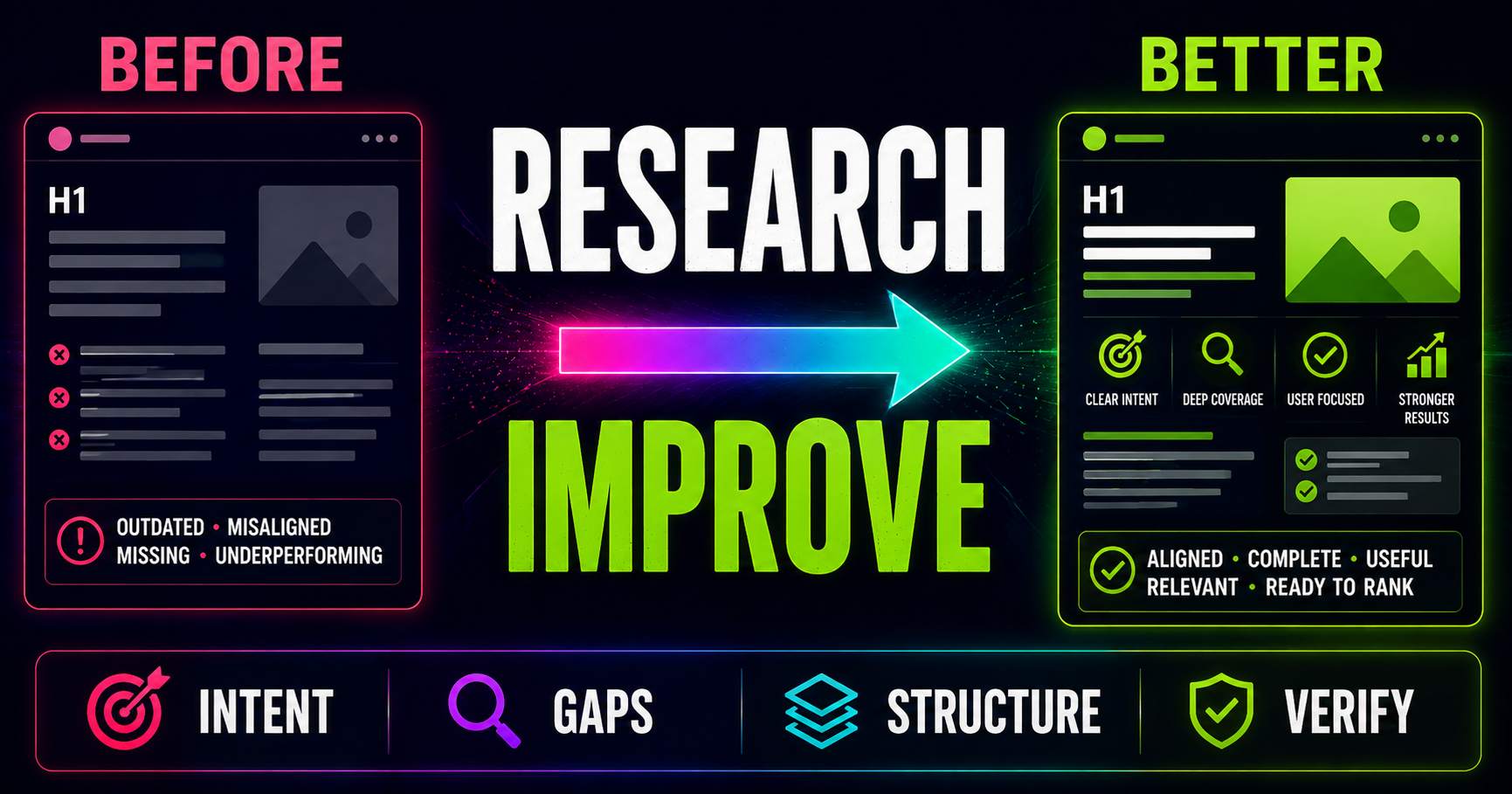
Keyword Research for Existing Pages: What Should You Improve?
Keyword research is not only for new content. Learn how to compare an existing page with current search intent, SERP patterns, related questions and content gaps to decide what actually needs improving.
Read guide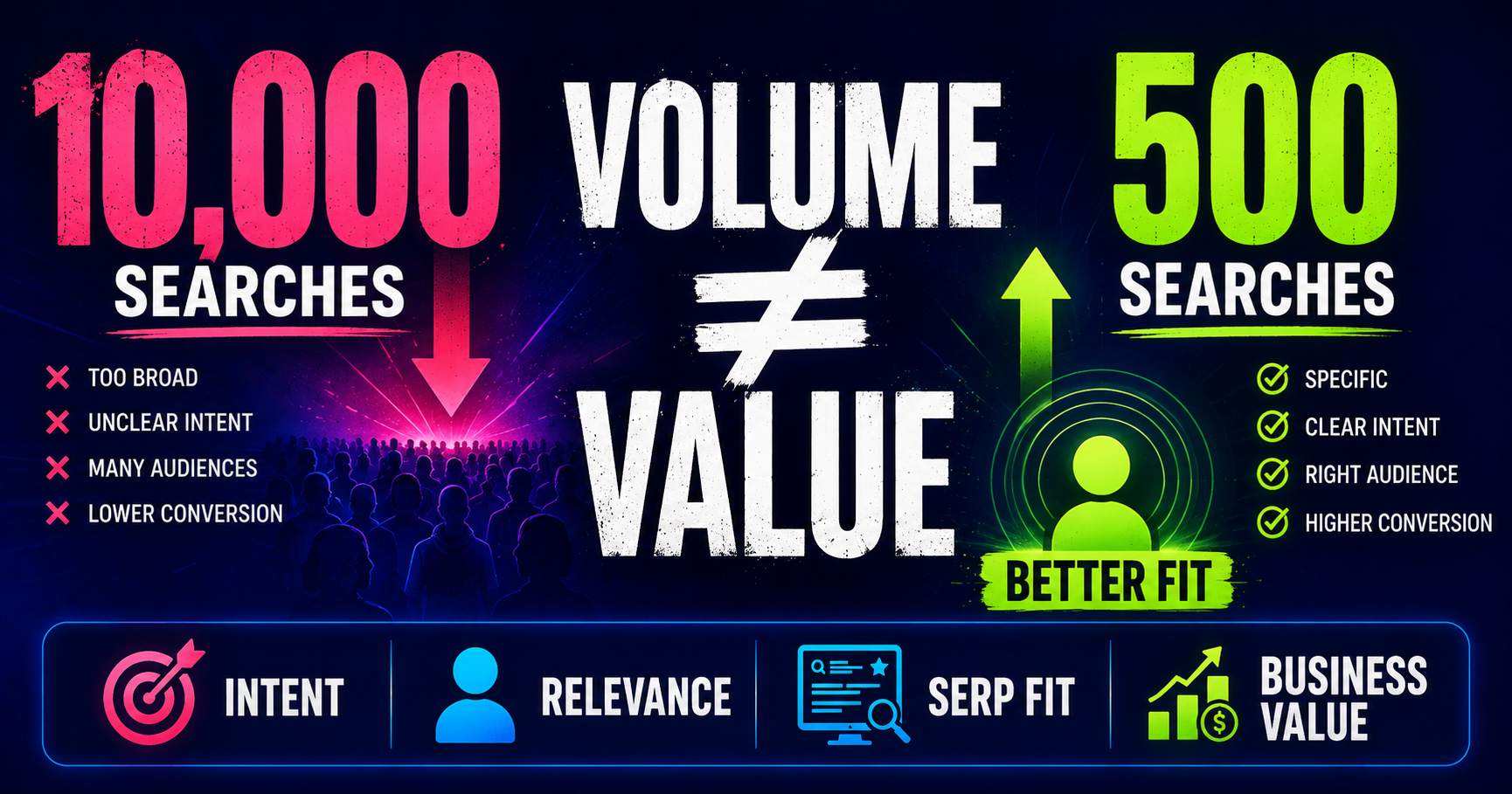
Search Volume Isn’t the Whole Story
Search volume can help you understand demand, but a bigger number does not automatically mean a better keyword. Learn how relevance, intent, specificity, SERP context and business value change the decision.
Read guide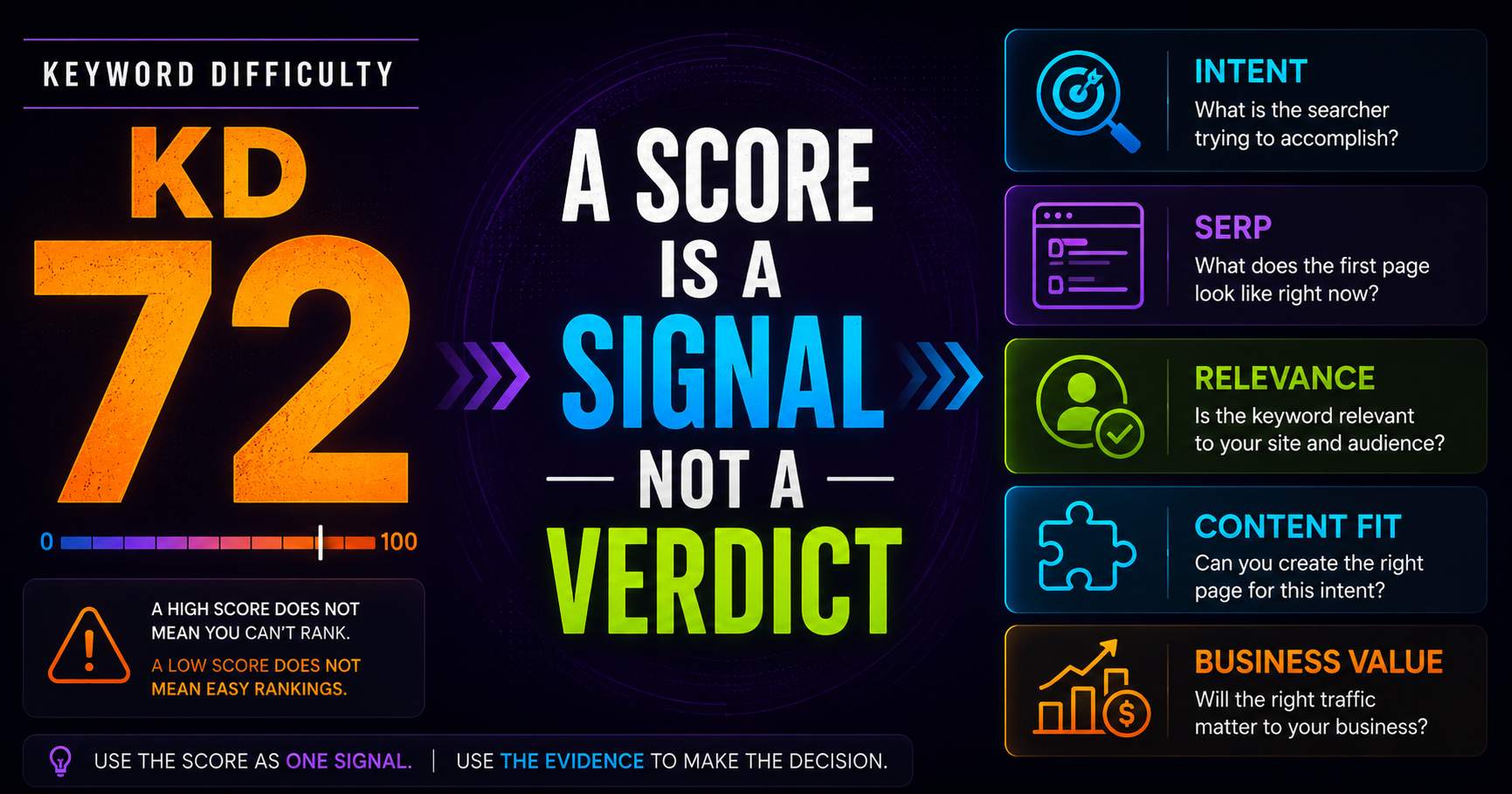
Keyword Difficulty: What the Number Does - and Doesn’t - Tell You
Keyword difficulty can be a useful comparison metric, but it is not a prediction of whether your page can rank. Learn what the score represents, what it leaves out, and how to use it alongside real SERP evidence.
Read guidePut this into practice
See what applies to your page.
Start with a one-page review, then run a full site audit when you are ready.