
Guide · SEO
Keyword Difficulty: What the Number Does - and Doesn’t - Tell You
Keyword difficulty can be a useful comparison metric, but it is not a prediction of whether your page can rank. Learn what the score represents, what it leaves out, and how to use it alongside real SERP evidence.
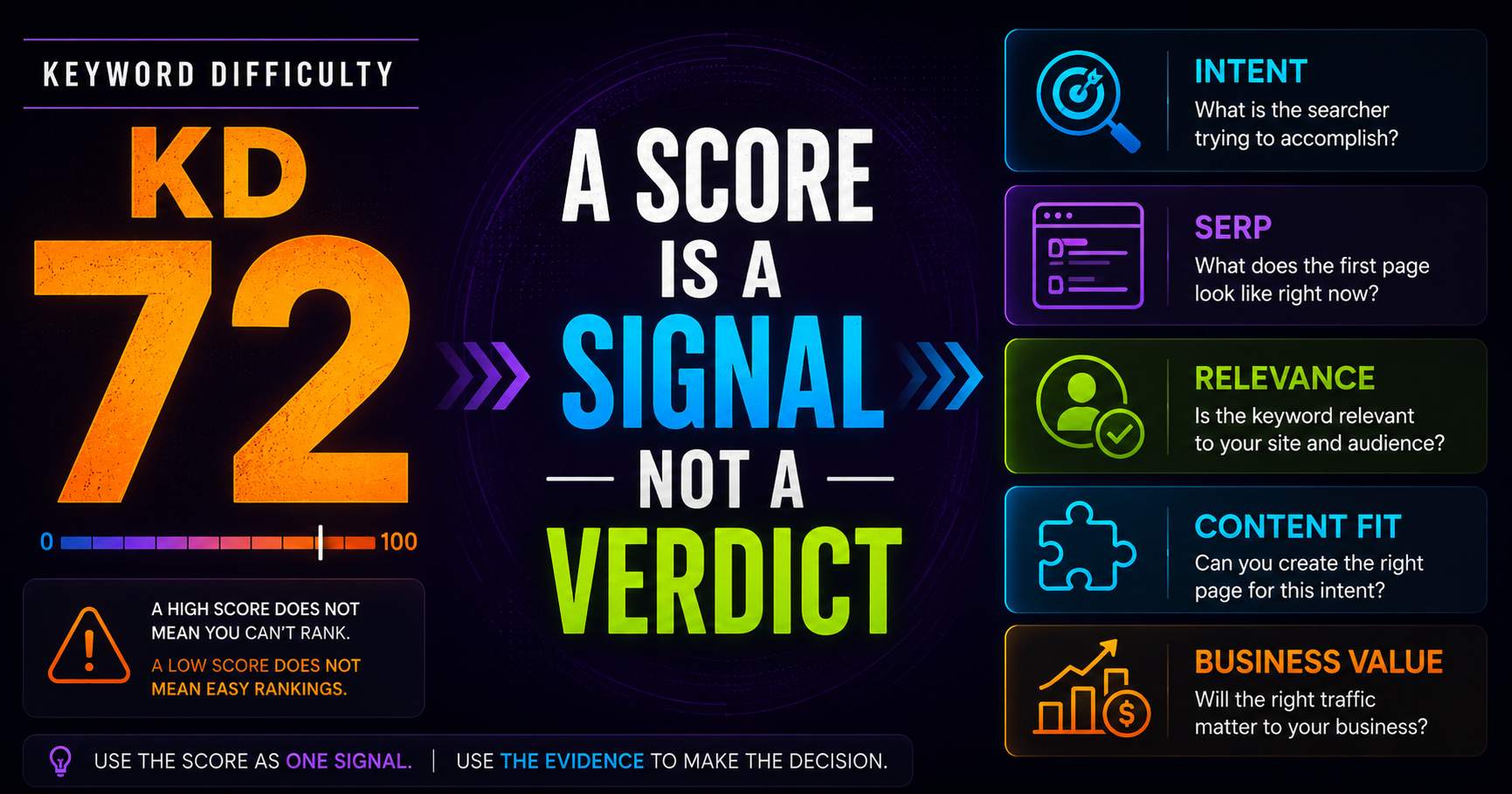
You enter a keyword into an SEO tool.
A number appears:
72.
Or:
34.
Or perhaps:
“Hard.”
It looks precise.
It looks objective.
And it is very tempting to treat it as a decision:
“High difficulty. Do not target.”
or:
“Low difficulty. Easy ranking.”
That is where keyword difficulty becomes dangerous.
The metric can be useful.
But it tells you much less than the number sometimes appears to promise.
What is keyword difficulty?
Keyword difficulty is a third-party SEO metric intended to estimate how competitive a keyword may be.
It is usually presented as:
- a numeric score;
- a percentage;
- or a label such as easy, medium or hard.
Different SEO platforms calculate keyword difficulty differently.
There is no universal keyword difficulty score shared across the SEO industry.
A keyword rated:
45
in one tool does not necessarily mean the same thing as:
45
in another.
Keyword difficulty is not a Google metric
This distinction matters.
Google does not publish a public SEO metric called:
Keyword Difficulty.
The number you see in an SEO platform is created by that platform.
The provider uses its own data, methodology and assumptions to estimate competition.
That does not make the metric useless.
It simply means you should understand what kind of number you are looking at.
It is an estimate.
Not a ranking rule.
Different tools can give different difficulty scores
If you check the same keyword in several SEO tools, you may see different results.
That is normal.
Each platform may use a different combination of signals.
Depending on the provider, the calculation may consider factors such as:
- the strength of ranking domains;
- link profiles;
- page-level authority signals;
- the competitive composition of the SERP;
- proprietary authority metrics;
- and other internal data.
The exact methodology varies.
This is one reason keyword difficulty should be most useful as:
a relative metric inside the same data source.
Comparing 20 keywords inside one tool can be useful.
Comparing a difficulty score from one tool with a score from another can be much less meaningful.
What can keyword difficulty tell you?
Used carefully, keyword difficulty can help answer:
“How competitive does this query appear compared with the other keywords I am researching?”
That can be helpful when:
- prioritizing a large keyword list;
- comparing related topics;
- identifying obviously competitive queries;
- finding potentially more accessible variations;
- and deciding where deeper SERP research may be necessary.
It can save time.
But it should usually be the beginning of the analysis rather than the end.
What keyword difficulty cannot tell you
A keyword difficulty score cannot reliably answer:
“Will my page rank?”
That question depends on much more than one number.
The score does not fully understand:
- your website;
- your expertise;
- your existing topical authority;
- your internal linking;
- the quality of the page you will create;
- the exact search intent;
- your brand;
- your audience;
- your distribution channels;
- or how the SERP may change after publication.
That is why:
difficulty is not probability.
A score cannot understand your content idea
Imagine two websites targeting the same keyword.
The first publishes:
a generic summary assembled from existing articles.
The second publishes:
- original research;
- real screenshots;
- practical examples;
- expert commentary;
- clear explanations;
- and a workflow that solves the searcher's problem better.
Both websites see the same keyword difficulty score.
But they are not creating the same page.
The metric cannot know what you are about to produce.
A high difficulty score does not mean “do not write this”
This is one of the most common mistakes.
Suppose a keyword is highly competitive.
That may still be the right topic for your website.
Why?
Because the page may be important for:
- your audience;
- your product;
- your services;
- your topical coverage;
- internal linking;
- brand education;
- or long-term content strategy.
Not every page exists only because it has the easiest possible keyword.
Sometimes a difficult topic is simply a topic your website needs to cover well.
A low difficulty score does not mean “easy ranking”
The opposite mistake is equally common.
You see:
Keyword Difficulty: 12.
It looks like an opportunity.
But the query may have:
- an intent your page cannot satisfy;
- very little relevance to your business;
- a SERP dominated by a page format you cannot create;
- almost no useful demand;
- or search results that are difficult for reasons the score does not fully capture.
Low difficulty is not a guarantee.
It is a signal worth investigating.
Always check the real SERP
A difficulty score summarizes competition.
The SERP shows you what that competition actually looks like.
That difference matters.
For an important keyword, inspect the first page yourself.
Look at:
- which domains rank;
- what types of pages rank;
- how closely they match the intent;
- how detailed the content is;
- whether tools or interactive features dominate;
- whether forums appear;
- whether small specialist sites appear;
- and whether the results are consistent or mixed.
The number gives you compression.
The SERP gives you context.
Two keywords with the same score can be very different
Imagine two keywords both rated:
50.
The first SERP contains:
- large global brands;
- deeply established product pages;
- strong commercial intent;
- and highly optimized comparison pages.
The second contains:
- several specialist blogs;
- a forum discussion;
- older content;
- mixed search intent;
- and obvious unanswered questions.
The score may look identical.
The content opportunity does not.
Search intent can matter more than difficulty
Suppose you want to write an informational guide.
You find a keyword with low difficulty.
But the SERP is dominated by:
- product pages;
- pricing pages;
- software tools;
- and signup pages.
The keyword may be “easy” according to one metric.
Your planned page still may not belong there.
Now imagine a higher-difficulty keyword where the SERP is dominated by high-quality educational guides.
If your site has genuine expertise in the topic, that query may actually be the more logical content target.
Difficulty should never replace intent analysis.
Page format can change the real challenge
A query can appear difficult because the results are not just articles.
They may include:
- interactive tools;
- calculators;
- product databases;
- maps;
- comparison interfaces;
- or large user-generated communities.
If the searcher expects to perform an action, publishing another article may not be enough.
The challenge is not simply:
“Write better SEO content.”
The challenge may be:
“Create the right experience.”
Keyword difficulty does not measure business value
A keyword can be extremely difficult and still be highly valuable to your business.
Another can be easy and almost worthless.
Imagine two queries:
“website”
and:
“technical SEO audit for ecommerce website.”
The broader query may have far more demand.
But the narrower query may be dramatically more relevant to a specialist SEO service.
Difficulty does not know which visitor matters to you.
Difficulty does not tell you whether the keyword fits your site
A website should not chase unrelated low-difficulty keywords simply because they appear attainable.
Ask:
- Does this topic fit our expertise?
- Does it support our site's purpose?
- Does the audience matter to us?
- Can we answer the query credibly?
- Does it strengthen the topics we want to be known for?
If the answer is no, a low difficulty score does not make the keyword strategically good.
Authority is not one universal number either
Keyword difficulty tools often rely partly on proprietary authority metrics.
Those metrics can be useful for comparison.
But they are not Google's public ranking scores.
This is worth remembering because SEO dashboards can create layers of numbers:
- domain authority;
- page authority;
- domain rating;
- keyword difficulty;
- competition scores;
- and various proprietary indexes.
Those numbers may help organize research.
They should not be mistaken for a direct view into Google's ranking system.
Difficulty can be useful for prioritization
Now for the part where the metric genuinely helps.
Suppose you have 200 relevant keyword ideas.
You cannot deeply analyze every SERP immediately.
A consistent difficulty metric can help you segment the list.
You might identify:
- highly competitive head terms;
- medium-difficulty supporting topics;
- specific lower-competition queries;
- and groups that deserve manual review.
That can make research faster.
The mistake happens when prioritization becomes automatic rejection.
Use difficulty to compare, not to obey
A useful mindset is:
“This keyword looks more competitive than these alternatives.”
Not:
“The tool says 63, therefore we cannot rank.”
The first statement uses the metric as evidence.
The second turns an estimate into a verdict.
Look for lower-difficulty variations carefully
Keyword tools often help you discover narrower related queries with lower competition.
That can be useful.
For example:
“SEO audit”
may be highly competitive.
A more specific query might be:
“SEO audit checklist for small business.”
But do not choose the variation only because its score is lower.
Also check:
- whether the query is genuinely different;
- whether the intent matches;
- whether the audience matters;
- whether the SERP supports the page you want to create;
- and whether it deserves its own page.
Do not create dozens of pages just to chase easier variants
Low difficulty can encourage unnecessary content fragmentation.
You discover:
- SEO audit checklist;
- SEO checklist audit;
- website SEO audit checklist;
- technical SEO checklist;
- SEO website checklist.
If those queries share the same intent and similar SERPs, you may not need five pages.
You may need one strong page.
Use SERP overlap and intent to decide whether topics belong together.
Keyword difficulty can change
Competition is not static.
A query can become more competitive when:
- new companies enter the market;
- large publishers target the topic;
- new products appear;
- search behavior grows;
- or the SERP changes format.
The reverse can happen too.
A difficulty score is therefore a snapshot based on the provider's current data.
It is not a permanent characteristic of the keyword.
Difficulty can differ by country and market
Search competition is not identical everywhere.
A query may be extremely competitive in one market and much less developed in another.
That is why keyword research should match:
- the country;
- the language;
- the audience;
- and the market you actually want to reach.
A global score without market context can hide important differences.
What should you check alongside keyword difficulty?
For an important keyword, do not look at difficulty in isolation.
Combine it with:
- Relevance: Does this topic matter to your audience and website?
- Search intent: What is the searcher actually trying to accomplish?
- SERP composition: What page types and formats currently rank?
- Content quality: What would you need to create to genuinely compete?
- Topic fit: Does the query belong within your wider content strategy?
- Business value: Would the right visitor matter to you?
- Search demand: Is there enough interest to support the effort when reliable data is available?
Together these signals provide much more useful context than difficulty alone.
A practical decision example
Imagine you are choosing between three keywords:
Keyword A
- very high difficulty;
- high relevance;
- strong informational intent;
- directly connected to your main product.
Keyword B
- medium difficulty;
- good relevance;
- clear intent;
- strong fit with your existing content.
Keyword C
- very low difficulty;
- weak relevance;
- unclear business value;
- barely connected to your site.
If you choose only by difficulty:
Keyword C wins.
Strategically, it may be the worst option.
Keyword B might be the best near-term opportunity.
Keyword A might still deserve content because it is strategically important.
That is why one number cannot make the entire decision.
What if you do not have keyword difficulty data?
You can still perform meaningful keyword research.
You can inspect:
- the real SERP;
- ranking page types;
- search intent;
- dominant formats;
- the types of domains appearing;
- related searches;
- questions;
- content gaps;
- and whether your page genuinely belongs in the search landscape.
You will not have a quantitative difficulty score.
That is fine.
What you should not do is invent one.
Where Fridica fits
Fridica's Keyword & Topic Assistant currently focuses on real search evidence and structured interpretation.
It can work with evidence such as:
- organic search results;
- related searches;
- questions when present;
- featured search elements when present;
- and AI Overview when available.
That evidence can help Fridica interpret:
- likely search intent;
- SERP patterns;
- dominant formats;
- topic opportunities;
- content gaps;
- questions worth answering;
- and possible content angles.
But Fridica does not currently fabricate a keyword difficulty score from those observations.
If a verified difficulty metric is not supplied by an appropriate external data source, the correct value is:
unknown.
Not:
“AI estimates 37.”
Why Fridica keeps difficulty separate from SERP analysis
You can look at the first page and say:
“This SERP contains several strong brands and highly developed guides.”
That is an observation.
You cannot honestly turn that observation into:
“Keyword Difficulty: 68.”
without a defined data source and methodology.
The distinction fits Fridica's larger principle:
Evidence tells us what we observed.
Analysis helps us interpret it.
Missing metrics remain missing.
Do you need keyword difficulty to choose a keyword?
Not always.
It is useful when available from a trusted source.
But you can make many good content decisions without it.
You can still understand:
- what the query means;
- who it is for;
- what the searcher expects;
- what currently ranks;
- whether your planned page fits;
- and whether the topic matters to your site.
Those are fundamental decisions.
A score can support them.
It cannot replace them.
A practical keyword difficulty checklist
When a keyword tool gives you a difficulty score, ask:
- Which tool produced this score?
- Am I comparing it with keywords from the same data source?
- Is the keyword actually relevant to my website?
- What is the likely search intent?
- What does the real SERP look like?
- Which page formats dominate?
- Does my intended page belong there?
- Can I create something genuinely useful?
- Does the topic have strategic or business value?
- Am I treating the score as evidence or as a verdict?
That last question is the most important one.
The short version
Keyword difficulty can be useful.
It can help you compare competition and prioritize research.
But it does not tell you:
- whether your page will rank;
- whether the topic is right for your site;
- whether the search intent matches your page;
- whether you can create something better;
- or whether the traffic would matter to your business.
Different tools can also calculate difficulty differently.
So use the metric for context.
Then inspect the real SERP.
Understand the intent.
Evaluate the content opportunity.
And make the final decision yourself.
Keyword difficulty can tell you that a search looks competitive. It cannot tell you whether your content deserves to compete.
In the next article in this series, we will look at search volume — why demand matters, why bigger is not always better, and why a high-volume keyword can still be the wrong content opportunity.
Keep learning
Related SEO guides
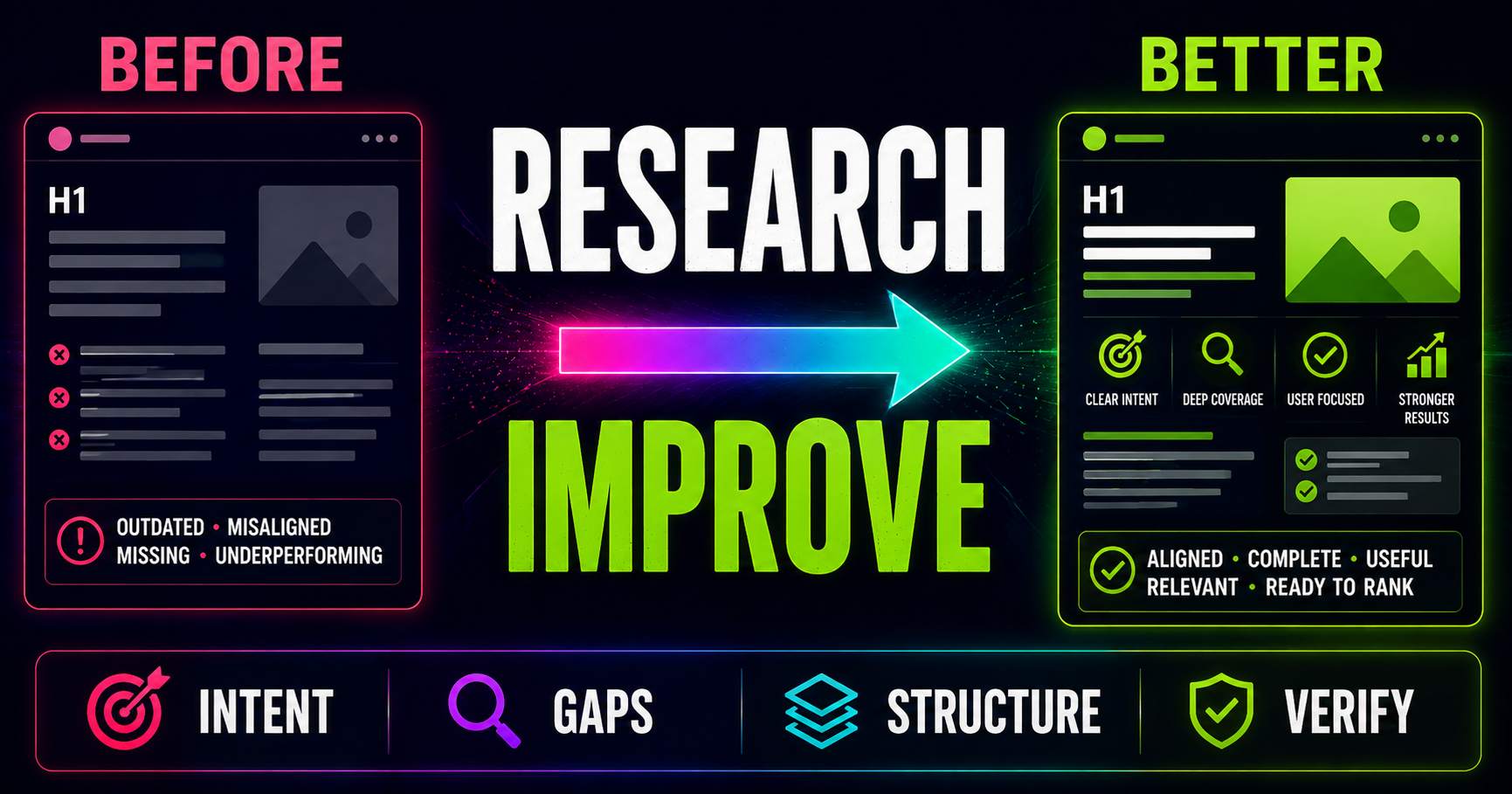
Keyword Research for Existing Pages: What Should You Improve?
Keyword research is not only for new content. Learn how to compare an existing page with current search intent, SERP patterns, related questions and content gaps to decide what actually needs improving.
Read guide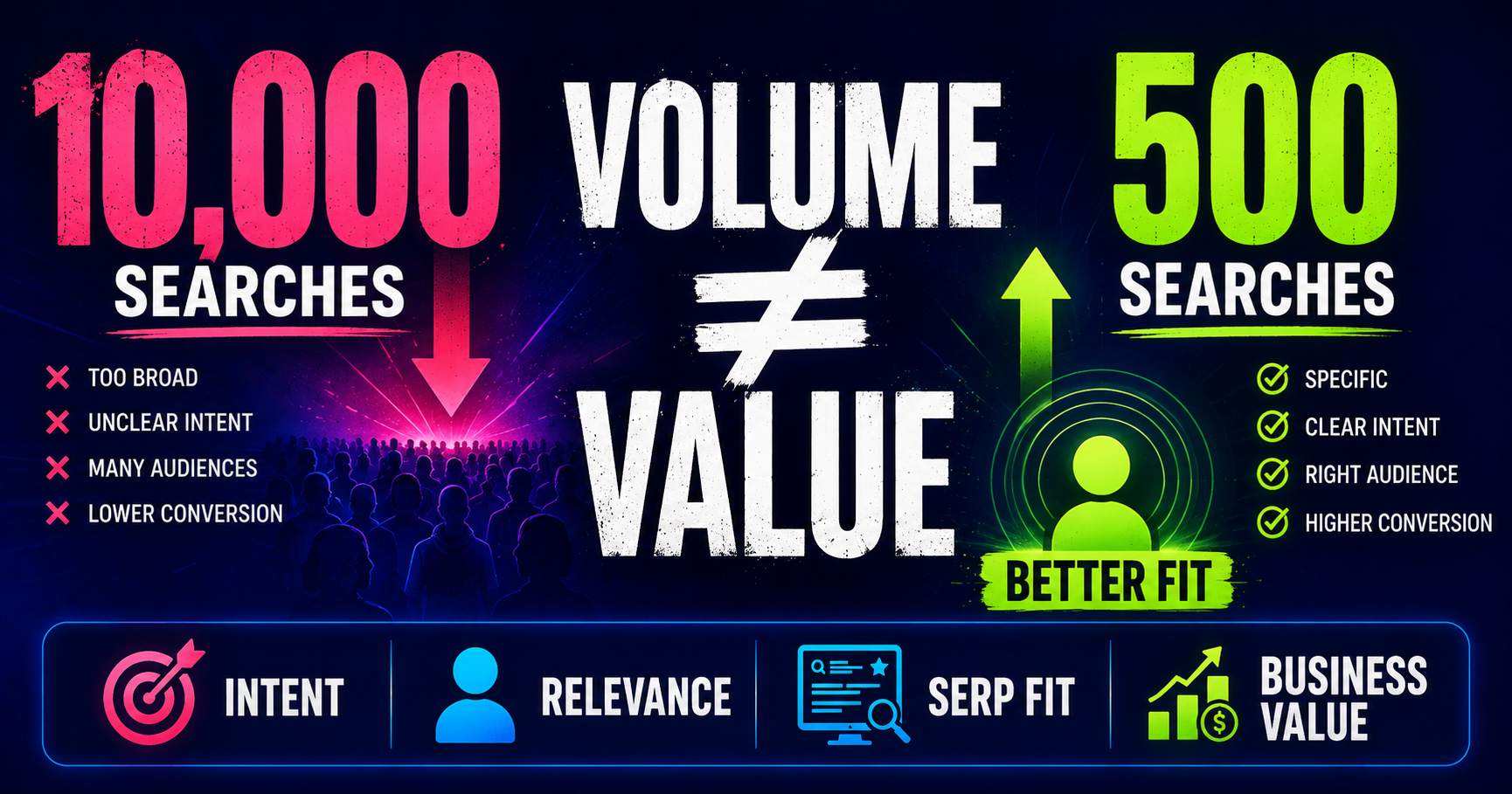
Search Volume Isn’t the Whole Story
Search volume can help you understand demand, but a bigger number does not automatically mean a better keyword. Learn how relevance, intent, specificity, SERP context and business value change the decision.
Read guide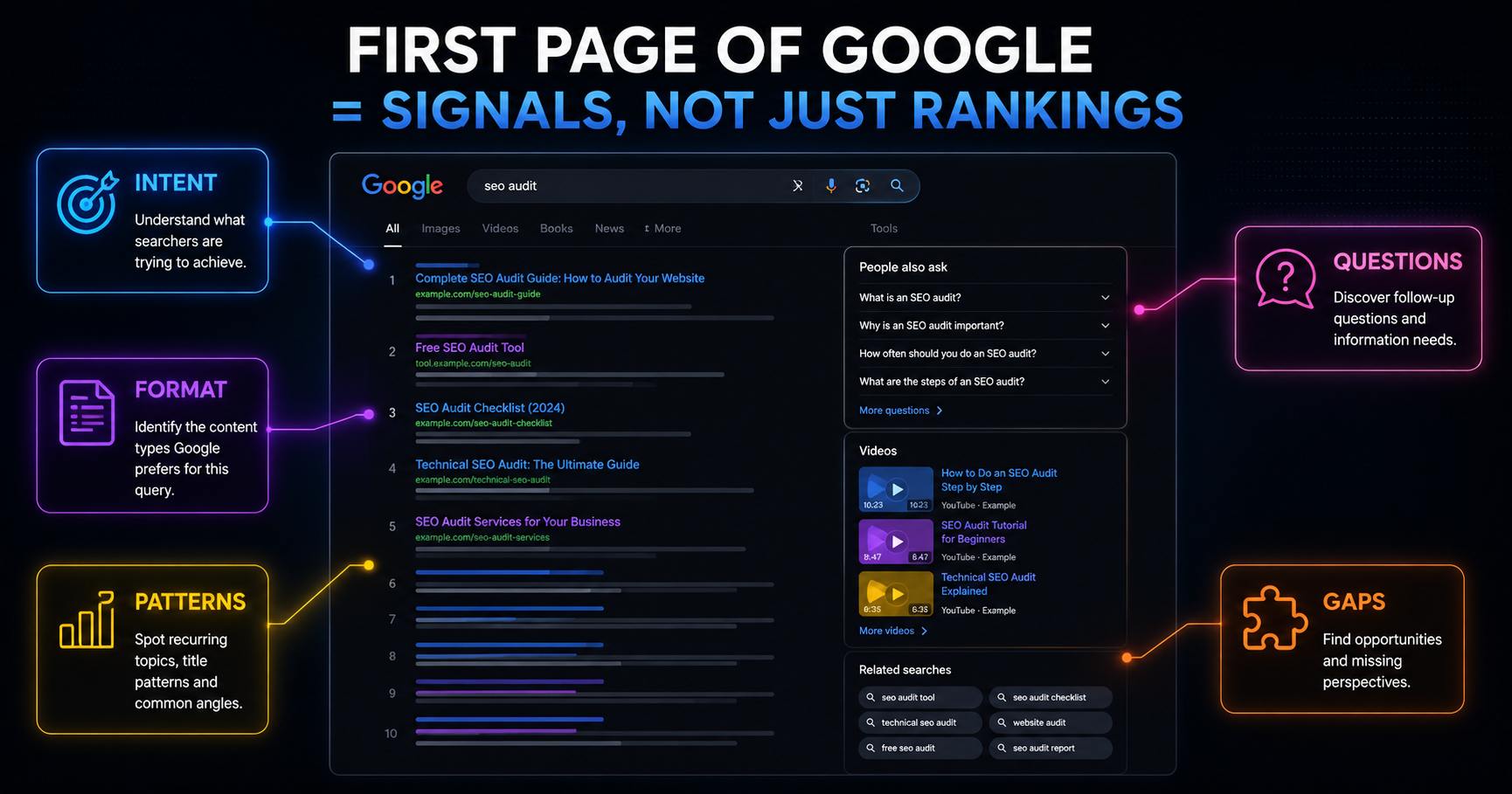
What Can You Learn From the First Page of Google?
The first page of Google can reveal much more than who currently ranks. It can help you understand search intent, dominant content formats, recurring topics, SERP features and where useful content opportunities may exist.
Read guidePut this into practice
See what applies to your page.
Start with a one-page review, then run a full site audit when you are ready.