
Guide · SEO
Search Intent Explained: What Is Someone Actually Looking For?
Search intent explains what someone is really trying to achieve when they type a query into a search engine. Understanding that intent helps you create content that answers the right question in the right format.
Two people can type only a few words into Google and expect completely different things.
Someone searching for:
“project management software”
might want to compare tools before making a decision.
Someone searching for:
“how to manage a project”
is probably looking for guidance.
And someone searching for:
“Trello login”
already knows exactly where they want to go.
The words people type into a search engine matter, but the reason behind those words matters even more.
That reason is called search intent.
Understanding search intent helps you move beyond simply choosing keywords. It helps you understand what people actually want, what kind of answer they expect, and what type of content is most likely to satisfy their search.
What is search intent?
Search intent is the goal behind a search query.
It answers a simple question:
What is this person trying to accomplish?
A searcher may want to:
- learn something,
- find a particular website,
- compare different options,
- buy a product,
- hire a service,
- solve a problem,
- find a definition,
- follow instructions,
- or get a quick answer.
The exact words in the query provide clues, but they do not always tell the whole story.
This is why keyword research should not stop with the keyword itself.
You also need to understand the search landscape around it.
Why does search intent matter for SEO?
Imagine writing an excellent 3,000-word educational guide for a query where almost every top search result is a product category page.
Your article could be accurate, useful and well written.
But it might still be the wrong type of page for that search.
The problem is not necessarily content quality.
The problem may be intent mismatch.
Search engines try to present results that are useful for what people appear to want. The pages already appearing prominently in search results can therefore provide valuable evidence about the likely intent behind a query.
If most results are tutorials, that tells you something.
If most are product pages, that tells you something different.
If the results contain comparison articles, videos, forums and product pages at the same time, the intent may be mixed.
Understanding this before creating content can save a lot of unnecessary work.
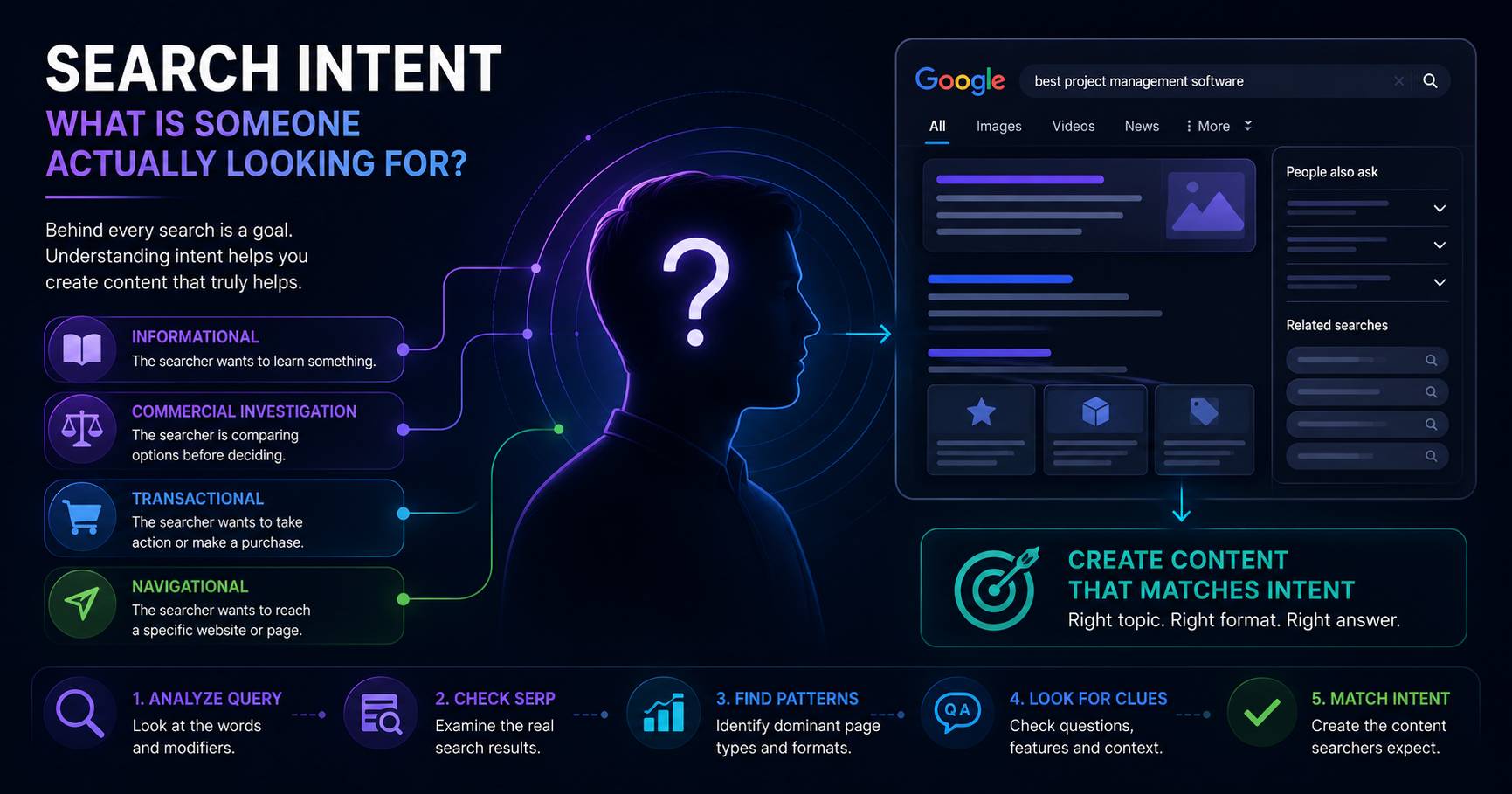
The four common types of search intent
Search intent is often divided into four broad categories.
These categories are useful, but they should be treated as a framework rather than a rigid rule.
1. Informational intent
The searcher wants to learn something.
Examples might include:
- what is technical SEO
- how to improve page speed
- why is my website not indexed
- how does keyword research work
Content that often fits informational searches includes:
- guides,
- tutorials,
- explanations,
- definitions,
- checklists,
- videos,
- and educational articles.
But even informational searches can have very different expectations.
Someone searching “what is SEO?” probably needs a beginner-friendly explanation.
Someone searching “canonical tag conflicting with hreflang” likely needs a much more technical answer.
Both are informational, but the content should not look the same.
2. Navigational intent
The searcher is trying to reach a specific website, brand, tool or page.
Examples:
- YouTube
- LinkedIn login
- Google Search Console
- Fridica
The search engine is mostly being used as a navigation tool.
Creating a long article targeting this kind of query usually makes little sense if the user simply wants to reach another destination.
3. Commercial investigation
The searcher is considering a decision but is not necessarily ready to buy yet.
Examples might include:
- best SEO tools
- WordPress vs Webflow
- best project management software for freelancers
- Ahrefs alternatives
The searcher wants information that helps evaluate options.
Typical content formats include:
- comparisons,
- reviews,
- alternatives,
- “best” lists,
- feature breakdowns,
- and buying guides.
This type of intent often sits between informational and transactional search.
4. Transactional intent
The searcher wants to take an action.
That action could be purchasing something, signing up, downloading something or hiring a service.
Examples:
- buy running shoes
- book hotel Lisbon
- hire WordPress developer
- start free SEO audit
Pages that satisfy transactional intent are often:
- product pages,
- service pages,
- pricing pages,
- signup pages,
- or landing pages.
Writing an educational article for a strongly transactional query may not match what the searcher expects.
Search intent is not always obvious from the keyword
Some queries are very clear.
“How to write a meta description” strongly suggests informational intent.
Others are much harder.
Consider:
“SEO audit”
What does the searcher want?
They could be looking for:
- an SEO audit tool,
- an SEO audit service,
- an SEO audit checklist,
- a definition of an SEO audit,
- or instructions for performing one themselves.
The keyword alone cannot reliably answer the question.
This is where the actual search results become especially useful.
Look at the SERP, not just the keyword
SERP stands for Search Engine Results Page.
When researching a topic, look at what the search engine is already showing for the query.
You are looking for patterns.
Ask questions such as:
- Are the top results articles or landing pages?
- Are there comparison pages?
- Are there product pages?
- Are videos prominent?
- Are forums or community discussions appearing?
- Is there a featured snippet?
- Does Google show People Also Ask questions?
- Are the results mostly beginner guides or advanced resources?
- Are major brands dominating the page?
- Are several different content formats mixed together?
These observations help you understand what kind of experience the search engine currently associates with the query.
This does not mean you should simply copy the pages that already rank.
The goal is to understand the landscape first.
Then you can decide how to create something useful within it.
Search intent can be mixed
Not every query fits neatly into one category.
A search such as:
“best WordPress hosting”
contains both informational and commercial intent.
The person wants to learn, but they are also evaluating a future purchase.
A query such as:
“ChatGPT SEO”
could represent several possible needs:
- how to use ChatGPT for SEO,
- whether ChatGPT is useful for SEO,
- SEO prompts,
- SEO tools involving ChatGPT,
- or discussions about AI search.
When search results contain several different kinds of pages, that can be evidence that Google itself sees multiple possible interpretations.
Mixed intent can also create opportunities.
Instead of forcing the query into one category, you can decide which part of the intent your content is best positioned to satisfy.
Search intent affects content format
Understanding intent helps answer another important question:
What should I actually create?
For example, a query dominated by step-by-step tutorials might suggest a practical guide.
A query filled with comparison pages might require a comparison rather than a general explanation.
A query dominated by tools could indicate that searchers want to perform an action rather than read about it.
Search intent therefore influences:
- page type,
- content format,
- angle,
- structure,
- level of detail,
- title,
- headings,
- examples,
- and calls to action.
This is why choosing a keyword and immediately starting to write can be risky.
The keyword is only the starting point.
Intent mismatch is a common content problem
A page can be technically optimized and still struggle if it answers the wrong question.
Imagine targeting:
“website speed test”
with a 2,500-word article explaining the history of website performance.
The article might contain the keyword, related terminology, internal links and excellent on-page SEO.
But someone searching for a website speed test probably wants to test a website.
They may prefer a tool.
The content fails because the page's purpose does not match the searcher's purpose.
SEO is not only about whether a page contains the right words.
It is also about whether the page provides the right experience.
Search intent is useful beyond traditional SEO
Understanding search intent is becoming even more important as search experiences evolve.
People now discover information through:
- traditional search results,
- AI-generated answers,
- conversational search,
- answer engines,
- featured snippets,
- forums,
- videos,
- and other discovery systems.
Whether you call the discipline SEO, AEO or GEO, the underlying question remains remarkably similar:
What does the person actually need to know or do?
Clear intent makes it easier to create content that provides direct answers while still giving enough context for deeper understanding.
That can improve both human usefulness and the ability of search and AI systems to understand what your content is about.
A practical way to analyze search intent
You do not need to make intent analysis complicated.
Start with the query and follow a simple process.
Step 1: Read the query literally
What do the words suggest?
Look for modifiers such as:
- how
- what
- why
- best
- review
- vs
- alternative
- buy
- price
- near me
These can provide useful clues.
But do not stop there.
Step 2: Check the real search results
Look at the pages that appear.
Identify the dominant page types and formats.
Step 3: Look for recurring patterns
If eight results are beginner guides, that is meaningful.
If most results are product pages, that is meaningful too.
Step 4: Notice additional search features
Related searches and questions can reveal additional aspects of the topic that people commonly explore.
Step 5: Decide what your page should accomplish
Do not ask only:
“How do I rank for this keyword?”
Ask:
“What would make this page genuinely useful for someone making this search?”
That is a much stronger starting point.
Do not confuse intent with a guaranteed formula
Search intent analysis is evidence, not certainty.
Search results change.
Different users may have different goals.
Some queries are ambiguous.
And the first page of Google is not a perfect description of everything people could possibly want.
That is why intent should guide your decisions rather than become another rigid SEO rule.
Use search results as evidence.
Look for patterns.
Then combine those patterns with your expertise, audience knowledge and the purpose of your website.
Search intent comes before the content brief
Before deciding on headings, word count or article structure, understand the intent.
Once you know:
- what people are searching for,
- what they are probably trying to achieve,
- what types of pages already appear,
- and what questions remain unanswered,
building a useful content brief becomes much easier.
That is the next step in the process.
In the next article in this series, we will look at how to build a content brief from real search results.
Keep learning
Related SEO guides
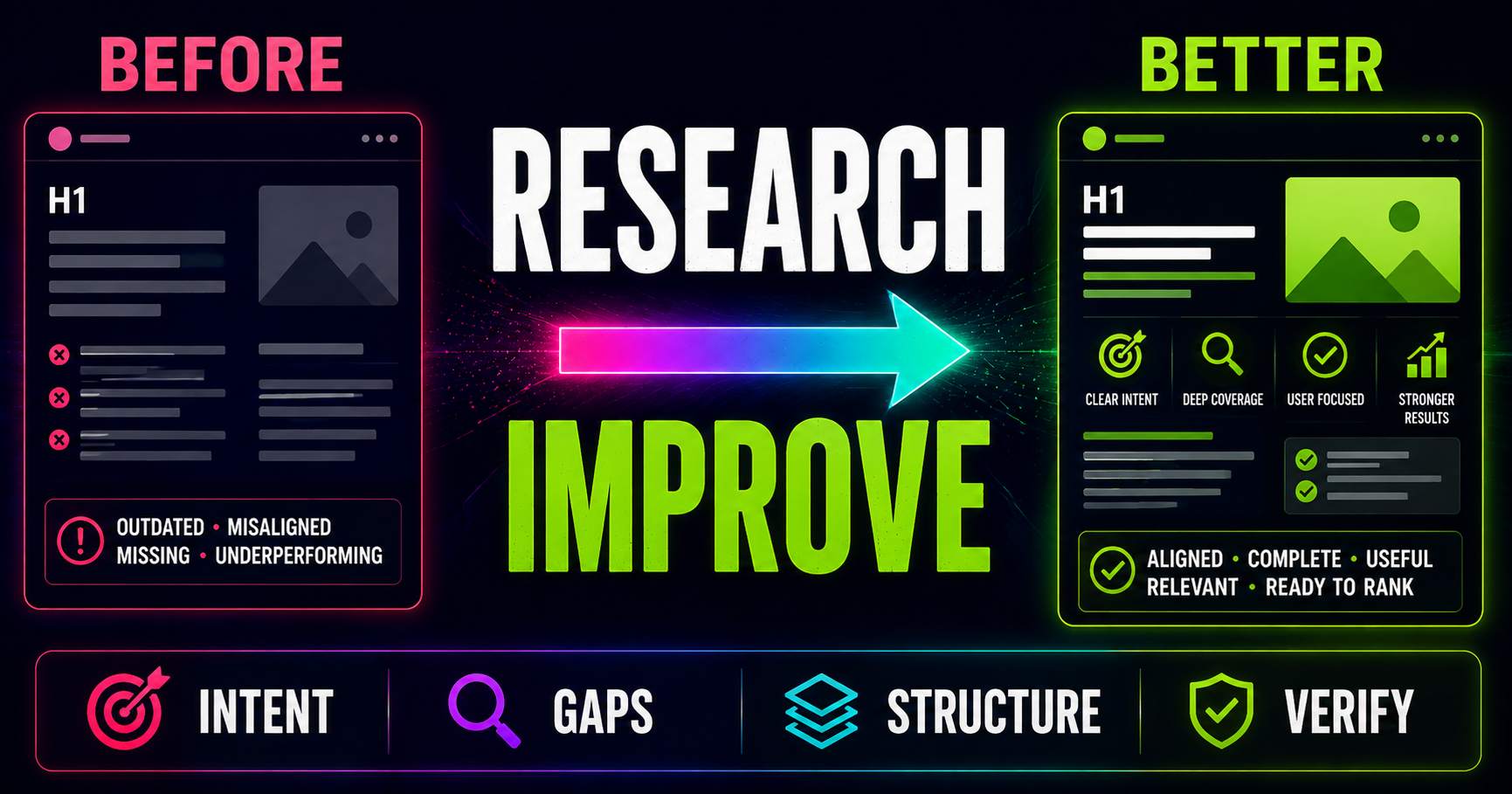
Keyword Research for Existing Pages: What Should You Improve?
Keyword research is not only for new content. Learn how to compare an existing page with current search intent, SERP patterns, related questions and content gaps to decide what actually needs improving.
Read guide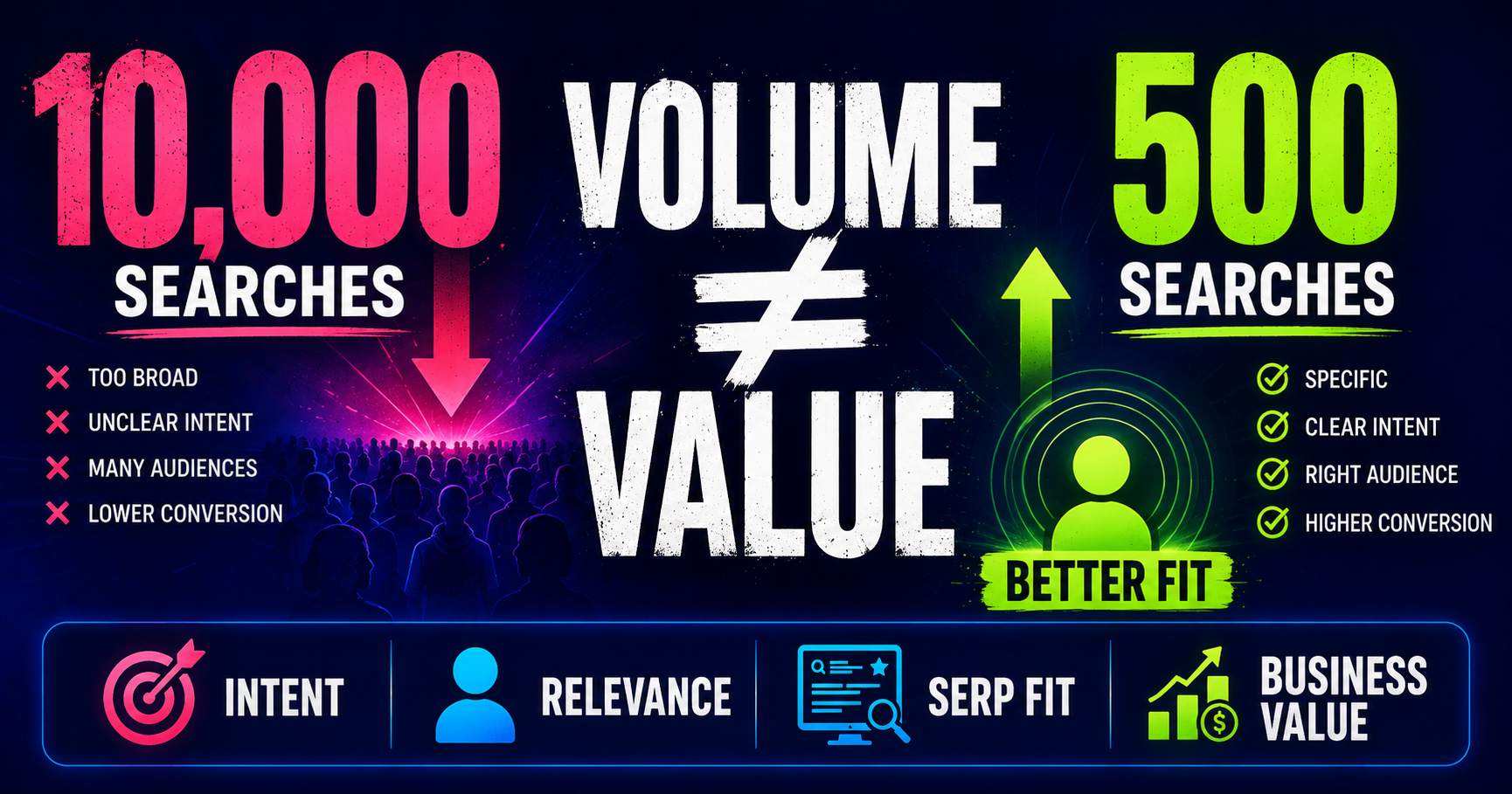
Search Volume Isn’t the Whole Story
Search volume can help you understand demand, but a bigger number does not automatically mean a better keyword. Learn how relevance, intent, specificity, SERP context and business value change the decision.
Read guide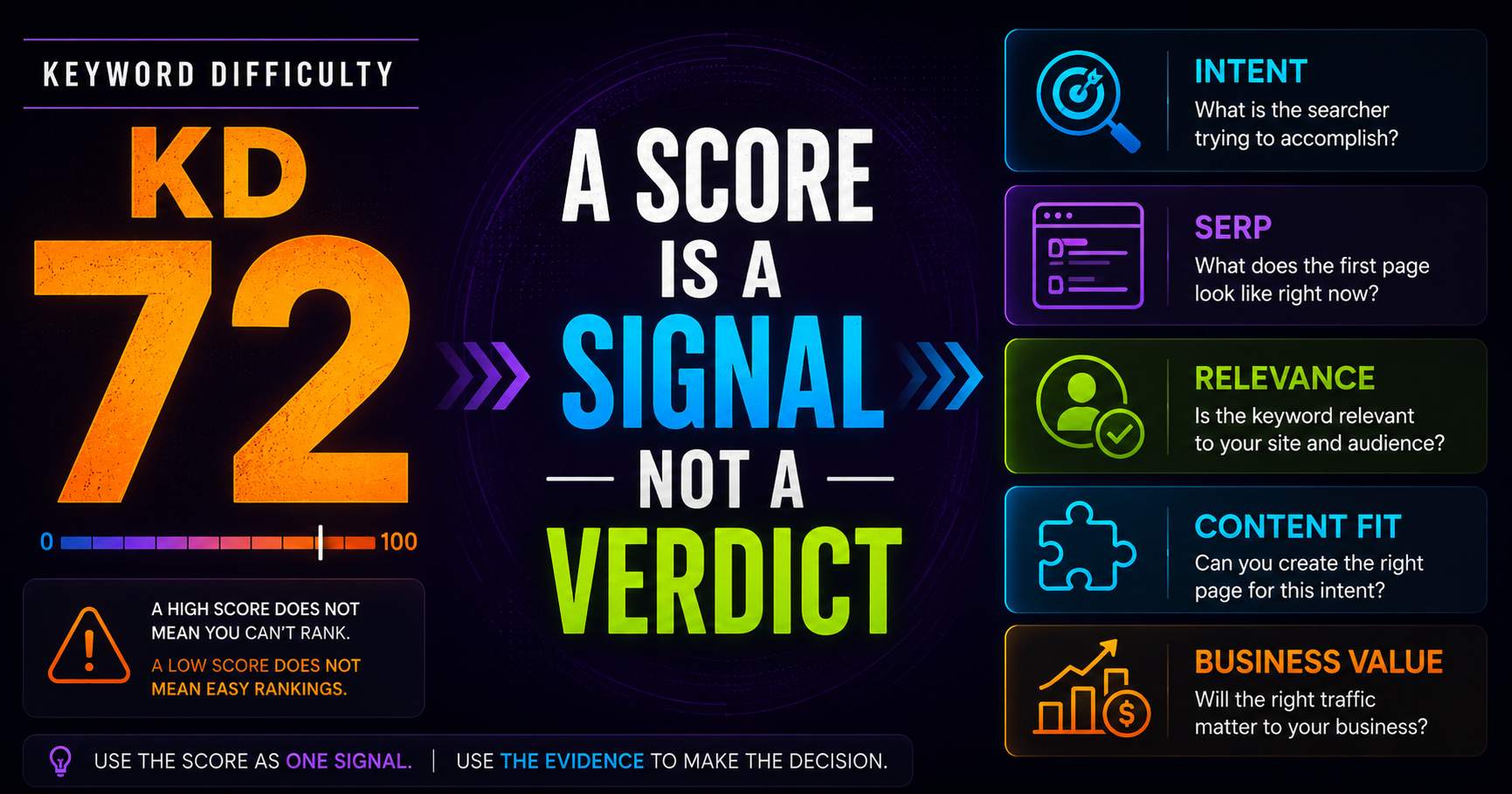
Keyword Difficulty: What the Number Does - and Doesn’t - Tell You
Keyword difficulty can be a useful comparison metric, but it is not a prediction of whether your page can rank. Learn what the score represents, what it leaves out, and how to use it alongside real SERP evidence.
Read guidePut this into practice
See what applies to your page.
Start with a one-page review, then run a full site audit when you are ready.