
Guide · SEO
How to Choose a Primary Keyword Without Guessing
Choosing a primary keyword should not mean picking the phrase with the biggest number. Learn how to use search intent, SERP evidence, relevance and content fit to choose a clear primary direction.
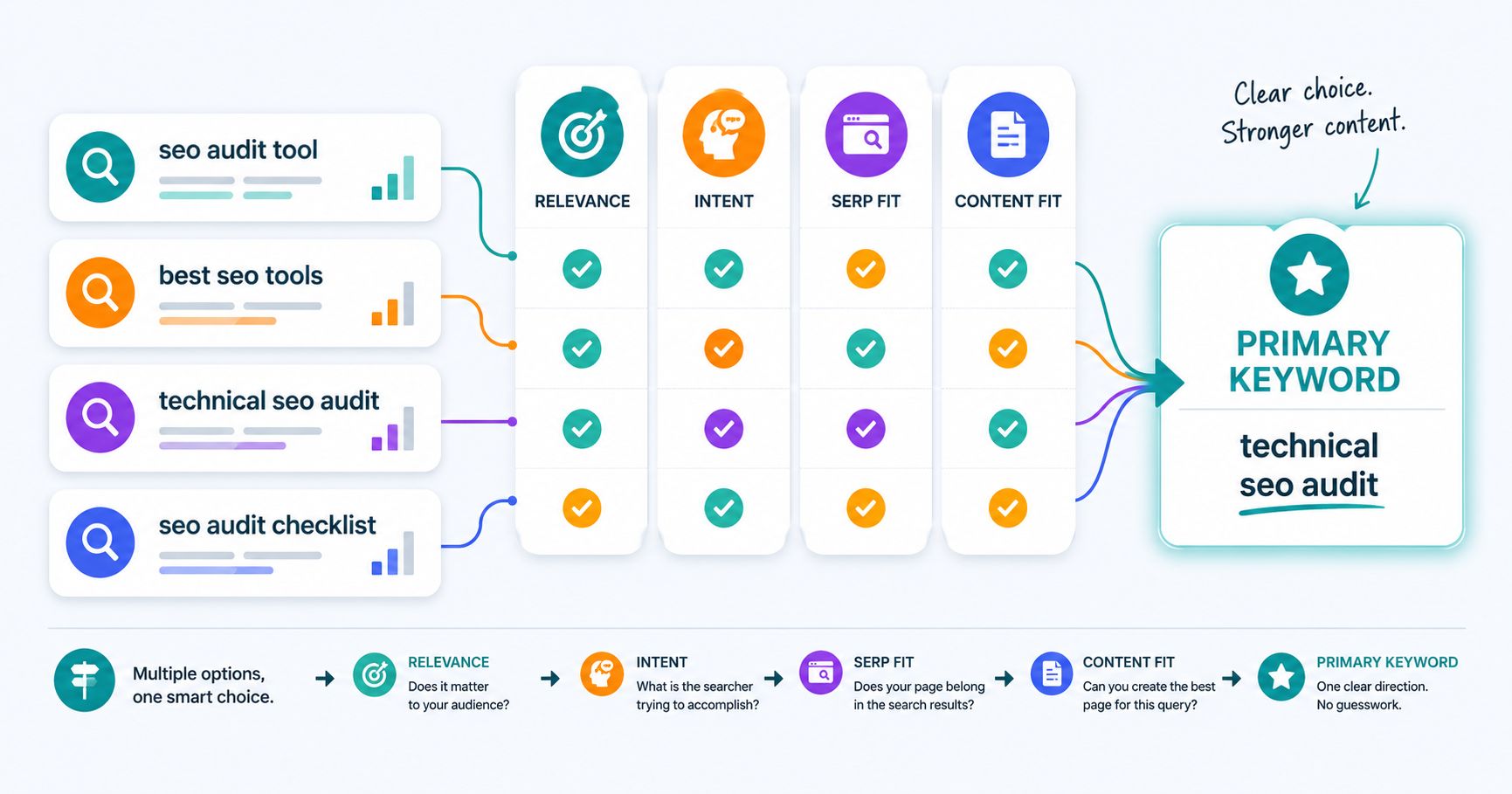
You have a list of possible keywords.
Now you need to choose one.
This is where keyword research often becomes strangely uncomfortable.
One phrase has more search volume.
Another looks easier.
A third sounds more relevant to your business.
And suddenly the question becomes:
“Which one is the primary keyword?”
The answer should not come from guessing.
And it should not come from blindly choosing the largest number in a keyword tool.
A useful primary keyword should reflect the page you actually want to create, the search intent behind the query and the search landscape you are entering.
What is a primary keyword?
A primary keyword is the main search query or topic direction a page is built around.
It helps clarify:
- what the page is mainly about;
- which search intent matters most;
- what kind of content should be created;
- which related topics belong on the page;
- and what should probably be left for another page.
The primary keyword is not a phrase you need to repeat mechanically throughout the article.
It is better understood as:
the main search direction for the page.
A primary keyword is not necessarily one exact phrase
Search engines do not require every useful page to target only one literal string.
A page about:
“how to perform an SEO audit”
may naturally also discuss:
- SEO audit checklist;
- technical SEO audit;
- website audit process;
- SEO audit steps;
- and common SEO issues.
Those related phrases may belong to the same topic and intent.
The goal is not to create a separate article for every wording variation.
The goal is to choose one clear primary direction and build a useful page around it.
Why choosing the primary keyword matters
Without a clear primary direction, content can become unfocused.
Imagine trying to write one page for all of these:
- what is SEO;
- best SEO tools;
- SEO services;
- SEO audit checklist;
- hire an SEO consultant.
They are all related to SEO.
But they do not represent the same search intent.
The page could easily become a mixture of:
- a definition;
- a commercial comparison;
- a service page;
- a technical guide;
- and a sales pitch.
That is not topical depth.
That is confusion.
A primary keyword helps you decide what the page is really for.
Do not start with search volume alone
Search volume can be useful when it comes from a reliable data source.
But it should not make the decision by itself.
A broad phrase with large search demand may be:
- too vague;
- too competitive;
- poorly matched to your business;
- or associated with an intent your page cannot satisfy.
Consider:
“project management”
versus:
“project management software for freelancers.”
The first phrase may represent a much larger topic.
But it tells you very little about what the searcher actually needs.
The second is narrower, but much clearer.
More searches do not automatically mean better fit.
Start with relevance
Before looking at metrics, ask:
“Does this query actually matter to the website, product, service or audience?”
A keyword can look attractive in a tool and still be almost useless to you.
For example, imagine you run a service helping small businesses build websites.
You discover a high-volume query:
“free website templates.”
It may attract plenty of searches.
But if your goal is to attract businesses looking for a custom website, the query may not be the strongest primary direction.
Another query such as:
“website design for small business”
could align much more closely with what you actually offer.
Relevance comes first.
Then check the search intent
Once a query looks relevant, ask:
“What is the searcher trying to accomplish?”
The same topic can hide very different intents.
Compare:
- SEO audit
- SEO audit checklist
- SEO audit service
- best SEO audit tool
They share similar words.
But the expected page type may be completely different.
One may need a guide.
Another may need a service page.
Another may need a comparison.
Another may need a tool.
If your planned page does not match the likely intent, the keyword may be a poor primary choice.
Look at the real SERP
The search results can help you verify whether your assumption about the query makes sense.
Search for the phrase and look at what currently appears.
Ask:
- What types of pages dominate?
- Are the results mostly informational?
- Are product or service pages common?
- Are comparison pages appearing?
- Are videos prominent?
- Are tools ranking?
- Is the result page mixed?
This is important because a keyword can sound perfect until you inspect the SERP.
Then you may discover that search engines interpret the query very differently from you.
Ask whether your page belongs in that SERP
This is one of the simplest and most useful questions in keyword research:
“Does the page I want to create belong among these results?”
Suppose you want to publish an educational guide.
But the search results are almost entirely:
- software tools;
- interactive calculators;
- product pages;
- and commercial landing pages.
That does not mean an article can never rank.
But it is evidence that the query may not be the best fit for your intended page.
A closely related informational query might be much stronger.
Look for alignment between query, page and intent
A strong primary keyword usually creates alignment between three things:
Query → Search intent → Page purpose.
For example:
Query: how to improve local SEO
Intent: informational
Page purpose: practical educational guide
That alignment is clear.
Now compare:
Query: local SEO agency
Intent: likely commercial or transactional
Page purpose: educational beginner guide
The match is much weaker.
This simple comparison can prevent many bad keyword decisions.
Specific keywords often reveal more
Broad keywords can hide multiple needs.
More specific queries often tell you much more.
Compare:
“WordPress”
with:
“how to improve WordPress site speed.”
The second query tells you:
- the platform;
- the problem;
- the likely intent;
- and the type of content the searcher probably needs.
That makes planning much easier.
Long-tail does not automatically mean better
More specific queries can be valuable.
But you should not automatically choose the longest phrase available.
A very narrow query may:
- have little relevance to the rest of your site;
- represent an extremely small audience;
- belong naturally inside a broader article;
- or simply be a wording variation rather than a separate topic.
For example:
“how to add canonical URL in WordPress without plugin”
might justify its own page in a highly technical WordPress publication.
On another site, it may work better as one section inside a broader canonical URL guide.
Context matters.
Check whether multiple keywords share the same intent
Sometimes several queries are really asking for the same page.
For example:
- how to do keyword research;
- keyword research guide;
- how keyword research works;
- keyword research for beginners.
If the search results for those queries are very similar, they may belong to the same topic cluster and intent.
You do not necessarily need four separate articles.
You may need one strong article with one clear primary keyword and several natural related phrases.
Search-result overlap can reveal whether topics belong together
A useful practical test is to compare the search results for two candidate queries.
If many of the same pages rank for both queries, that can indicate that search engines see them as closely related.
If the results are almost completely different, the queries may represent different intents or page types.
This is not an absolute rule.
But it is useful evidence when deciding whether:
- two keywords belong on one page;
- or deserve separate content.
Do not choose a keyword your page cannot realistically satisfy
This is different from asking whether a keyword is difficult.
The first question should be:
“Can we create the kind of page this query deserves?”
Suppose the SERP is dominated by interactive tools.
If you only plan to publish a short article, there may be a fundamental format mismatch.
Or suppose the strongest pages contain:
- original data;
- large product comparisons;
- expert testing;
- or detailed technical documentation.
If you cannot offer anything comparable or meaningfully different, another keyword may be a smarter primary target.
Think about business relevance too
SEO traffic is not automatically useful traffic.
A keyword can attract visitors who have very little connection to what your organization actually does.
Ask:
- Does this audience matter to us?
- Can our expertise genuinely help them?
- Does the topic support our website's purpose?
- Is there a useful next step after they read the page?
This does not mean every article needs to sell something.
Educational content can build awareness, trust and topical depth.
But the topic should still make sense within the larger website.
Consider topical relevance
A site becomes harder to understand when it publishes unrelated articles simply because the keywords look attractive.
Imagine a website about technical SEO suddenly publishing:
“Best coffee machines for 2026.”
The keyword may have demand.
It still has almost nothing to do with the site's purpose.
Primary keyword selection should support a coherent content strategy.
Ask:
“Does this topic strengthen the areas we want this website to be known for?”
Related searches can help refine the primary direction
Sometimes the initial keyword is too broad.
Related searches can reveal a clearer angle.
Imagine starting with:
“website audit.”
Related searches might reveal:
- website audit checklist;
- SEO website audit;
- technical website audit;
- website audit tools;
- website audit service.
These variations can help you decide what kind of page you actually want to create.
The broad keyword starts the research.
The evidence helps narrow the direction.
Questions can reveal the real problem behind the keyword
Search questions can also help clarify what people need.
Suppose you are researching:
“technical SEO.”
Questions around the SERP might focus on:
- what technical SEO includes;
- whether technical SEO requires coding;
- how to perform a technical SEO audit;
- which technical issues matter most;
- and how technical SEO differs from on-page SEO.
That may tell you that a beginner-oriented explanation is more useful than a vague page targeting the broad term alone.
Primary keyword and content angle are connected
Choosing the keyword and choosing the angle should not be two completely separate decisions.
For example:
Primary query: keyword research
could support several angles:
- keyword research for beginners;
- keyword research for existing pages;
- keyword research without expensive tools;
- keyword research for local businesses;
- or keyword research using real SERP evidence.
The broader query defines the topic.
The angle defines why your page deserves to exist.
Do not force the exact keyword into every heading
Once you choose a primary keyword, it is tempting to become overly literal.
You do not need:
- the exact phrase in every H2;
- the exact phrase in every paragraph;
- awkward grammatical variations;
- or repetitive sentences written for a keyword counter.
Use the primary keyword to keep the page focused.
Then write naturally about the subject.
Search engines and readers both benefit from clear language more than forced repetition.
What about keyword difficulty?
Keyword difficulty metrics can be useful when they come from established SEO data providers.
They can help compare relative competition.
But they should not become a yes-or-no switch.
A difficulty score does not understand:
- your expertise;
- your existing audience;
- your site's topical relevance;
- the quality of the page you can create;
- your distribution channels;
- or whether the keyword is commercially important to you.
Treat difficulty as one signal.
Not as permission to create the page.
What if you do not have search volume or difficulty data?
You can still make useful decisions.
You can examine:
- relevance;
- search intent;
- current organic results;
- dominant content formats;
- related searches;
- questions;
- topic fit;
- and whether you can create a genuinely useful page.
Those signals do not replace professional keyword databases when you need quantitative research.
But they are much better than pretending to have metrics you do not have.
Where Fridica fits
Fridica's Keyword & Topic Assistant does not currently choose a primary keyword by inventing a score.
Instead, it helps you understand the evidence around a query.
You provide:
- the topic or query;
- country;
- and language.
Fridica can then work with current search evidence such as:
- organic results;
- related searches;
- questions when present;
- featured search elements when present;
- and AI Overview when returned in the search evidence.
The analysis can help you understand:
- likely search intent;
- dominant result types;
- content patterns;
- topic opportunities;
- possible gaps;
- and a recommended primary content angle.
That gives you evidence for making a decision.
It does not pretend that a single mysterious score can choose the keyword for you.
Fridica does not invent keyword metrics
The current Keyword & Topic Assistant does not fabricate:
- search volume;
- keyword difficulty;
- CPC;
- traffic estimates;
- or ranking probabilities.
If those metrics are not supplied by a verified external data source, they should not appear as if they were measured facts.
This keeps the research process clear:
observed evidence is evidence;
analysis is interpretation;
and missing data stays missing.
A practical primary keyword checklist
Before choosing the primary keyword for an important page, ask:
- Is the query relevant to my audience?
- Does it fit the purpose of my website?
- What is the likely search intent?
- What kinds of pages dominate the SERP?
- Does the page I want to create belong in that search landscape?
- Are there more specific variations that better describe the need?
- Do several candidate keywords appear to share the same intent?
- Can those queries reasonably be served by one page?
- Can I create content that genuinely satisfies the searcher's need?
- Does the topic support my wider content strategy?
If the answers line up, you probably have a much stronger primary direction.
An example
Imagine you are choosing between:
“SEO tool”
and:
“SEO audit tool for small business.”
The first query is broad.
It could refer to:
- keyword research;
- rank tracking;
- backlinks;
- technical audits;
- content optimization;
- or complete SEO platforms.
The second query is more specific.
It tells you:
- the desired product type;
- the audience;
- and part of the likely commercial intent.
If your product is specifically designed to help site owners understand audit findings, the narrower query may create a much clearer content direction.
That does not automatically make it easier to rank.
It makes it easier to understand what page you should create.
The primary keyword is a decision, not a prediction
You cannot know with certainty which phrase will eventually bring the most traffic.
Search results change.
Competition changes.
Language changes.
User behavior changes.
The goal of keyword research is not to eliminate uncertainty.
It is to make a more informed decision.
The short version
Do not choose a primary keyword because:
“It has the biggest number.”
Choose it because the pieces fit together.
Look at:
- relevance;
- search intent;
- the real SERP;
- content format;
- topic specificity;
- related searches;
- business relevance;
- and whether you can actually satisfy the query.
Then choose one clear primary direction.
Use related terms naturally.
And build the page around the searcher's problem rather than around a keyword counter.
The best primary keyword is not always the biggest keyword. It is the one that best connects the search, the intent and the page you are capable of creating.
In the next article in this series, we will look at what related searches can tell you about a topic and how they can help expand your research without turning one page into a collection of random keywords.
Keep learning
Related SEO guides
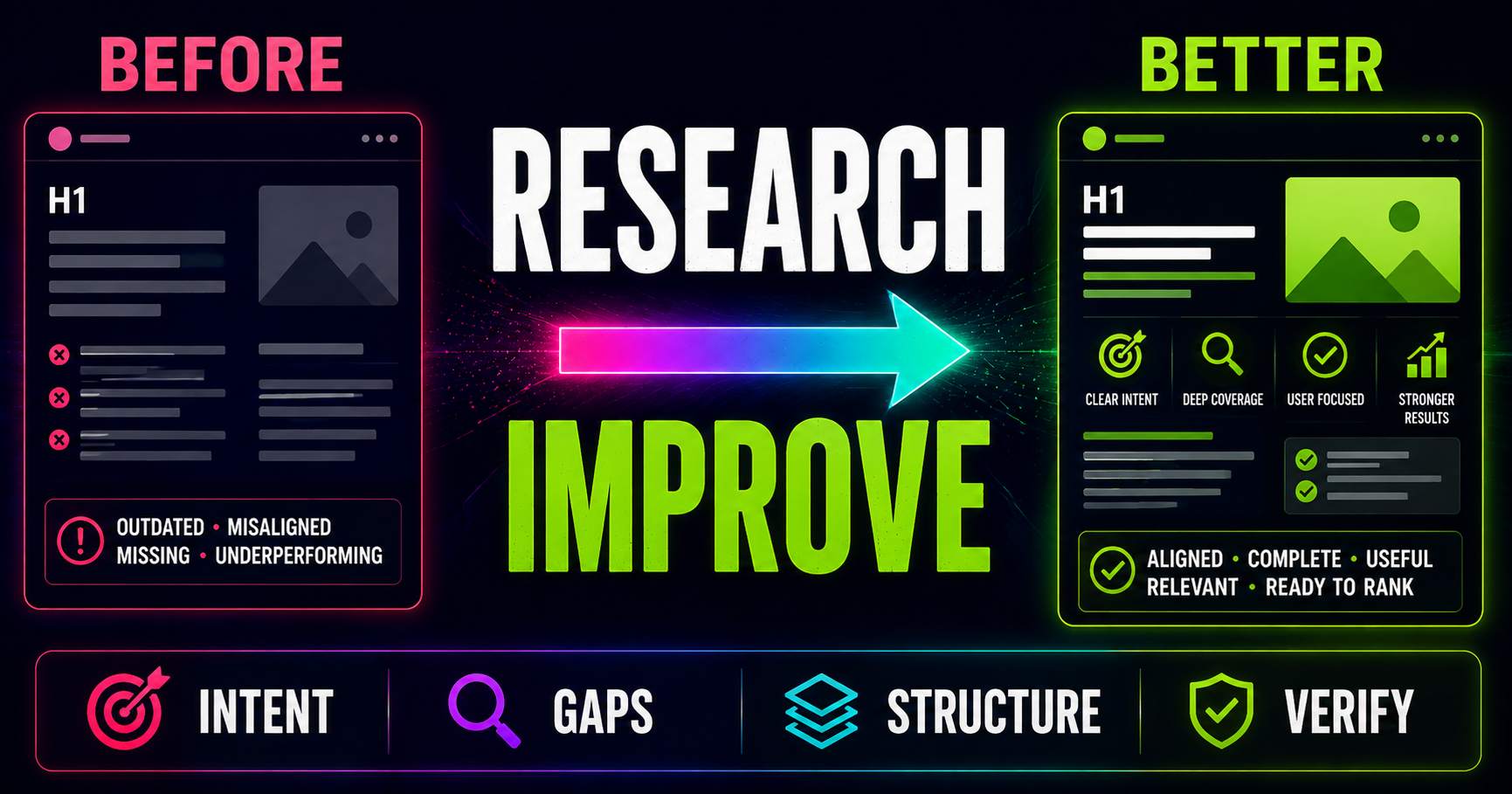
Keyword Research for Existing Pages: What Should You Improve?
Keyword research is not only for new content. Learn how to compare an existing page with current search intent, SERP patterns, related questions and content gaps to decide what actually needs improving.
Read guide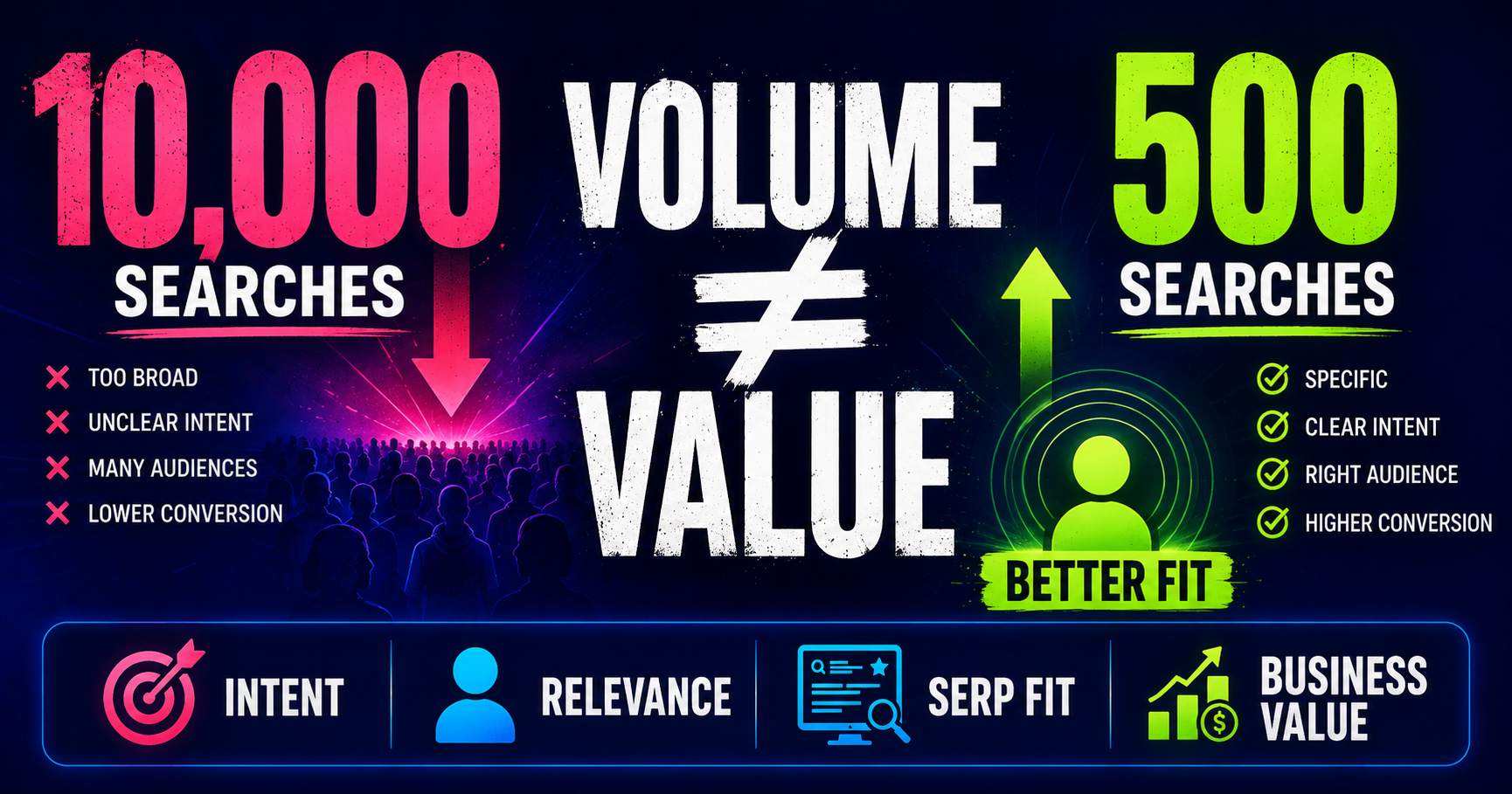
Search Volume Isn’t the Whole Story
Search volume can help you understand demand, but a bigger number does not automatically mean a better keyword. Learn how relevance, intent, specificity, SERP context and business value change the decision.
Read guide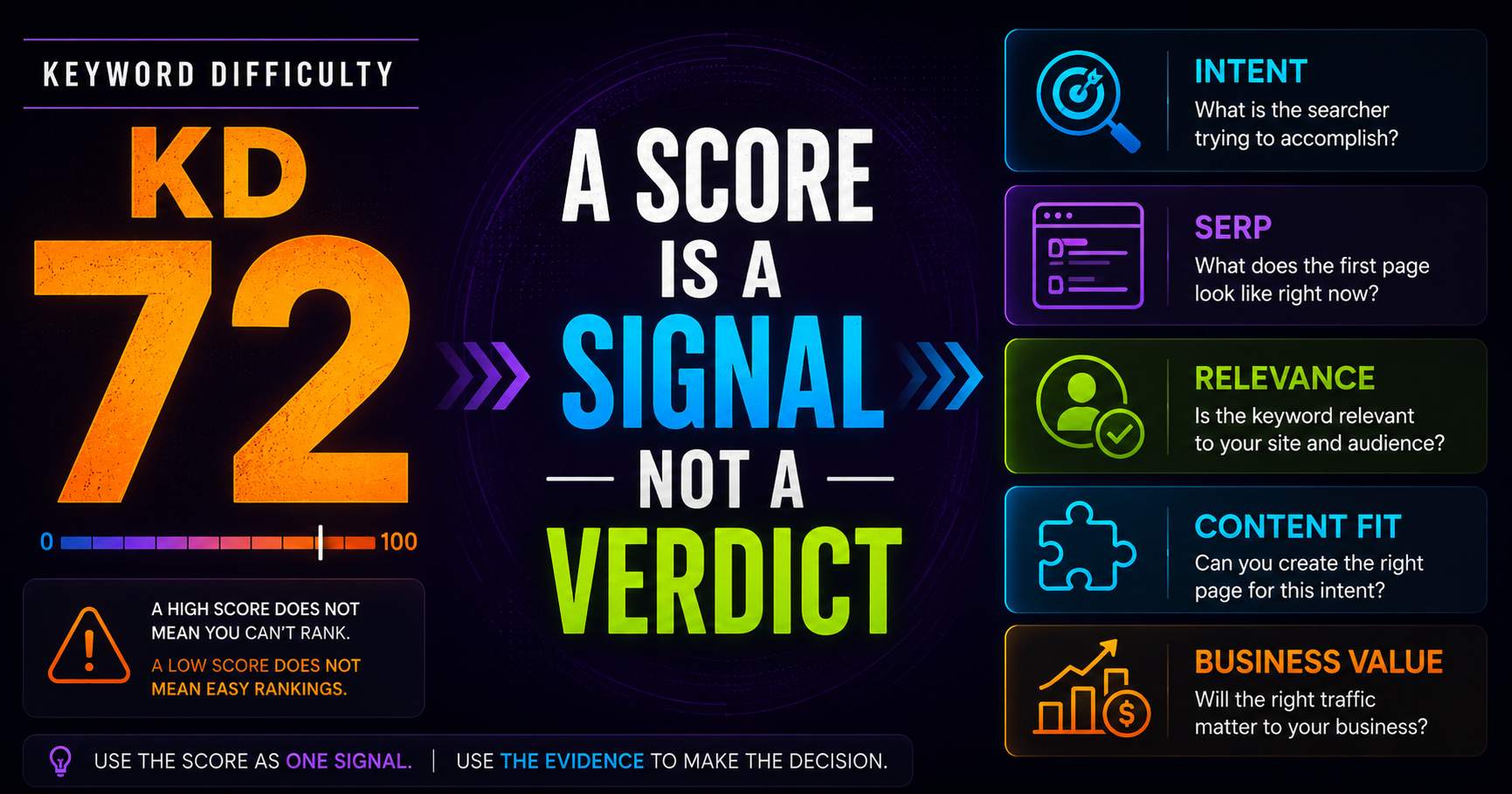
Keyword Difficulty: What the Number Does - and Doesn’t - Tell You
Keyword difficulty can be a useful comparison metric, but it is not a prediction of whether your page can rank. Learn what the score represents, what it leaves out, and how to use it alongside real SERP evidence.
Read guidePut this into practice
See what applies to your page.
Start with a one-page review, then run a full site audit when you are ready.