
Guide · SEO
How to Build a Content Brief From Real Search Results
A useful content brief should be built from evidence, not guesses. Learn how to use real search results, recurring patterns, related questions and search intent to plan content before you start writing.
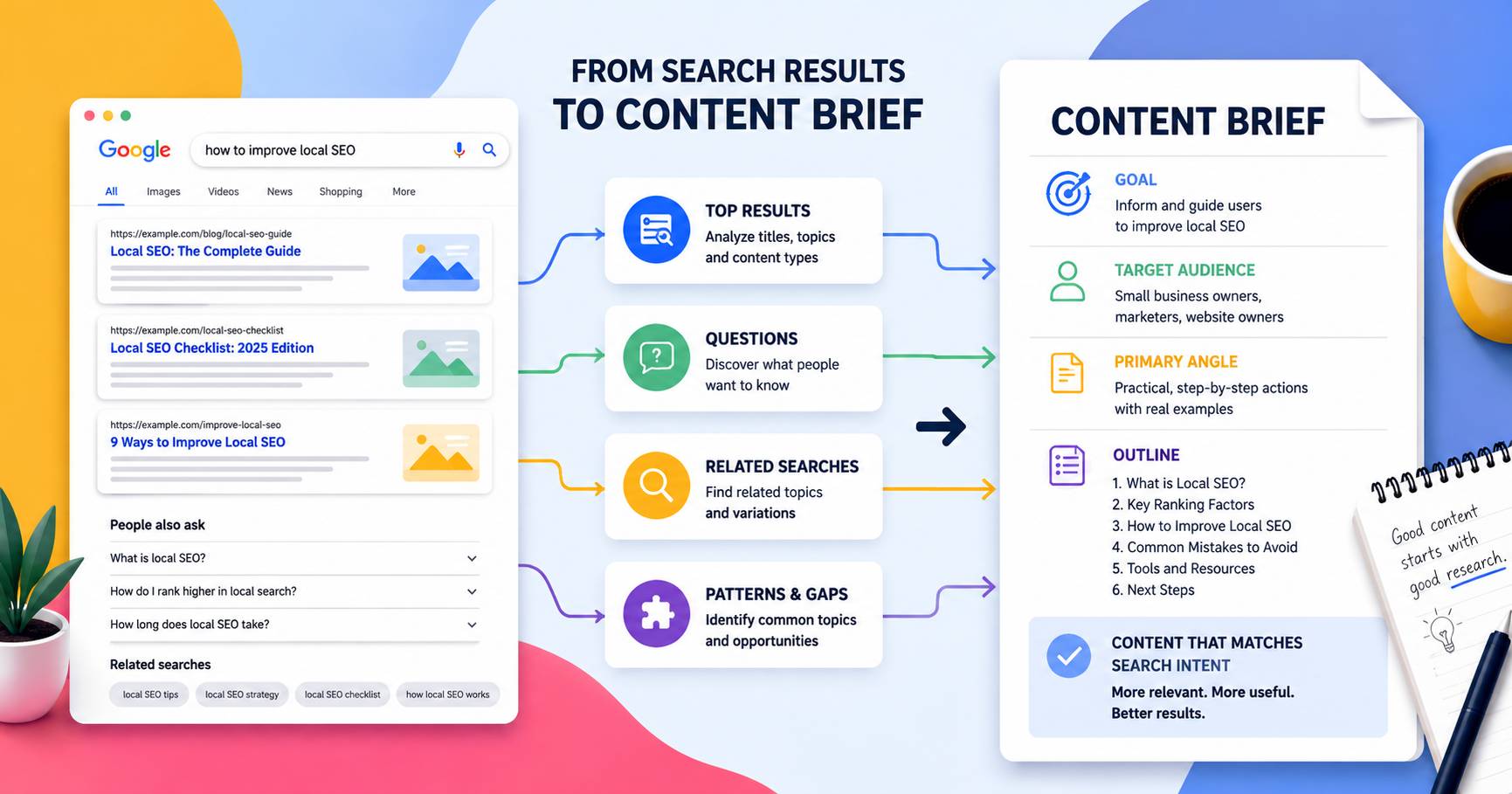
You have chosen a topic.
You understand the likely search intent.
Now comes the part where many content projects become surprisingly vague.
Someone opens a blank document and writes:
“Write a comprehensive article about this topic.”
That is not really a content brief.
It is a request.
A useful content brief should help answer much more practical questions:
- What is the page actually trying to accomplish?
- Who is it for?
- What kind of content does the searcher appear to expect?
- Which questions should the page answer?
- Which topics repeatedly appear in the search results?
- Where might there be room to add something genuinely useful?
- What should the page probably not become?
The best starting point for many of those answers is the real search landscape.
What is a content brief?
A content brief is a practical plan for creating a page or article.
It gives the writer direction before the writing begins.
A useful brief might contain:
- the primary topic;
- the likely search intent;
- the recommended content angle;
- the page type or format;
- important subtopics;
- questions worth answering;
- possible content gaps;
- a suggested title;
- a suggested H1;
- and a rough outline.
The point is not to predict the perfect article.
The point is to reduce unnecessary guessing.
A content brief should not begin with word count
One of the easiest ways to create a weak brief is to start with:
“We need a 2,000-word article.”
Why 2,000 words?
Maybe the topic needs 800.
Maybe it needs 3,500.
Maybe it does not need an article at all.
The required length should follow the topic, intent and level of explanation needed.
It should not be chosen simply because competing pages look long.
A good brief focuses first on:
what needs to be answered.
Length comes later.
Start with one clear query or topic
Before examining the SERP, define what you are actually researching.
For example:
“how to improve local SEO”
is different from:
“local SEO services”
and different again from:
“best local SEO tools.”
The words overlap.
The likely intent does not.
Your brief becomes much easier to build when the research starts with one clear direction.
Step 1: Identify the likely search intent
Before deciding what the article should contain, decide what the searcher is probably trying to accomplish.
Is the query primarily:
- informational?
- navigational?
- commercial?
- transactional?
- or mixed?
Do not rely only on the wording of the query.
Look at what currently appears in the search results.
If the SERP is dominated by tutorials, that is evidence.
If product pages dominate, that is different evidence.
If several page types appear together, the query may have mixed intent.
The brief should reflect that.
Step 2: Look at the dominant result types
Now inspect the first page of search results.
Do not start by reading every article from top to bottom.
First, look at the page types.
Are they mostly:
- guides;
- product pages;
- service pages;
- comparison articles;
- listicles;
- videos;
- forums;
- documentation;
- category pages;
- or tools?
This gives you a fast picture of what kind of content search engines currently associate with the query.
That should influence your brief.
If almost every result is a practical tutorial, a purely theoretical essay may be a poor fit.
Step 3: Find recurring topics and patterns
Next, look for things that appear repeatedly.
You are not trying to copy headings.
You are looking for patterns.
For example, several pages about technical SEO might repeatedly discuss:
- crawlability;
- indexing;
- site speed;
- canonical URLs;
- structured data;
- internal linking;
- and mobile usability.
If a topic appears again and again, it may be something searchers expect a useful page to address.
That does not automatically mean every competing page is correct.
It simply tells you that the topic is part of the current search landscape.
Step 4: Look at related searches
Related searches can help expand the topic beyond the exact query.
Suppose your main query is:
“SEO audit.”
Related searches might point toward areas such as:
- SEO audit checklist;
- technical SEO audit;
- free SEO audit;
- SEO audit tools;
- website SEO analysis;
- or how to perform an SEO audit.
Not all of these belong in one page.
But they can help reveal:
- adjacent questions;
- possible sections;
- future articles;
- or different intents that should not be mixed together.
That last point is important.
A good brief should also help you decide what not to cover.
Step 5: Review questions that appear in the SERP
Questions can reveal how people explore a topic after the initial search.
If People Also Ask or similar question features appear, review them carefully.
They may reveal questions such as:
- What does an SEO audit include?
- How often should you audit a website?
- Can you perform an SEO audit yourself?
- How long does an SEO audit take?
Some may belong naturally in the main article.
Others may work better as FAQ items.
And some may deserve their own separate page.
The important thing is to keep the source clear.
If a question appears in real search evidence, treat it as evidence.
If you generate a useful editorial question yourself, that can still be valuable.
Just do not pretend it came from the search results.
Step 6: Look for gaps, not just similarities
Once you know what everyone covers, ask another question:
What is missing?
This is where a brief becomes more valuable than a competitor summary.
A content gap might be:
- a common question that receives weak answers;
- a practical step competitors skip;
- a missing example;
- a beginner explanation hidden behind technical language;
- a technical detail ignored by general articles;
- a useful comparison;
- a real-world scenario;
- or a different audience perspective.
But a gap is only useful if it helps the reader.
Do not add sections simply because competitors do not have them.
The goal is not:
“Make our article longer than theirs.”
The goal is:
“Make our article more useful.”
Step 7: Choose one primary angle
At this point, you may have dozens of ideas.
That is where another problem appears.
Trying to include everything.
A strong brief needs one clear primary direction.
For example, an article about:
“website audit”
could take several angles:
- a beginner explanation;
- a technical checklist;
- a tool comparison;
- a service buyer's guide;
- or a step-by-step audit workflow.
Trying to make one page serve all of those equally can create an unfocused article.
Choose the angle that best matches the search intent and the purpose of your site.
Step 8: Turn the evidence into an outline
Once the angle is clear, you can start structuring the page.
A useful outline should reflect the reader's journey.
For example:
- Explain the problem or topic.
- Answer the main question early.
- Introduce the important concepts.
- Explain the practical process.
- Cover recurring questions.
- Add useful examples or evidence.
- Address common mistakes or misunderstandings.
- Give the reader a clear next step.
The exact structure will vary.
That is the point.
The outline should come from the topic and intent, not from a fixed SEO template.
Do not copy competitor headings
If several ranking articles contain:
“What is technical SEO?”
that does not mean your article needs exactly the same heading.
The repeated concept may be important.
The wording is not sacred.
Use competitor pages to understand:
- topics;
- patterns;
- formats;
- expectations;
- and missing information.
Then create your own structure.
Titles should follow the angle
A good title should tell the reader what the page will actually deliver.
Compare:
“SEO Audit”
with:
“How to Perform an SEO Audit: A Practical Website Checklist”
or:
“SEO Audit Explained: What to Check and What to Fix First”
Each title suggests a slightly different page.
Your title should match the angle chosen in the brief.
The H1 does not need to be artificially different
SEO advice sometimes turns simple things into unnecessary puzzles.
Your SEO title and H1 do not need to be completely different just to prove that they are different fields.
They can be similar or identical when that makes sense.
Clarity matters more than forced variation.
What should a practical content brief contain?
A useful content brief can stay surprisingly simple.
For most articles, you may want:
- Primary topic: What is the page mainly about?
- Likely intent: What is the searcher trying to accomplish?
- Search landscape: What types of pages currently dominate?
- Primary angle: What specific direction should the page take?
- Important topics: What recurring concepts should be considered?
- Questions: What does the audience likely need answered?
- Content gaps: Where could the page add genuine value?
- Suggested title: How can the page communicate its purpose clearly?
- Suggested H1: What should the main page heading say?
- Outline: What is the logical order of the content?
- Notes: What should the writer be careful not to assume or invent?
That is already enough to turn research into a practical writing plan.
Separate evidence from interpretation
This is one of the most important parts of the process.
Suppose a SERP shows:
- seven long-form guides;
- two product pages;
- a People Also Ask section;
- and several related searches about beginner questions.
Those are observations.
You might then conclude:
“The query is primarily informational, with some commercial overlap.”
That is interpretation.
Both are useful.
But they are not the same thing.
A strong research workflow keeps them separate.
AI can help interpret evidence, but it should not invent the evidence
AI can be useful when turning raw search information into a structured brief.
It can help:
- summarize recurring patterns;
- group similar questions;
- identify likely intent;
- suggest content angles;
- organize an outline;
- and turn observations into a practical plan.
But there is an important boundary.
AI should not invent:
- search volume;
- keyword difficulty;
- CPC;
- ranking probability;
- traffic estimates;
- or search features that were not actually observed.
If the data source did not provide a metric, the brief should not quietly manufacture one.
Where Fridica fits
Fridica's Keyword & Topic Assistant follows this evidence-first approach.
You start with:
- a query or topic;
- a target country;
- and a language.
Fridica then works with current search evidence such as:
- organic results;
- related searches;
- questions when they are present;
- featured search elements when they are present;
- and AI Overview when it appears in the returned evidence.
That evidence is then interpreted to help produce practical recommendations such as:
- likely search intent;
- SERP patterns;
- dominant content formats;
- topic opportunities;
- content gaps;
- questions worth answering;
- a recommended primary angle;
- a suggested title;
- a suggested H1;
- an outline;
- and a structured content brief.
The principle remains the same:
Search evidence first.
Interpretation second.
A content brief is not a command to the writer
A brief should guide the writer.
It should not turn the writer into a machine following 47 mandatory headings.
Good content still requires:
- judgment;
- expertise;
- examples;
- experience;
- clear explanations;
- and editorial decisions.
The brief reduces uncertainty.
It does not replace thinking.
A simple workflow for building a content brief
For an important article or landing page, you can use this process:
- Choose one clear topic or query.
- Identify the target country and language.
- Inspect the current search results.
- Determine the likely search intent.
- Identify dominant page types and formats.
- Find recurring topics.
- Review related searches.
- Review search questions when present.
- Look for useful gaps.
- Choose one primary content angle.
- Create a suggested title and H1.
- Build a logical outline.
- Add notes about evidence, assumptions and limitations.
Now you have something much more useful than:
“Write 2,000 words about SEO.”
The short version
A good content brief is not a collection of keywords.
It is a plan built from evidence.
Start with the query.
Understand the intent.
Look at the real SERP.
Find the patterns.
Review related searches and questions.
Look for useful gaps.
Choose one clear angle.
Then turn that evidence into a structure the writer can actually use.
A useful brief does not tell you how many words to write. It tells you what deserves to be said.
In the next article in this series, we will look at how Fridica's Keyword & Topic Assistant works and how it separates search evidence from AI interpretation.
Keep learning
Related SEO guides
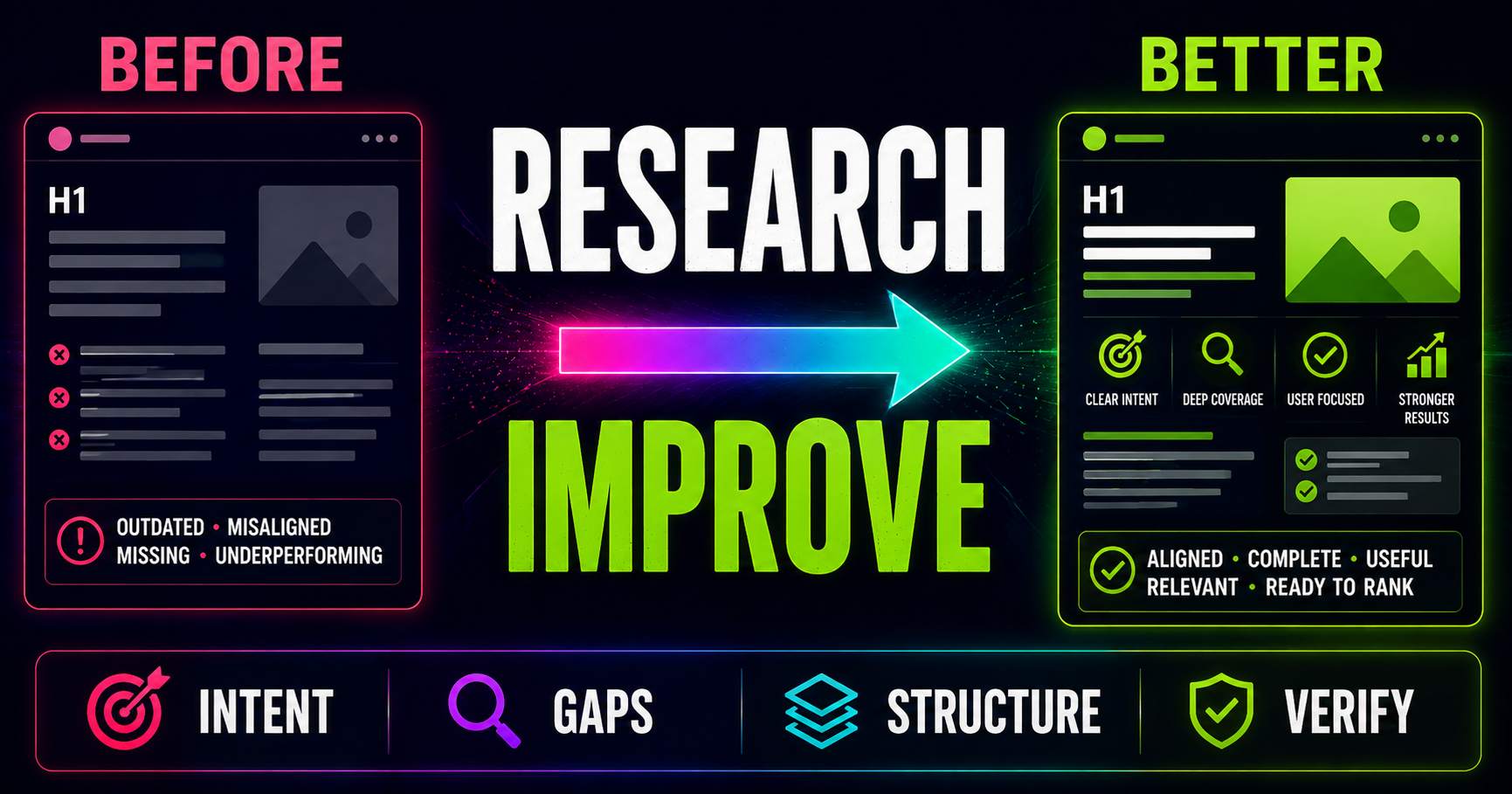
Keyword Research for Existing Pages: What Should You Improve?
Keyword research is not only for new content. Learn how to compare an existing page with current search intent, SERP patterns, related questions and content gaps to decide what actually needs improving.
Read guide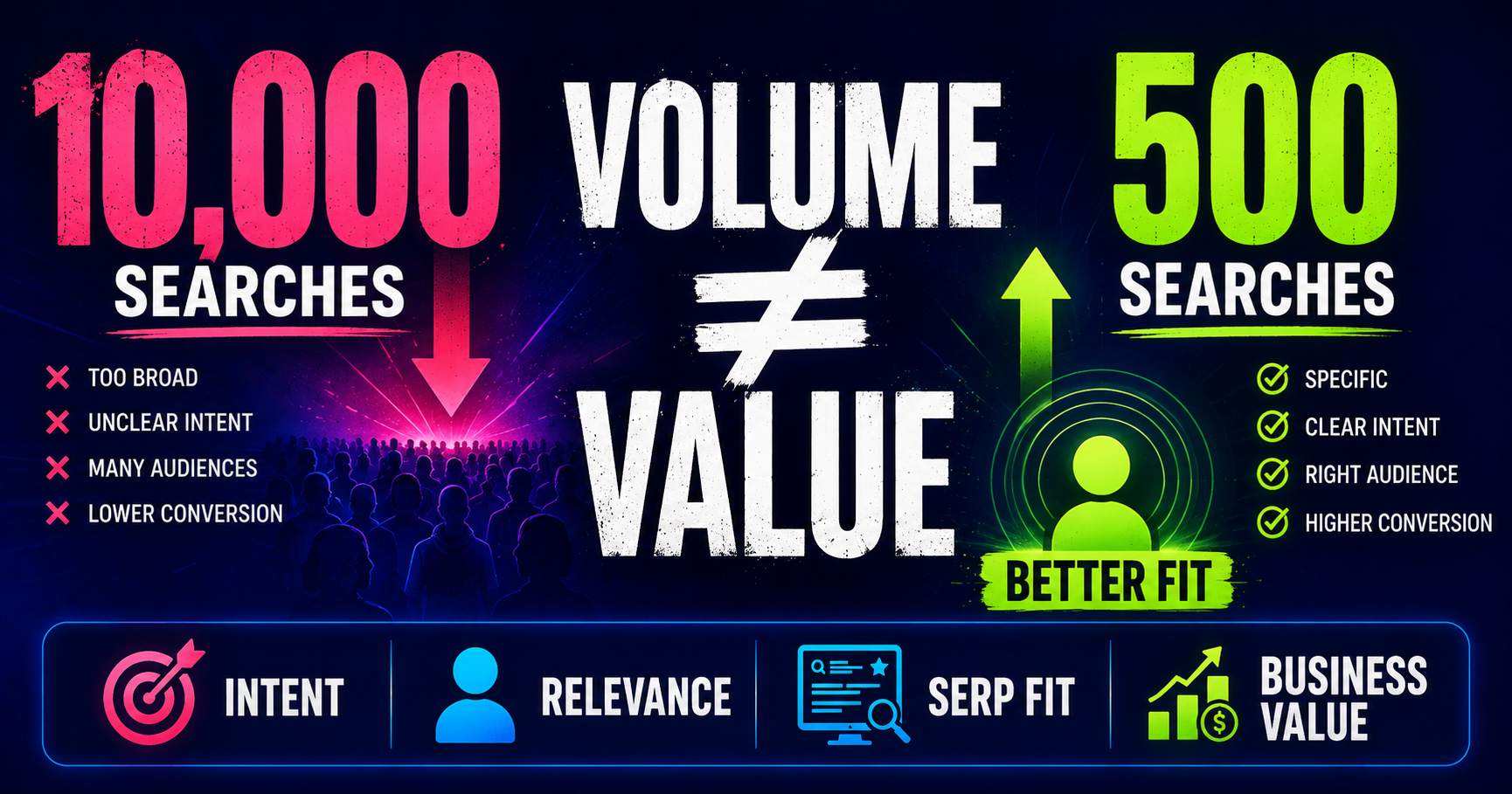
Search Volume Isn’t the Whole Story
Search volume can help you understand demand, but a bigger number does not automatically mean a better keyword. Learn how relevance, intent, specificity, SERP context and business value change the decision.
Read guide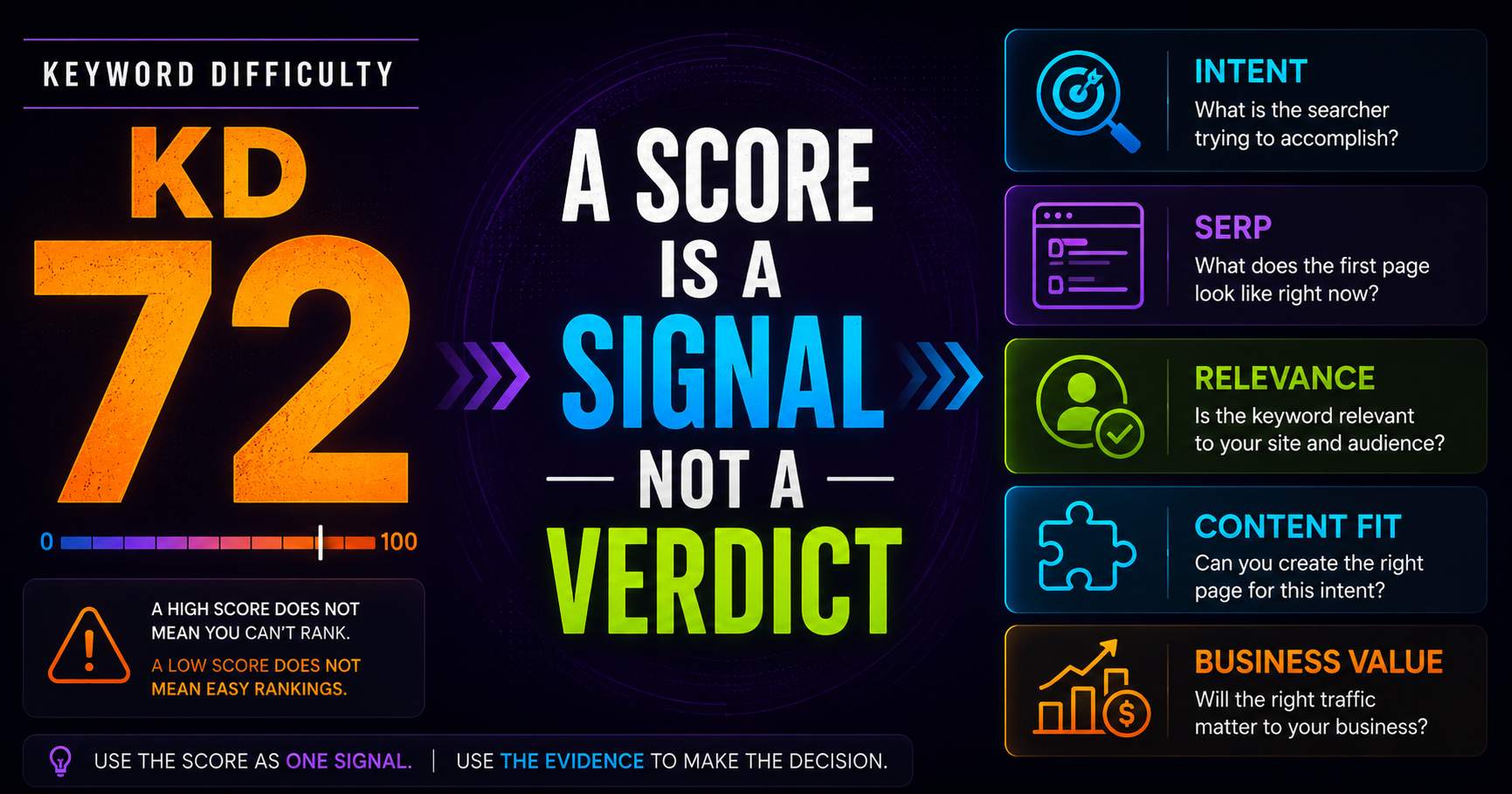
Keyword Difficulty: What the Number Does - and Doesn’t - Tell You
Keyword difficulty can be a useful comparison metric, but it is not a prediction of whether your page can rank. Learn what the score represents, what it leaves out, and how to use it alongside real SERP evidence.
Read guidePut this into practice
See what applies to your page.
Start with a one-page review, then run a full site audit when you are ready.