
Guide · SEO
Fridica for SEO Professionals: Evidence Without the Black Box
A score is useful, but an SEO professional needs to know what sits underneath it. See how Fridica combines deterministic findings, affected-page scope, evidence and audit comparison without asking AI to decide what the website passed or failed.
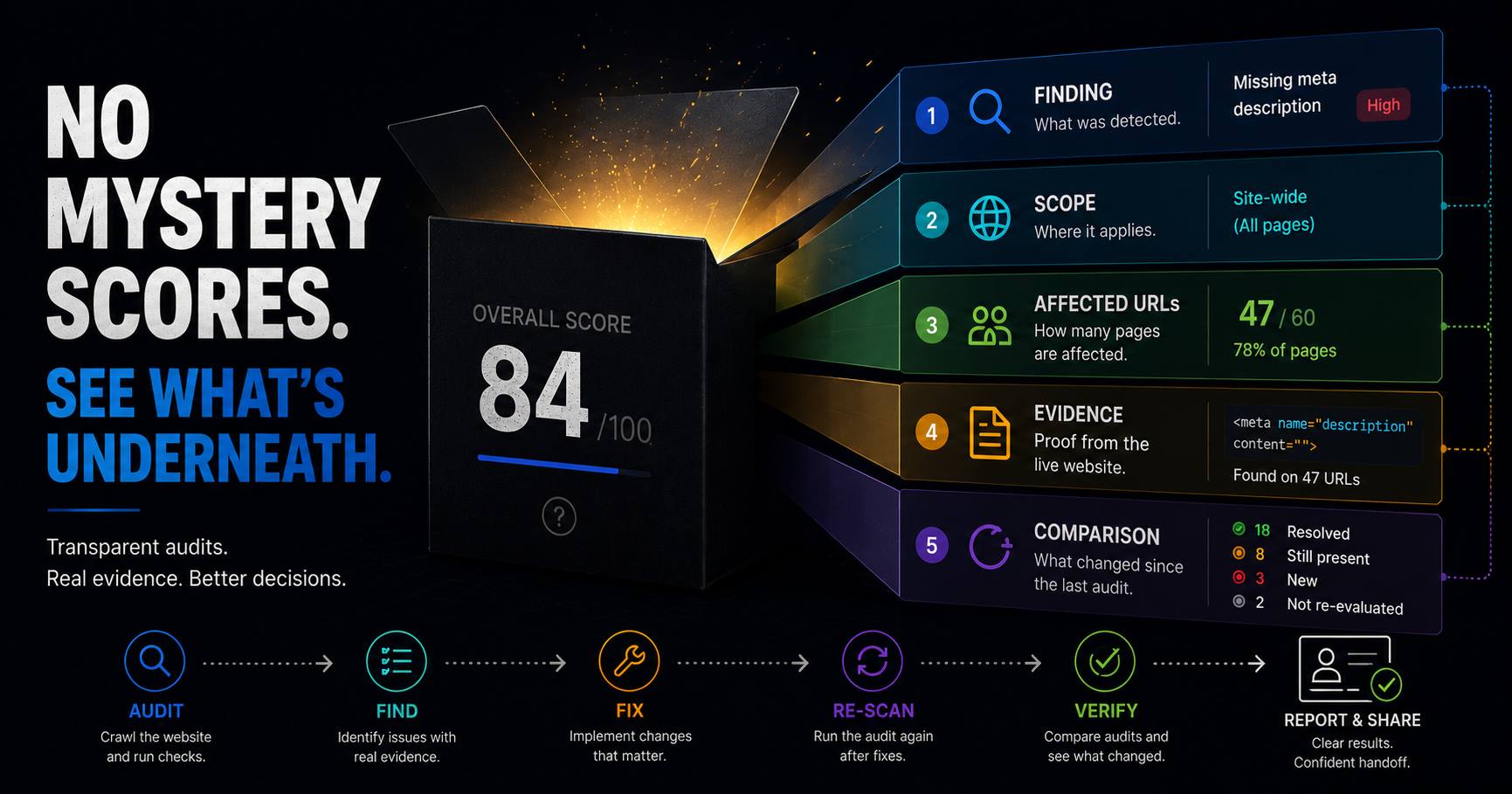
You probably do not need another dashboard telling you:
“Your website health score is 84.”
The natural next question is:
“Based on what?”
That question matters even more when you work in SEO professionally.
A client may be happy with a green number.
You need to know what the number represents, which checks failed, how widespread the problems are, what evidence exists, and what actually changed after the work was done.
That is the side of Fridica this guide is about.
Simple explanations on the surface. Inspectable evidence underneath.
SEO professionals usually need more than a score
Scores are convenient.
They are quick to read, easy to compare and very good at ending up in screenshots.
But a score is a summary.
It is not the diagnosis.
Imagine two websites both have:
SEO Readiness: 91/100
On one site, the remaining issues affect two low-priority pages.
On the other, one technical finding affects every page on the site.
Same score.
Very different conversation.
That is why Fridica keeps the findings, scope and evidence visible rather than asking the score to explain everything.
Start with deterministic findings
Fridica's audit findings come from explicit audit checks.
AI does not crawl the website, look at it and decide:
“This feels like a canonical problem.”
The crawler captures observable website signals.
Applicable deterministic rules evaluate those signals.
The result of those checks becomes the audit.
That boundary is important.
Especially now that many tools are adding AI to everything that has enough room for a button.
Where does AI fit then?
After the audit.
Not instead of it.
Fridica uses AI to help with tasks such as:
- explaining a finding in plain language;
- organizing existing findings into a practical Fix Plan;
- suggesting a reviewable fix for supported issues;
- and explaining an already-computed audit comparison.
AI does not:
- create audit findings;
- change a finding's severity;
- change rule weights;
- change the SEO, AEO or GEO score;
- decide whether a comparison finding is resolved;
- or quietly rewrite the evidence because another answer sounds more convincing.
A useful way to think about it is:
The deterministic engine answers “What did we detect?”
AI helps answer “What does this mean and what might I do next?”
Severity is useful. Scope often tells the rest of the story.
SEO professionals already know that one label rarely tells you enough.
A finding can have a severity level.
But you may also want to know:
- is it page-level or website-wide?
- how many scanned pages are affected?
- what percentage of the relevant crawl does that represent?
- which URLs illustrate the issue?
- is the same pattern repeating across a template?
Consider:
Missing meta description — 1 of 80 pages.
Now compare it with:
Missing canonical URL — 80 of 80 pages.
Even before deeper investigation, the second finding gives you a strong clue:
look for a shared cause.
Affected-page prevalence can change the priority
A long audit report can easily become noisy if every warning is treated like an independent task.
But repeated findings often tell you more about the system than the individual URLs.
If 42 pages share the same problem, you may be looking at:
- a template issue;
- CMS configuration;
- metadata generation logic;
- a plugin setting;
- or another shared implementation pattern.
That gives you a much better starting point than opening 42 tabs.
Your browser will also appreciate it.
Representative URLs help you find the pattern
Fridica can surface representative affected URLs for findings.
That matters because the distribution itself can be informative.
Perhaps:
- all category pages fail;
- all articles pass;
- the homepage is different;
- service pages share one template;
- or a specific content type is responsible for most of the issue.
You may not need every URL on the first screen.
You need enough evidence to see where to investigate next.
Rule weight is not the same thing as page count
This distinction is useful when interpreting Fridica scores.
A finding's contribution to the readiness score comes from the applicable weighted audit checks.
The number of affected pages does not simply get multiplied into repeated score penalties.
That means a rule failing across 30 pages does not automatically become thirty independent deductions from the score.
Why?
Because otherwise large websites could be punished dramatically simply because the same root problem repeats across many URLs.
Instead, these are two different signals:
Weight helps describe the rule's role in the score.
Prevalence helps describe how widespread the issue is.
You may care deeply about both.
But they answer different questions.
This is why a high score can coexist with a serious-looking finding
Suppose an audit reports:
SEO Readiness: 94/100
and:
Canonical issue — 100% of scanned pages affected.
That can look contradictory if the score is treated like a verdict.
It is not.
The score summarizes performance across the applicable weighted checks.
The finding tells you that one specific check deserves attention and that its scope is broad.
Both can be true at the same time.
For SEO work, the second piece of information may be much more actionable.
Not every audit check applies to every page or site
Another useful distinction is applicability.
A good audit should not fail a website for something that was not applicable in the first place.
For example, some structural checks only make sense when the relevant content pattern exists.
Fridica therefore distinguishes applicable checks from conditions that are informational or not applicable.
That keeps the score closer to:
“How did this website perform on the checks that actually applied?”
rather than:
“How many boxes could we possibly invent?”
SEO, AEO and GEO remain separate perspectives
Fridica reports three readiness perspectives:
SEO Readiness
Technical and page-level search signals covered by the current ruleset.
AEO Structural Answer-Readiness
Signals related to how clearly content is structured for interpretation and answering.
GEO Structured Source-Readiness
Signals related to explicit source identity, attribution, structured relationships and other observable source-level information.
These should not be interpreted as:
- ranking probabilities;
- Google visibility predictions;
- AI citation probabilities;
- or a universal measure of website quality.
They are readiness scores derived from the rules Fridica actually evaluates.
GEO deserves special caution
AI search has produced plenty of ambitious metrics.
Some of them look very precise.
Precision and observability are not the same thing.
Fridica cannot inspect a website and honestly tell you:
“You have an 83% chance of being cited by an AI answer engine.”
That would require information the audit does not possess.
What Fridica can inspect are signals such as:
- publisher and author identity;
- structured entity references;
- canonical relationships;
- descriptive source references;
- and other structured source-readiness signals covered by the ruleset.
That is a narrower claim.
It is also one we can defend.
Discoverability is not the same as indexing
The same caution applies to technical search signals.
Fridica can inspect things such as:
- robots.txt;
- sitemap discoverability;
- page-level robots directives;
- X-Robots-Tag signals;
- and other technical conditions visible from the public website.
Those are useful.
But they do not prove that Google has indexed a URL.
Indexing happens inside an external system.
For actual indexing information, you need data from systems that observe it directly, such as Search Console.
Fridica deliberately calls these Technical Indexability Signals rather than pretending it can see Google's internal state.
Fix Plan is prioritization assistance, not a second audit engine
When the audit contains many findings, Create My Fix Plan can help organize the work.
It can use existing deterministic context such as:
- severity;
- rule weight;
- scope;
- affected-page prevalence;
- representative URLs;
- available guidance;
- and whether a finding supports Fix Assistant.
Then it can group work into categories such as:
- Start here;
- Quick wins;
- Can wait.
The important distinction:
the AI is organizing existing findings.
It is not running a second invisible SEO audit and quietly mixing its own opinions into the result.
You can disagree with the Fix Plan
And sometimes you should.
The audit does not know everything you know.
You may have:
- a client deadline;
- a migration scheduled tomorrow;
- revenue data;
- Search Console evidence;
- keyword priorities;
- content strategy;
- or development constraints outside Fridica's context.
A Fix Plan is a structured recommendation.
It is not an instruction from the SEO heavens.
Professional judgment still matters.
Fix Assistant stays close to the actual finding
For supported issues, Help me fix this works at finding level.
You choose an affected page.
Fridica receives bounded context already captured by the audit.
Depending on the finding, it may suggest:
- a meta description;
- a title;
- a heading structure;
- more descriptive anchor text;
- canonical implementation guidance;
- or supported structured-data improvements.
This is intentionally reviewable.
It does not publish to the CMS.
It does not change the website.
And when the available evidence is insufficient to safely determine a value, the correct response may be:
“Verify this first.”
That is a feature, not a failure.
The useful part really begins with the second audit
One audit gives you a snapshot.
Two comparable audits give you a story.
After implementing changes, you can run another Full Website Audit and compare it with the previous one.
Fridica's deterministic comparison can classify comparable findings as:
- Resolved;
- Still present;
- New;
- Not re-evaluated.
This creates a much stronger workflow than:
“The score went from 91 to 95, therefore everything worked.”
Resolved means something specific
When Fridica marks a comparable finding as resolved, the current audit no longer detects that finding under the relevant comparison conditions.
That does not mean:
- Google has recrawled the page;
- rankings improved;
- traffic changed;
- the client achieved a business goal;
- or an AI system will now cite the content.
It means something narrower:
the captured website condition changed sufficiently for that deterministic finding to no longer be present.
That boundary keeps the result useful.
“Not re-evaluated” may be more trustworthy than “Resolved”
Nobody gets excited about a status called:
Not re-evaluated.
But it solves an important comparison problem.
Suppose a finding existed in an older audit.
The newer audit does not contain enough comparable evidence to safely run the same conclusion.
A naïve system might say:
“The finding disappeared. Success!”
Fridica can instead say:
“We do not have enough comparable evidence to claim that.”
Less exciting.
More useful.
Explain What Changed does not decide what changed
Once an audit comparison becomes large, even good lifecycle data can take time to read.
That is where Explain What Changed comes in.
Fridica can summarize:
- what was resolved;
- what still needs attention;
- what is new;
- how readiness scores moved;
- and what might deserve attention next.
But the lifecycle classifications are already determined before the AI sees them.
AI is not allowed to promote:
Still present
into:
Resolved
because the explanation sounds nicer that way.
A practical SEO workflow
For an SEO professional, a Fridica workflow might look like this:
- Run a Full Website Audit.
- Review readiness scores for orientation.
- Move quickly to the underlying findings.
- Check severity, weight, scope and affected-page prevalence.
- Inspect representative affected URLs and available evidence.
- Identify repeated patterns and likely shared root causes.
- Combine the audit with your external data and strategic context.
- Prioritize the work.
- Implement or hand off the changes.
- Re-scan.
- Compare the new audit with the baseline.
- Review resolved, persistent and new issues.
Fridica occupies one part of the workflow.
It should make that part clear rather than pretending to replace the rest.
Combine Fridica with the data it does not have
A professional SEO workflow will usually include information outside a public website crawl.
For example:
- Google Search Console;
- analytics;
- keyword research;
- competitor data;
- backlink data;
- conversion data;
- business priorities;
- content performance;
- and historical trends.
Fridica currently does not try to manufacture substitutes for those datasets.
No backlink database?
Then it should not invent a domain-authority-style number.
No keyword-volume provider?
Then it should not confidently print:
“12,400 searches/month.”
Use the right evidence for the right question.
Evidence does not mean pretending every rule is universal truth
Deterministic does not mean infallible.
It means the rule is explicit and reproducible.
A particular implementation may be intentional.
A page may have business context the crawler cannot know.
A recommendation may deserve manual review.
The useful thing is that you can inspect:
what the rule detected and why it produced the finding.
Then you apply professional judgment.
Why avoid the black box?
Because SEO already contains enough uncertainty.
You do not need more of it from the auditing tool.
If an audit says:
“Critical AI Visibility Score: 63”
you should be allowed to ask:
“What observable evidence produced 63?”
Sometimes there is a good answer.
Sometimes there is a formula.
Sometimes there is mostly branding.
Fridica's approach is deliberately narrower:
show the captured signals, apply explicit checks, expose the findings, and be careful about claims that go beyond them.
That does not mean the interface has to feel technical
Transparency does not require showing every internal field on the first screen.
A site owner might want:
“This issue affects your whole website and deserves attention.”
An SEO professional may want:
- the rule;
- severity;
- weight;
- scope;
- affected-page count;
- representative URLs;
- evidence;
- and comparison history.
Those are simply two views of the same underlying result.
Clear enough to use quickly. Detailed enough to inspect when necessary.
Fridica is not trying to replace your SEO stack
It probably should not.
Your existing stack may already handle:
- rank tracking;
- keyword databases;
- backlink analysis;
- Search Console;
- analytics;
- content research;
- competitive intelligence;
- and reporting.
Fridica's job is more focused:
inspect the public website, identify the deterministic signals covered by its rules, make those findings understandable, help organize remediation, and verify what changed on a later audit.
Use it where that boundary is useful
That may be:
- technical SEO QA;
- website migrations;
- pre-launch checks;
- client audits;
- developer handoffs;
- template troubleshooting;
- structured-data reviews;
- or recurring website maintenance.
The narrower the question, the easier it is to know whether the evidence actually answers it.
The short version
If you work in SEO, you probably do not need Fridica to make every concept simpler.
You need it to avoid hiding the useful details.
Look past the headline score.
Inspect the finding.
Check its scope.
See how many pages are affected.
Review the URLs and evidence.
Use AI for explanation and organization, not as the source of truth for the audit.
Re-scan after the work.
Compare the deterministic result.
And keep the claims proportional to the evidence.
Less black box. More inspectable evidence.
Keep learning
Related SEO guides
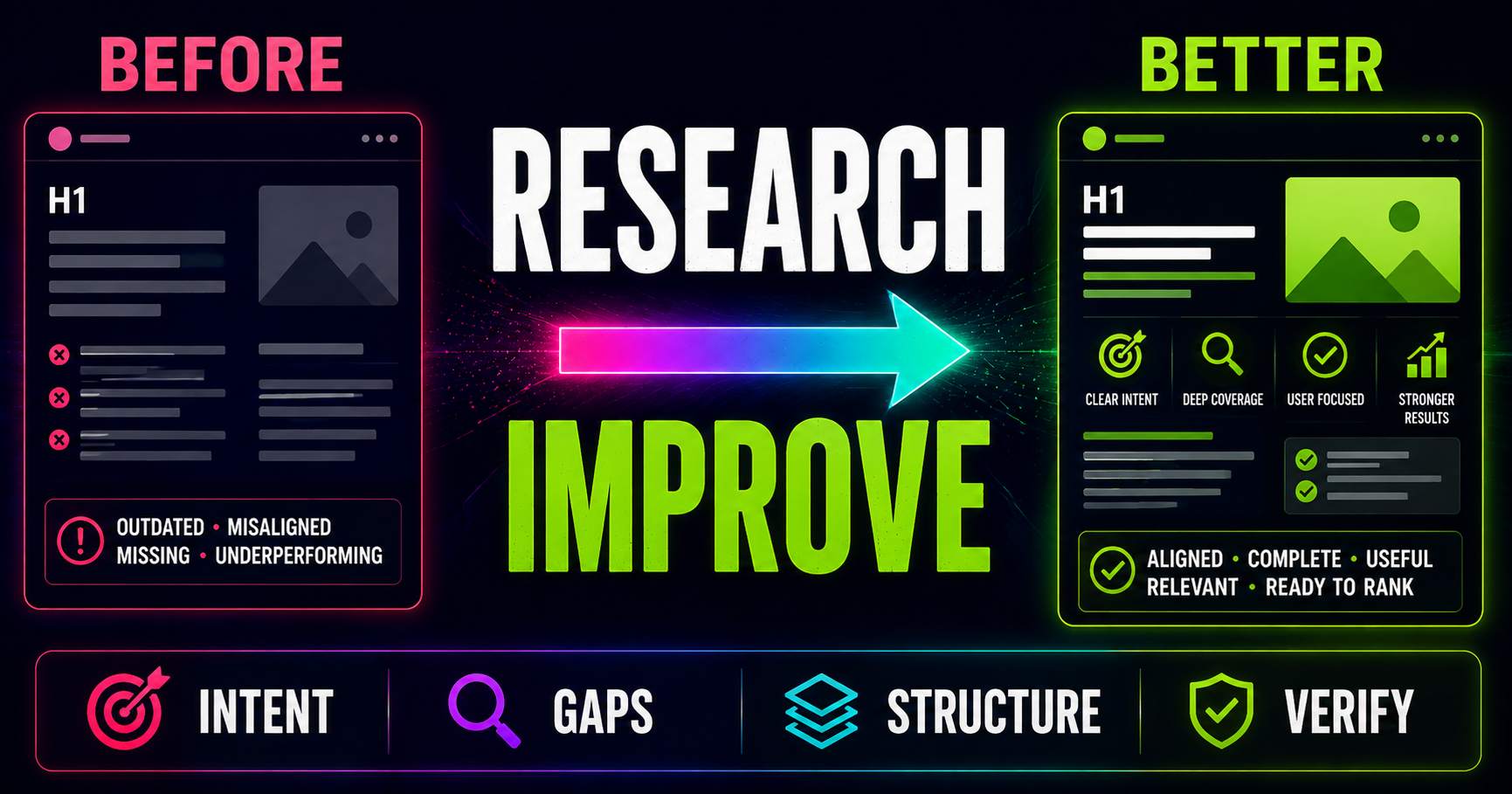
Keyword Research for Existing Pages: What Should You Improve?
Keyword research is not only for new content. Learn how to compare an existing page with current search intent, SERP patterns, related questions and content gaps to decide what actually needs improving.
Read guide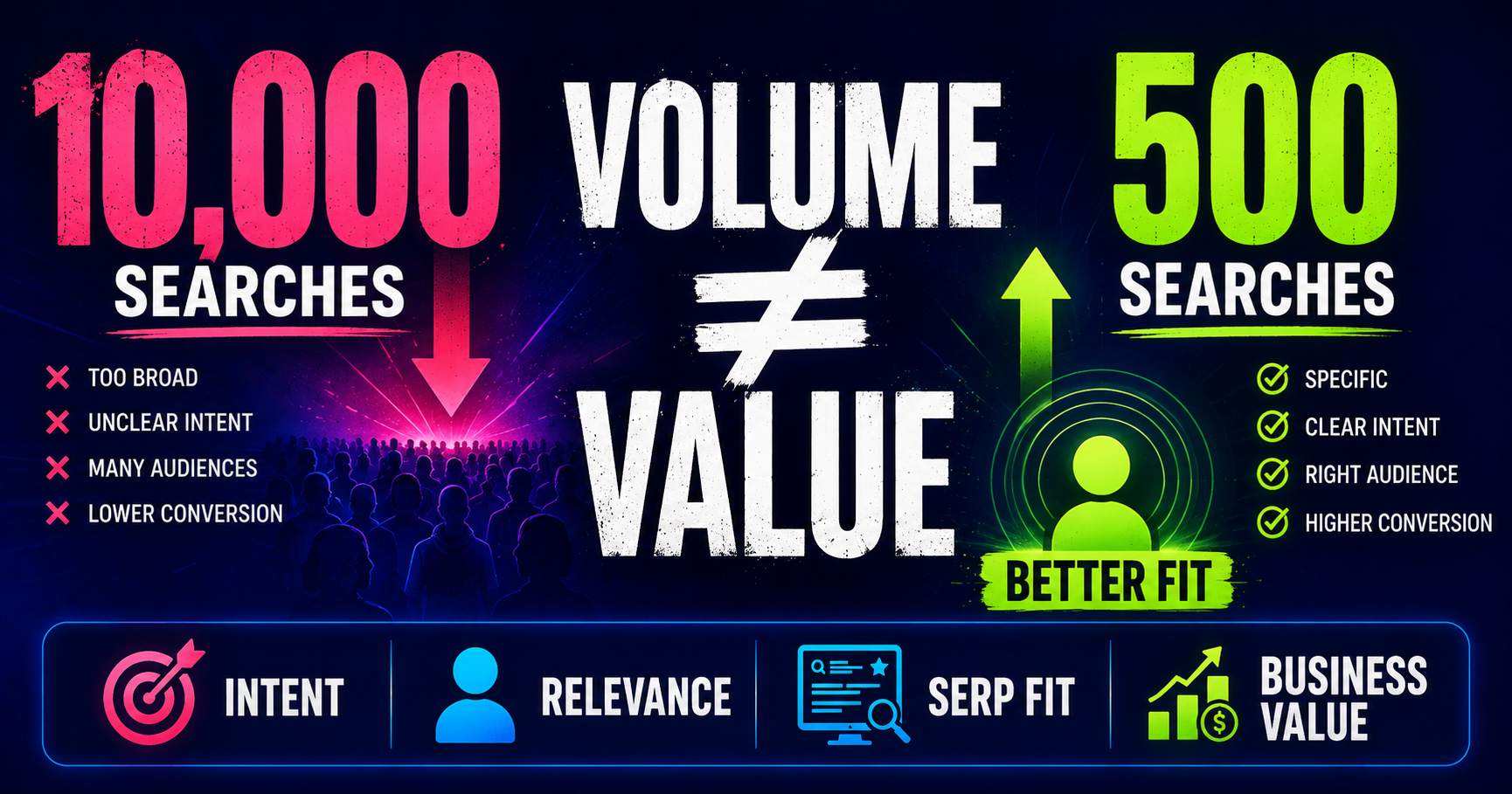
Search Volume Isn’t the Whole Story
Search volume can help you understand demand, but a bigger number does not automatically mean a better keyword. Learn how relevance, intent, specificity, SERP context and business value change the decision.
Read guide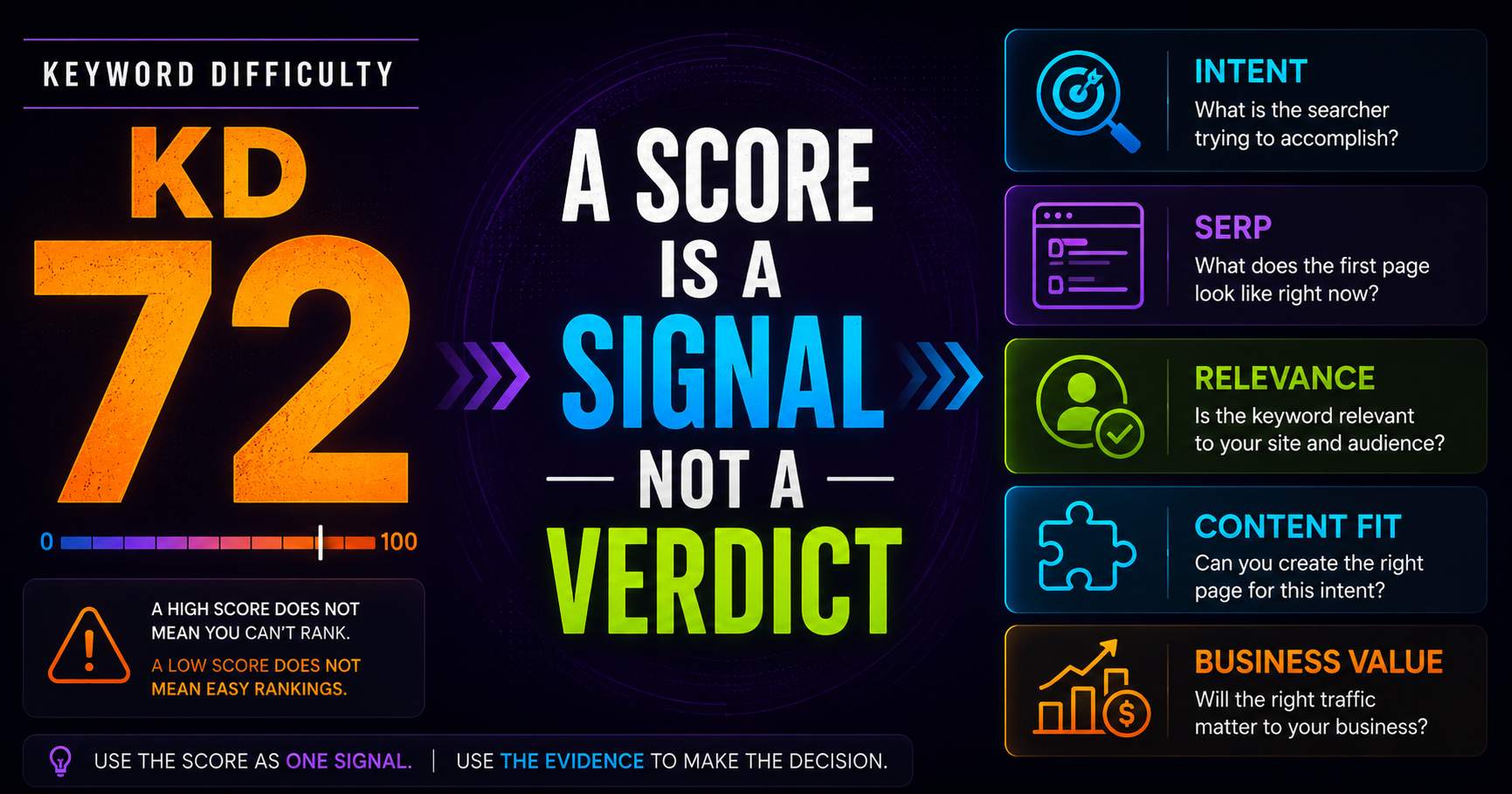
Keyword Difficulty: What the Number Does - and Doesn’t - Tell You
Keyword difficulty can be a useful comparison metric, but it is not a prediction of whether your page can rank. Learn what the score represents, what it leaves out, and how to use it alongside real SERP evidence.
Read guidePut this into practice
See what applies to your page.
Start with a one-page review, then run a full site audit when you are ready.