
Guide · GEO
What Is GEO? Understanding Structured Source-Readiness
Learn what Generative Engine Optimization means, which source and identity signals Website Auditor evaluates, and what the GEO Readiness score actually tells you.
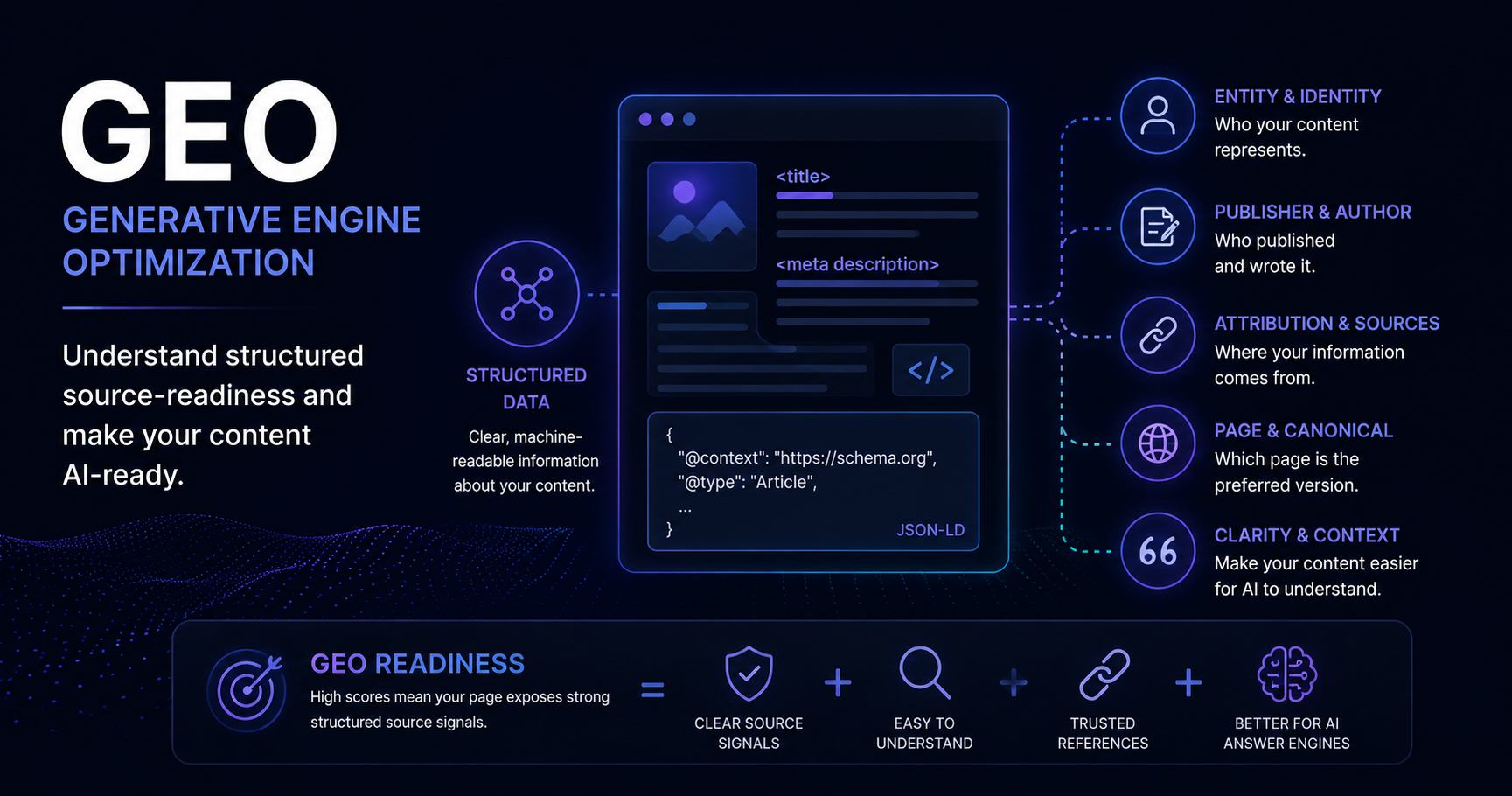
Generative Engine Optimization, commonly shortened to GEO, is a developing area of web optimization focused on making published information easier for AI-assisted search and answer systems to understand as a source.
The important word here is source.
A web page does not contain only text. It can also provide structured information about who published it, which organization or person it represents, what page is the preferred version, how an article identifies itself, and which external references it points to.
Website Auditor groups several of these observable signals under:
GEO Structured Source-Readiness
This does not attempt to predict whether an AI system will cite, recommend, rank, or include your website.
Instead, it asks a narrower and more measurable question:
Does the page expose useful structured signals that make its source, identity, attribution, and references clearer?
What does “structured source-readiness” mean?
Imagine two articles containing similar information.
The first article contains useful text, but provides little structured information about its publisher, author, page identity, or official profiles.
The second article contains the same useful information but also exposes clear structured signals identifying:
- the organization or person behind the content;
- the publisher of the article;
- the preferred public URL;
- the page represented by the Article markup;
- official identity references;
- descriptive links to supporting sources.
The second page provides more explicit machine-readable context about the source itself.
That is the type of difference GEO readiness in Website Auditor is designed to evaluate.
How Website Auditor evaluates GEO readiness
Website Auditor uses deterministic rules.
An AI model does not decide whether a page receives a GEO warning or what its GEO score should be.
The auditor examines observable markup and page signals and evaluates them against explicit rules.
Depending on the page and the structured data it contains, these signals can include the following.
Official identity references with sameAs
Structured data can use the sameAs property to associate an entity with other public URLs representing that same organization or person.
Examples may include an organization’s official social profile or another authoritative public profile belonging to the same entity.
Website Auditor checks whether the captured identity markup contains usable public HTTP or HTTPS references.
It does not decide whether a particular profile is famous, trustworthy, or authoritative.
It only evaluates the structured signal that is actually present.
Publisher attribution
Article and BlogPosting markup can explicitly describe the publisher behind the content.
A meaningful publisher identity may include a name, URL, or structured identifier.
This helps make the relationship between the content and its publishing entity more explicit.
Website Auditor evaluates whether usable publisher identity information is present where the rule applies.
Article page identity with mainEntityOfPage
Article structured data can use mainEntityOfPage to identify the page that the structured Article entity describes.
This can help make the relationship between an Article object and its public web page more explicit.
Website Auditor checks for a usable URL or structured @id where this signal is applicable.
Canonical and structured identity consistency
A canonical URL indicates the preferred public version of a page.
Structured data may also identify URLs or entities representing that page.
Clear and consistent identity signals reduce ambiguity about which public resource the markup represents.
Website Auditor can evaluate observable canonical and structured-data signals, but it does not claim to know which URL a search engine has actually indexed.
Descriptive external references
External references are more useful when their purpose is clear.
For example, a link labelled:
European Commission digital policy report
communicates more about the referenced source than generic anchor text such as:
click here
Website Auditor can identify external references whose visible link text provides little descriptive context.
This does not judge the reputation of the destination. It evaluates how clearly the reference is represented on the audited page.
What does a GEO score of 100 mean?
A GEO Readiness score of 100/100 does not mean that your website is guaranteed to appear in generative AI answers.
It means that the website passed all applicable weighted GEO checks in the current deterministic ruleset.
For example, Website Auditor may display:
100/100 across 12 applicable structured-source checks
That should be interpreted as:
The audited pages satisfied the structured-source checks that were applicable to them.
It should not be interpreted as:
“This website has perfect AI visibility.”
Website Auditor deliberately avoids making that claim.
Why can the number of applicable GEO checks be small?
Some GEO rules depend on markup that is not relevant to every page.
For example, an Article-specific identity rule should not penalize a page that is not an article.
A rule can therefore be marked:
NOT_APPLICABLE
rather than creating an artificial warning.
This is why Website Auditor displays the number of applicable structured-source checks alongside the GEO score.
The score should always be read together with that context.
GEO is not an AI citation score
This is one of the most important distinctions in Website Auditor.
The auditor can inspect public markup and page content.
It cannot determine from those signals alone whether:
- ChatGPT will cite a page;
- Google will select it for an AI-generated result;
- Gemini will use it as a source;
- another generative system will retrieve it;
- a particular answer engine considers the source authoritative.
Those decisions depend on systems, data, retrieval processes, ranking mechanisms, and other factors outside the audited page.
Website Auditor therefore measures structured source-readiness, not AI visibility.
How GEO differs from SEO and AEO
Website Auditor separates SEO, AEO, and GEO because each perspective focuses on a different part of the published page.
SEO Readiness evaluates technical and page-level search signals such as titles, descriptions, canonicalization, links, and other applicable checks.
AEO Structural Answer-Readiness focuses on how clearly page information is organized and exposed for interpretation.
GEO Structured Source-Readiness focuses more closely on source identity, attribution, structured entities, and references.
These areas overlap.
For example, a canonical URL may be important for traditional SEO while also helping make page identity more explicit.
Good web publishing practices frequently benefit more than one readiness perspective.
What should you do when Website Auditor reports a GEO warning?
Start with the exact deterministic finding rather than trying to “optimize for AI” in general.
If Website Auditor reports missing official identity references, inspect whether the relevant organization or person markup should contain appropriate sameAs references.
If it reports missing publisher identity, inspect the Article or BlogPosting structured data and determine whether the publisher is represented clearly.
If it reports an Article page-identity problem, inspect mainEntityOfPage and the page URL represented by the structured data.
If it reports weak external reference text, review the affected links and make their visible anchor text more descriptive where appropriate.
The goal is not to add markup merely to remove a warning.
The goal is to make the published source more explicit and internally consistent.
Where Ask Fridica fits
GEO terminology can be unfamiliar, so Ask Fridica can help explain what a specific finding means.
You might ask:
- Why does publisher identity matter?
- What is a sameAs reference?
- Why is my GEO score lower than my SEO score?
- Which GEO issue affects the most pages?
Fridica receives the findings already produced by Website Auditor.
It does not independently decide that your website has a GEO problem.
The distinction remains:
The deterministic engine detects the signal. Fridica helps explain it.
The goal of GEO readiness
GEO should not become a collection of tricks for trying to force an AI system to mention a website.
A more sustainable objective is:
Make the identity, attribution, structure, and references of your published content clearer.
That improves the explicit information available about the source while keeping the limits of what can actually be measured transparent.
Put this into practice
See what applies to your page.
Start with a one-page review, then run a full site audit when you are ready.