
Guide · AEO
What Is AEO and How Do You Make Content Answer-Ready?
Learn what Answer Engine Optimization means, which structural signals can make content easier to interpret, and what the AEO Readiness score in Website Auditor actually measures.
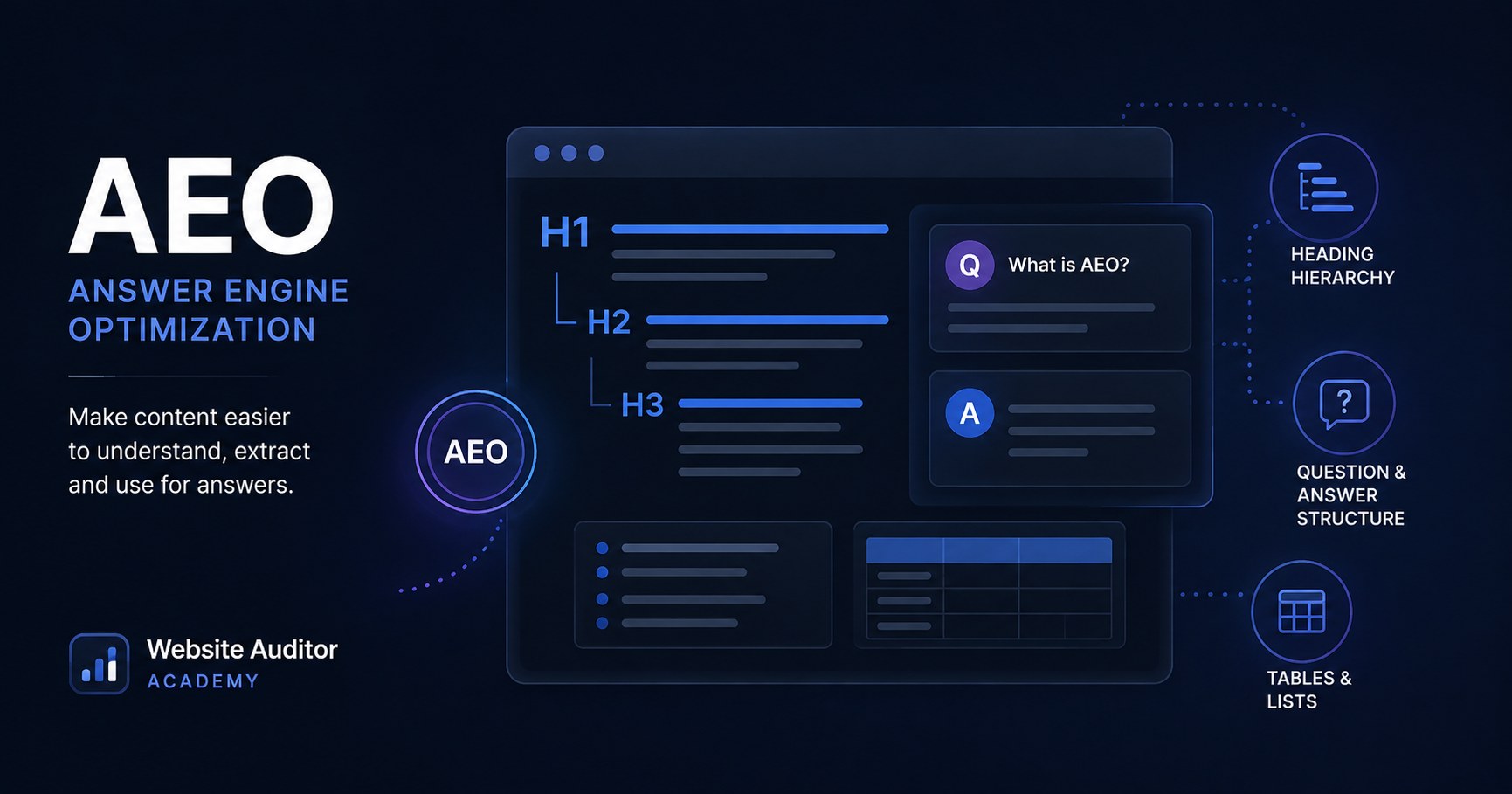
Answer Engine Optimization, usually shortened to AEO, is the practice of making web content easier for systems to understand, extract, and use when producing direct answers.
Traditional SEO often focuses on whether a page can be discovered, indexed, understood, and presented in search results. AEO looks more closely at another question:
Is the information on the page structured clearly enough for an answer-oriented system to understand what the page is about and locate useful information within it?
This can matter for traditional search features as well as newer answer-based search experiences.
However, AEO should not be treated as a promise that a page will appear in an AI-generated answer. A website can be well structured and still not be selected, cited, ranked, or included by a particular search or AI system.
That distinction is important to understanding the AEO Readiness score in Website Auditor.
What does “answer-ready” mean?
Consider two pages containing the same basic information.
The first page may consist of several large paragraphs with weak headings and no obvious relationship between a question and its answer.
The second may use:
- a clear main heading;
- descriptive section headings;
- logically nested headings;
- direct explanations;
- properly structured lists;
- meaningful tables;
- visible text that can be understood without relying entirely on scripts.
The information may be similar, but the second page exposes its structure more clearly.
That is the type of difference AEO readiness attempts to describe.
It is not about inserting special “AI keywords” into a page. It is primarily about clarity and structure.
How Website Auditor evaluates AEO readiness
Website Auditor uses deterministic checks.
That means the AEO score does not come from asking an AI model whether it “likes” a page. Instead, the auditor examines observable structural signals in the page.
Depending on what is present and applicable, these can include signals such as the following.
A clear primary heading
A page should provide a clear indication of its main topic. A meaningful primary heading helps establish that structure.
Logical heading hierarchy
Headings should describe the organization of the content rather than simply act as visual formatting.
For example, jumping directly from an H1 to an H3 can make the document hierarchy less clear.
Website Auditor can detect these structural patterns without trying to judge whether the writing itself is “good.”
Visible page content
Useful information needs to exist in content that can actually be observed in the fetched page.
A page whose meaningful content is unavailable in the captured document provides weaker deterministic evidence for answer readiness.
Question and answer structure
When a page contains genuine questions, clearly associated answers can make the relationship between the two easier to understand.
This does not mean every page needs an FAQ section.
Adding artificial questions merely to satisfy a checklist is not useful AEO.
Properly structured tables
When a table is used, header cells can clarify what rows and columns represent.
This is a good example of AEO overlapping with good semantic HTML and accessibility practices.
Lists and semantic organization
Lists can make collections of steps, requirements, features, or options explicit.
Again, the goal is not to convert every paragraph into bullets. The structure should reflect the actual content.
What does an AEO score of 100 mean?
This is one of the most important things to understand about Website Auditor.
An AEO Readiness score of 100/100 does not mean that a website has “perfect AEO.”
It means that the page or audited website passed all applicable weighted AEO checks in the current deterministic ruleset.
For that reason, Website Auditor also shows information such as:
Across 38 applicable structural checks
A result of 100/100 across 38 applicable structural checks means something very different from claiming that a website is guaranteed to perform perfectly in AI search.
Website Auditor deliberately does not make that second claim.
Why are some AEO checks not applicable?
Not every structural rule makes sense for every page.
For example, a rule related to a table cannot meaningfully evaluate a page that contains no table.
Instead of penalizing the page for something it does not need, Website Auditor can mark that check as NOT_APPLICABLE.
Those checks do not become artificial failures.
The readiness score is therefore based on the weighted checks that were actually applicable to the audited content.
AEO is not the same as AI visibility
This distinction is especially important.
Website Auditor can inspect observable properties of a public page. It can determine whether certain structural signals are present.
It cannot determine from the page alone whether:
- ChatGPT will cite it;
- Google will include it in an AI-generated answer;
- Gemini will use it as a source;
- another answer engine will recommend it;
- the page will rank for a particular query.
Those outcomes depend on systems and information outside the audited page.
That is why Website Auditor describes the result as Structural answer-readiness rather than an “AI visibility score.”
SEO, AEO and GEO are related, but different
Website Auditor separates three perspectives because they answer different questions.
SEO Readiness asks whether important technical and page-level search signals are in place.
AEO Readiness examines whether information is structurally organized in ways that make answers and page meaning easier to interpret.
GEO Readiness looks at structured source, identity, attribution, and entity signals that can help make the source itself more explicit.
There is overlap between them. A well-written heading can be useful for users, SEO, and answer-oriented systems at the same time.
That is not a problem. Good web structure often serves several purposes.
What should you do when Website Auditor reports an AEO warning?
Start with the evidence shown in the audit.
For example, if Website Auditor reports a heading hierarchy problem, do not add more headings simply to remove the warning.
Instead, inspect the structure:
- Identify the main page topic.
- Use the H1 for that primary topic.
- Organize major sections under H2 headings.
- Use H3 headings for subsections of those H2 sections.
- Re-run the audit after making the change.
The same principle applies to other AEO findings:
understand the reason → improve the real content structure → re-scan → verify the result.
Where Ask Fridica fits
If an AEO finding is unclear, Ask Fridica can explain the deterministic result in simpler language.
For example, you might ask:
- Why does this heading hierarchy matter?
- Which AEO problems affect most pages?
- What should I fix first?
Fridica receives the audit findings that Website Auditor has already calculated.
The AI does not decide whether the page passed or failed the AEO check.
That boundary is intentional:
The audit engine finds the issue. Fridica helps you understand it.
The goal of AEO
AEO should not become a collection of tricks designed to manipulate answer engines.
A more useful objective is simpler:
Make important information clear, well organized, and easy to interpret.
That benefits readers first, while also giving search and answer-oriented systems clearer structural evidence about what the page contains.
Put this into practice
See what applies to your page.
Start with a one-page review, then run a full site audit when you are ready.